

DATA-DRIVEN INSIGHTS AND NEWS
ON HOW BANKS ARE ADOPTING AI
🎄🎅 AI and be merry 🥳 🎉

Source: Adobe Firefly
18 December 2025
Today, we look ahead to 2026, and reflect on the year passed. This is our final edition of the Banking Brief of 2025, so happy holidays!
People mentioned: Kristin Milchanowski, Jeff Valane, Antonio Bravo, Donald MacDonald, Marco Argenti, Michael Ruttledge, Vibhor Rastogi, Jared Cohen, Mike Dargan, Sergio Ermotti, Chris Gelvin, Beatriz Martin, Daniele Magazzeni, Anand Francis, Dhivyaa Thayalan, Andrew McMullan, Derek Waldron and Charlie Scharf.
This edition is 1,663 words, a 5 minute read. Check it out online. If you were forwarded the Brief, you can subscribe here. We always want to hear from you at [email protected].
– Alexandra Mousavizadeh & Annabel Ayles
%201.svg&w=96&q=80)
YEAR IN REVIEW
THE MEASURE OF AI
To paraphrase Ronald Reagan, are you better off with AI than you were a year ago? And incidentally, can you really know by how much
You won’t find the answer in the headlines: MIT this year told us that 95% of AI fails, while Wharton says three-quarters succeed. Do you buy Deloitte’s claim this week that 11% of companies use agents? Or Google’s this fall that half of financial firms do?
After a year spent in bank offices watching what actually got built, where we are on the adoption curve is clearer than the surveys suggest. It shows up in how banks moved and pivoted in 2025.
Look first at how top banks now build AI. In January, DeepSeek – the previously-obscure Chinese lab – put OpenAI on notice with a powerful, low-cost LLM. Banks took note, not by teaching their models Mandarin, but by architecting systems to keep up with the AI labs’ arms race. JPMorganChase led the way, designing marquee applications to be model agnostic, meaning they could swap in any vendor’s offerings on the fly (see: "Age of promiscuity," The Brief, May 29). Morgan Stanley embedded ongoing model evaluations into operations so it knew when to replace one LLM with another (see: "On-paper tiger," The Brief, Nov. 13).
You can see it in how they scale now, too. When AI bubble talk started getting louder in the spring, investors wanted answers on spending. The top banks responded by showing they’d moved beyond point solutions – pilots built from scratch – to AI platforms they could use to mass produce AI tools. BNY and Goldman Sachs pointed to how they could reuse their architecture to scale faster (see: “Death of the Use Case,” The Brief, May 15). And Capital One detailed how its centralized AI platform let employees safely customize AI tools to their own needs (see: “Go big or go home,” The Brief, Dec. 11).
That set up the real question investors and boards had been asking all year: returns. Early on, bank CEOs could deflect (see: “Trust me, the AI spend is worth it,” The Brief, Jan. 23). Now, with real scale, they address it head-on: The number of the 50 banks we track reporting ROI doubled by October (see: “Your 2025 Index leaders,” The Brief, Oct. 8), and more have reported since.
So where are banks on the adoption curve? Picture a split screen, because the answer depends on how they spent 2025. Leading banks turned last year’s investments in talent and experimentation into better-connected systems, tools that span the business and the first real agent deployments. Those critical improvements to the AI’s plumbing are already paying off, and in our view, will set those banks up to deliver substantial, dollars-and-cents returns as soon as next year. That’s earlier than we expected. But the other side of the split screen is that banks that avoided this harder work will see their ROI delayed more than expected. And as 2025 winds down, that leaves them worse off than they were when it started.

2026 PREDICTIONS
GOOD, BAD AND PROVOCATIVE
We asked you to share your thoughts about what will and won’t happen next year. These were a few of our favorites.
What AI in banking prediction that you’ve seen do you think is dead wrong?
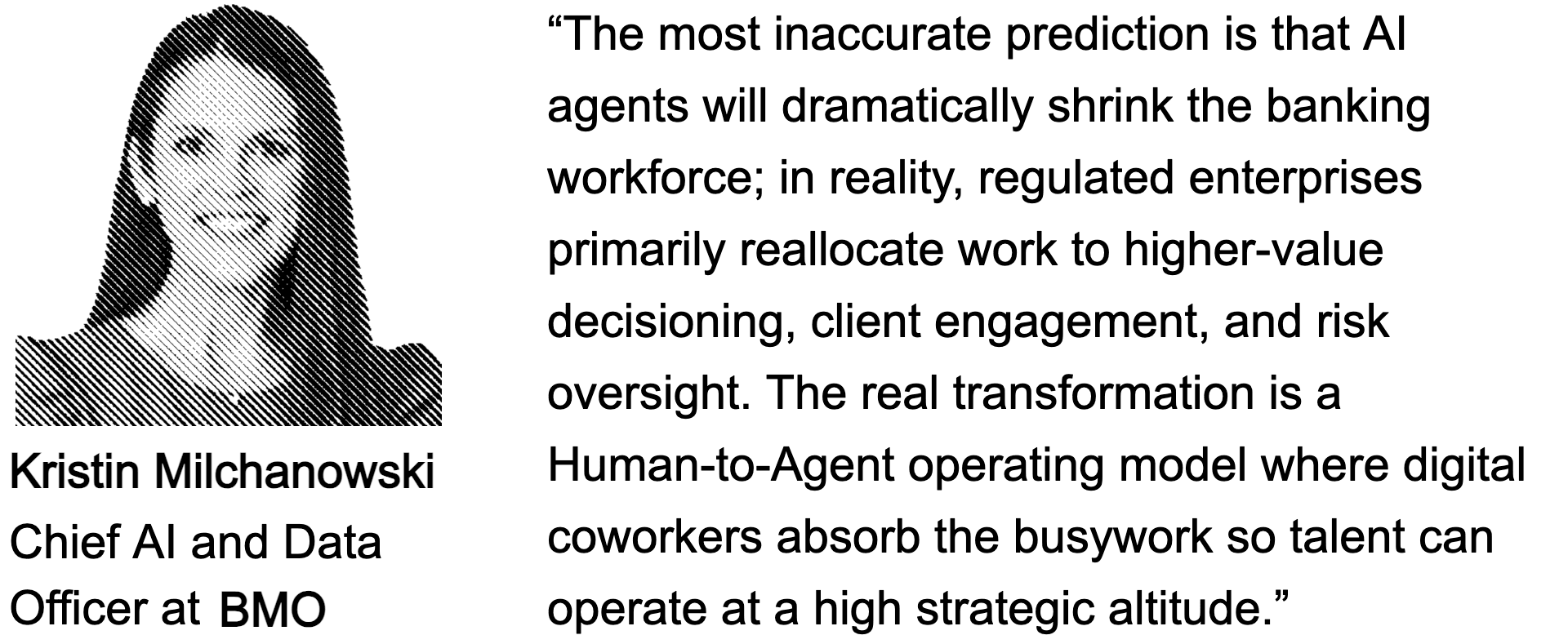
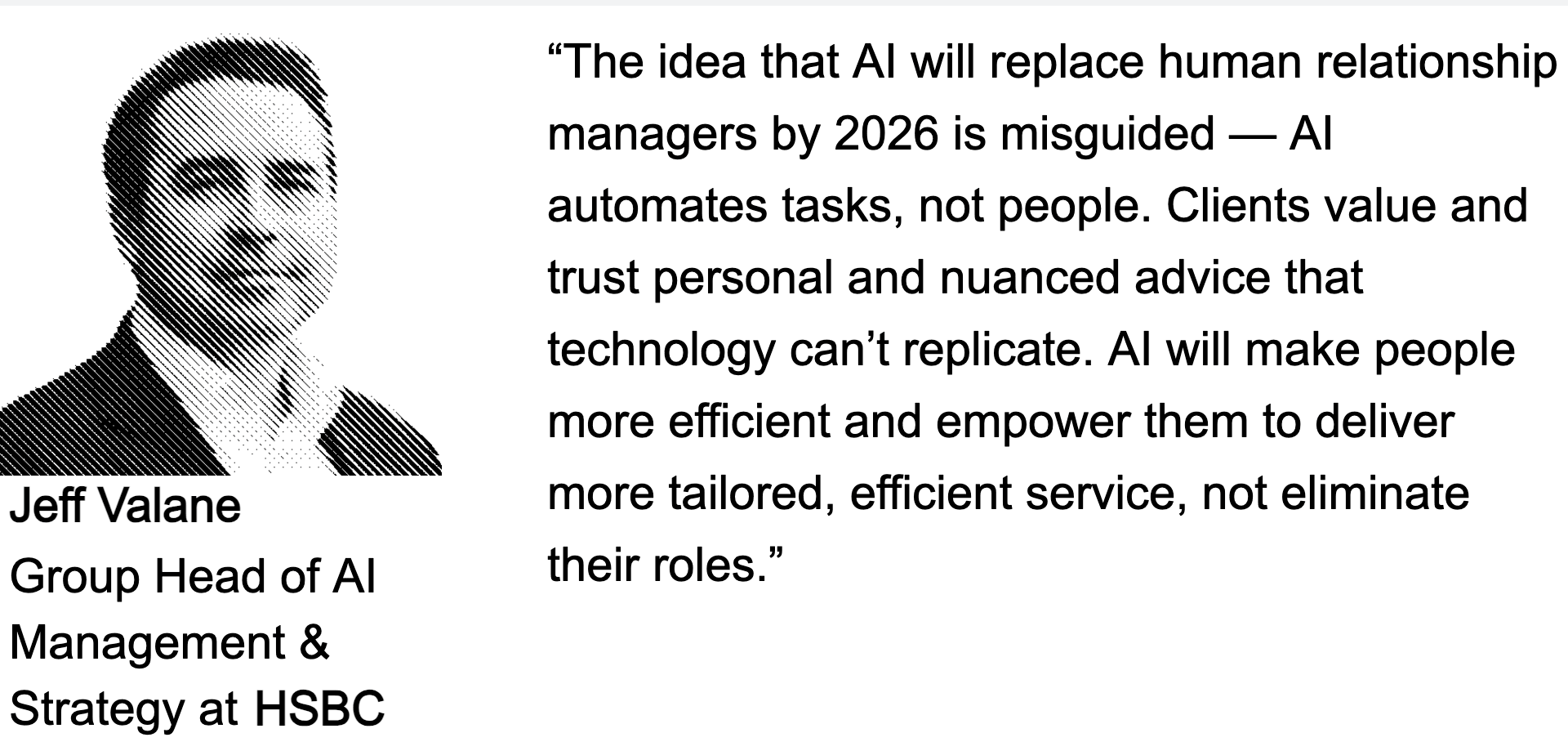
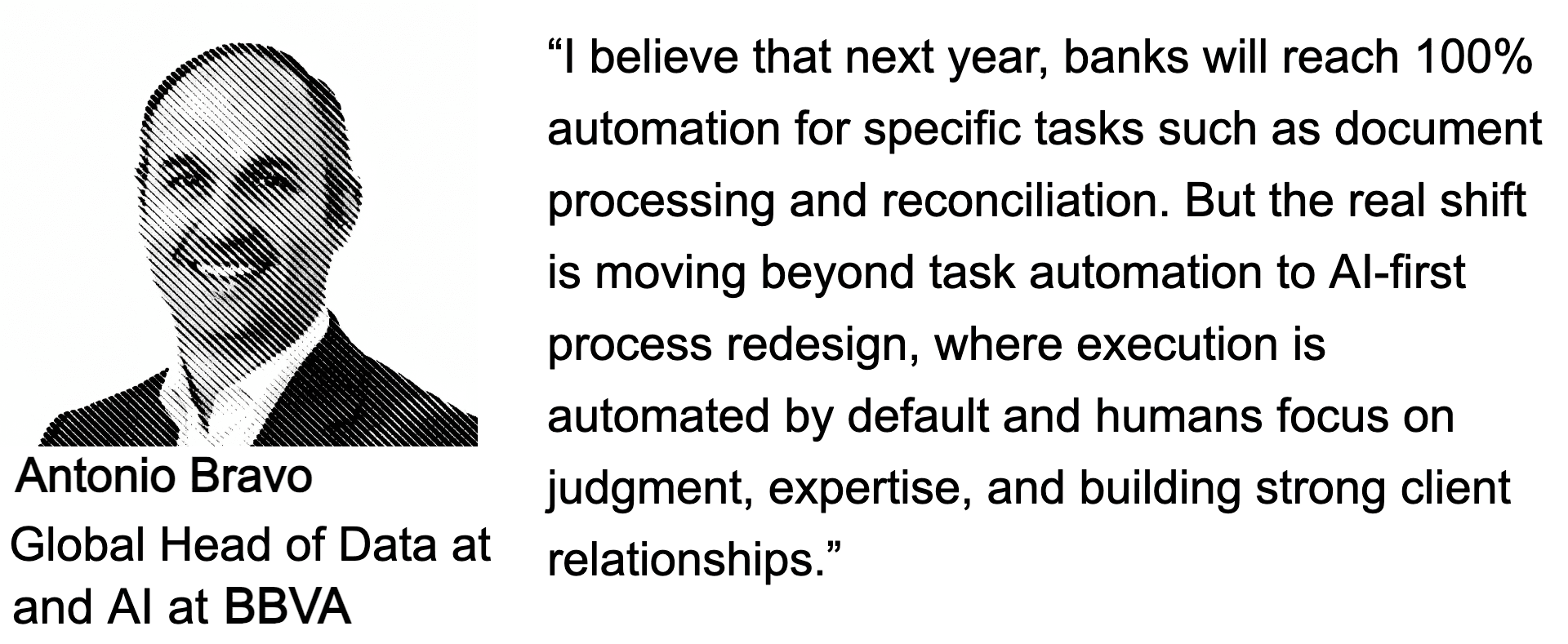
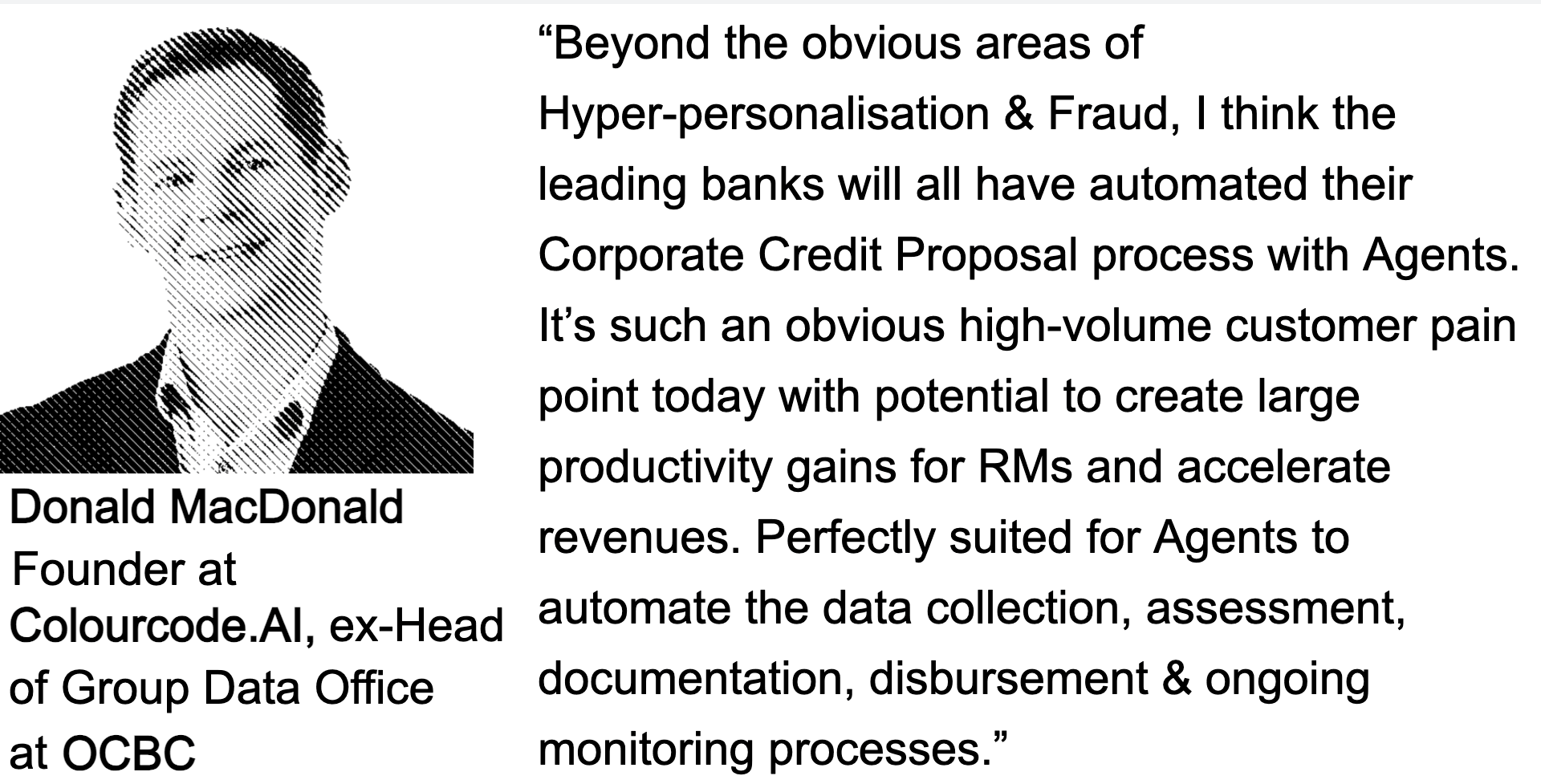
What process in a bank do you think will be 100% automated next year?
Three other interesting 2026 predictions from the wider world also caught our eye:
- A brand new banking interface: “We’re going to start to see a change in this traditional compute model, where the models are the new operating system…so they’re going to have more and more capabilities to really be able to give applications access to intelligence and access to tools.”
– Marco Argenti, CIO at Goldman Sachs
- Build, don’t buy: “There’s going to be a bit of a pivot toward homegrown solutions versus vendor solutions…certainly, if we’re getting 5x productivity growth, which is what we’re predicting for next year, then you want those engineers to be your engineers, not paying a vendor for that.”
– Michael Ruttledge, CIO at Citizen’s Financial
- Leaders pull away: “While the AI emphasis is expected to be persistent, the evolution will likely follow a perceived winner versus loser dynamic.”
– Citi analysts in the bank’s 2026 forecast
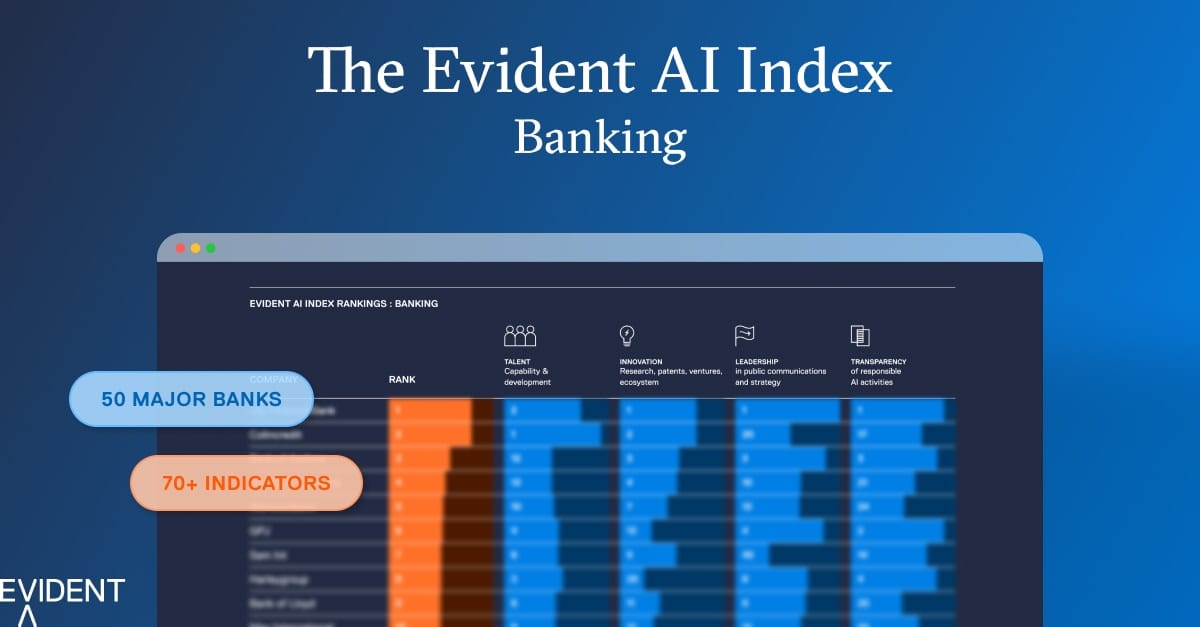
In Case You Missed It: The Evident AI Index sets the global standard for measuring how banks are adopting AI. It is the most comprehensive and trusted benchmark of its kind, analysing 50 of the world’s largest banks and drawing on millions of publicly available data points across four critical pillars of AI capability: Talent, Innovation, Leadership, and Transparency.

PERFORMANCE REVIEW
GRADING 2025 TAKES
A year ago, some of you made bold predictions for 2025 in this very space. It only seems right to look back — after all, should old acquaintance be forgot? And never brought to mind? — and see how you did. With grades the way a financial analyst might.
🟢 BUY: The next Gen AI wave shifts focus from LLM-based copilots to specialized SLMs and AI agents. – Vibhor Rastogi, head of AI/ML investments at Citi Ventures
- Yes! Banks looked for ways to squeeze more value out of AI tools this year by tasking different models to handle the work they were most suited for. Wells Fargo, for example, uses a combination of small and large language models to power its virtual assistant, Fargo: An LLM from Google does the heavy lifting of generating a response, but a purpose-built SLM serves as a middleman to strip out any personal information the users have entered to keep their data safer (see: “Confidence bots,” The Brief, May 15).
🟡 HOLD: “I also doubt we’ll get answers to the only question that matters: when will the infrastructure get built to meet this demand.” –Jared Cohen, president of global affairs at Goldman Sachs.
- Yes and no. The answer to when AI infrastructure gets built is: as fast as banks can cut the checks. There’s been a feeding frenzy to bankroll data centers this year; Goldman Sachs this week went as far as revamping the investment bank’s technology, media and telecom team to better position itself for the AI infrastructure windfall. Getting all those data centers up and running will happen over time, but banks’ hunger for deals has shown how quickly the process will start moving.
🔴 SELL: Don’t bank on another banner year for the Mag7 (Alphabet, Amazon, Apple, Meta, Microsoft, Nvidia and Tesla). – name redacted
- This one looked like it might come true in April and May. Since then, less so. The Mag7 is up nearly 25% since the start of the year. And with Nvidia primed to sell chips to China, it doesn’t look like the good times will stop rolling.

USE CASE CORNER
4 FAVORITES FOR '25
In this week’s “Corner” we look back at several use cases that stood out for us – selected (in no particular order) for what they actually do or why it’s important.
BEST AGENT IN THE WILD
Use case: AskDavid
Bank: JPMC
Why it stood out: It’s a live example of agents changing how work gets done and shows how much good architecture can be an advantage. The bank’s tool has agents with retrieval automated generation (RAG) capabilities and with SQL skills, so it can search the bank’s documents and write code that searches its data.
LEAD PROGRAMMER
Use case: DevGen.AI
Bank: Morgan Stanley
Why it stood out: The tool was homegrown (the product of a hackathon) and trained on Morgan Stanley’s internal codebase, an example of the bank using its wealth of data for its advantage. It also shows how fixing the plumbing can enable a bank to move the AI needle: Translating code could take thousands of hours, which are now freed up to develop new tools.
FIRST CLASS CUSTOMER
Use case: Share of Wealth Assistant
Bank: Bank of Singapore
Why it stood out: It’s a multi-agent system for KYC, one of the highest-value areas for AI deployments. Banks need to get money in the door faster, and letting agents do manual research tasks in parallel cuts the time it takes to onboard complex customers. The bank also built a 1,000-question benchmark specific to the tool so it could swap in new models as they got better.
YOU’VE GOT MAIL…FASTER
Use case: Merlin
Bank: Lloyds
Why it stood out: The bank’s email routing tool, which understands what a customer says and directs it to the right people, is an example of a bank rethinking a process around technology. When humans handled the task, the sorting categories were messy and overlapping, so the bank had to take the process back to the studs – redesigning each step to make sure the model could understand human logic. Then it reworked its technology stack to handle training that model. As a result, the share of emails sent to the right place jumped from 43% to 93%.
Want to know more about the specific ways banks are rolling out AI? Check out our Use Case Tracker – the inventory of all the AI use cases announced by the world’s largest banks available to members.

Want to speak directly to tech decisionmakers at the biggest banks around the world? Our highly-engaged audience of more than 20,000 subscribers includes CIOs, CDAOs, CTOs and CEOs of the top banks and financial services companies. Sponsorship for 2026 is now open; secure your spot today.
.svg&w=96&q=80)
TALENT MATTERS
NEOBANK NABS UBS EXEC
Mike Dargan, chief technology and operations officer at UBS, is stepping down at the end of the year and will join German neobank N26 as CEO. Dargan had been at the Swiss bank since 2016 and was instrumental in “progressing the firm’s strategic shift towards AI and digitalization,” CEO Sergio Ermotti said. Starting Jan. 1, the bank’s technology function will report into COO Beatriz Martin, and Chris Gelvin will serve as the interim head of group technology. Daniele Magazzeni, who was poached from JPMorganChase in October, is also slated to join the bank on Jan. 1 as chief AI officer.
Dhivyaa Thayalan joined Westpac as head of AI strategy, partnerships, education and adoption. She was previously AI products and partnerships lead at CommBank. It’s a reunion with chief digital, data and AI officer Andrew McMullan, who joined Westpac from CommBank this fall.
U.S. Bank elevated Anand Francis to be head of AI strategy and transformation for the bank’s wealth, corporate, commercial and institutional banking unit. Francis has been with the firm since 2021 and led software engineering teams at Capital One prior to that.
JPMorganChase is building an “agentic private bank,” recent job descriptions show. Among the remit: “Analyze existing processes and vast amounts of data to design autonomous AI agents,” and “reimagining the entire process from start to finish,” a reflection of how the bank is being “fundamentally rewired,” as analytics chief Derek Waldron put it this fall.

STAT OF THE WEEK

The share of executives who believe AI will increase entry-level headcount in the year to come, according to a new survey by advisory firm Teneo. Banks tend to agree, as you read above. Evident data shows the banks leaning into AI most are the ones growing their workforce the most, too (see: “Not guilty,” The Brief, Nov. 6) But holdouts remain: “What [AI is] going to do potentially to headcount, it is extremely significant, and anyone who doesn't say that…doesn't know what they're talking about,” said Wells Fargo CEO Charlie Scharf at a conference last week.
IN THE NEWS
BBVA GOES WIDE
BBVA and OpenAI inked a bigger deal last week, giving all 120,000 of the Spanish bank’s employees access to ChatGPT Enterprise. The bank had previously been piloting the tool with 11,000 staffers.
Google demonstrated how to build a financial analysis agent without writing any code in 10 minutes using Vertex AI. The demo shows how to build a tool that can take a PDF of an earnings report, extract key financial information and convert it into structured data that can be read by other software – like visualization tools or dashboards – without manual cleanup. It comes as new research lands, showing models from OpenAI, Google, DeepSeek, xAI and Anthropic can now all pass all three levels of the CFA exam, a test LLMs struggled to pass just last year.
Citi and the London Stock Exchange Group announced a multi-year data partnership. LSEG will provide Citi with “artificial intelligence-ready content” for tools. LSEG also inked a deal with OpenAI to bring data into ChatGPT this month.
WHAT'S ON
Mon 19 - Fri 23 Jan
WEF, Davos, Switzerland
Weds 18 - Thurs 19 Feb
CDAO Financial Services, New York, NY
Tues 24 - Thurs 26 Feb
International Association for Safe & Ethical AI, Paris
- Alexandra-Mousavizadeh|Co-founder & CEO|[email protected]
- Annabel-Ayles|Co-founder & co-CEO|[email protected]
- Colin-Gilbert|VP, Intelligence|[email protected]
- Andrew-Haynes|VP, Innovation|[email protected]
- Alex-Inch|Data Scientist|[email protected]
- Gabriel-Perez-Jaen|Research Manager|[email protected]
- Matthew-Kaminski|Senior Advisor|[email protected]
- Kevin-McAllister|Senior Editor|[email protected]
- Sam-Meeson|AI Research Analyst|[email protected]
- Jay Prynne|Head of Design|[email protected]
- Marcus Gurtler|Junior Designer|[email protected]

