

DATA-DRIVEN INSIGHTS AND NEWS
ON HOW BANKS ARE ADOPTING AI
Bye, bye OpenAI

Source: Adobe Firefly
29 January 2026
Welcome back to the Banking Brief! This week: OpenAI is beginning the year on the back foot. A payments company cracks the general purpose agent. And our last big ideas column explores why AI legends are betting on "world models." Plus, bonus season has brought promotions and shakeups to AI teams across the banking sector.
People mentioned in this edition: Dario Amodei, Sarah Friar, Dhanji R. Prasanna, Fei-Fei Li, Demis Hassabis, Yann LeCun, Faraz Shafiq, Saul Van Beurden, Charles Holive, Peter P. Petrianni, Francesco Maria Delle Fave, Iain Long, Ethan Mollick and Richard Fairbank.
This edition is 1,620 words, a 5 minute read. Check it out online. If you were forwarded the Brief, you can subscribe here. We always want to hear from you at [email protected].
– Alexandra Mousavizadeh & Annabel Ayles

TREND LINES
SAM GETS SQUEEZED
Since the Gen AI boom started some three years ago, banks have been the bellwether for AI adoption by business. The way they’re acting now could spell more bad news for OpenAI in 2026.
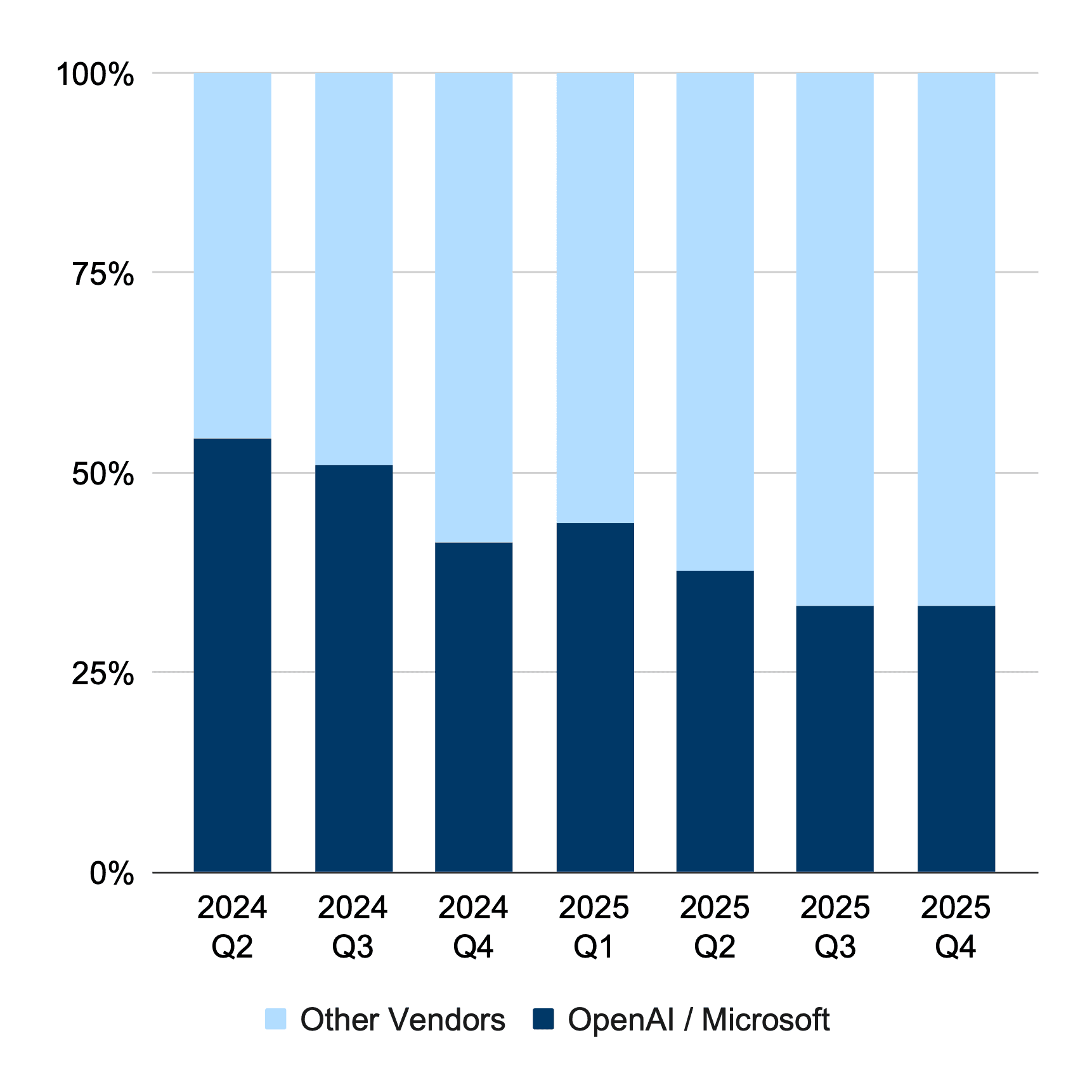
A year and a half ago, the ChatGPT-maker built the technology of choice for roughly half of the use cases that included vendor information announced by the 50 banks we track in the Evident AI Index. By the end of 2025, that dropped to just one-third, according to the Evident Use Case Tracker.
OpenAI would have you believe this is the byproduct of the sector’s push for model agnosticism. But bankers we’ve spoken to in recent months tell a different story: OpenAI isn’t the only lab building what enterprises actually need right now, and competitors like Anthropic and Google are quickly gaining market share.
GPTEETHING ISSUES
Of bank use cases that included vendor information, the share featuring OpenAI dropped from more than half to one-third in 18 months.
Start with coding, arguably banking’s first “killer use case,” and one of the only areas where more than half of the tools in our Use Case Tracker demonstrate tangible ROI. On code generation and review, experts say Anthropic is at the top of the class. The fanfare around Claude Code in recent months suggests the public agrees. Google, meanwhile, is using its preexisting cloud relationships to give banks access to tools that can then get integrated into their systems more easily, as BNY demonstrated last month by bringing Gemini Enterprise together with its AI platform, Eliza.
You’re seeing defections from OpenAI beyond banking. Last month, Menlo Ventures (which has a financial stake in Anthropic) published data showing that 40% of enterprise workloads were now going to Anthropic models, compared to 27% for OpenAI and 21% for Google. A year ago, OpenAI still had the market share lead, the venture firm’s data shows. Rivals' growth with the corporates is paying off: At Davos last week, Anthropic CEO Dario Amodei said his company now gets 80% of its business from enterprise customers, compared to OpenAI’s 40%. OpenAI did not respond to a request for comment.
“Growth does not move in a perfectly smooth line,” OpenAI’s CFO Sarah Friar said recently. With how much competition there is now, she's right. But if OpenAI continues losing ground, keeping that line pointing in the right direction will depend on the lab proving how much value its tech can create with each bank it works with.
COMING SOON
EVIDENT AI INDEX | PAYMENTS
.jpg%3FupdatedAt%3D2026-01-29T10%3A35%3A06.956Z&w=3840&q=100)
On 25 February, we will be launching the Evident AI Index for Payments - an unrivalled benchmark of AI maturity across leading payment networks and processors in North America and Europe.
Built on 60+ indicators across Talent, Innovation, Leadership, and Transparency, the Index provides an independent, data-driven view of how providers are adopting AI across their organizations.

USE CASE CORNER
TALK TO ME, GOOSE
Two weeks ago, we called general enterprise agents one of 2026’s “Big Ideas” because figuring out how to get agents to move beyond the engineering team is how financial services companies can start to unlock the tech’s full value (see: “Talk to my agent,” The Brief, Jan. 15). In this week’s “Corner” we look at how payments company Block built an agent called Goose (yes, named for Top Gun) that’s already acting as a time-saving wingman for various teams across the firm.
Use Case: Goose
Vendor: N/a
Firm: Block
Why it's interesting: Goose is an open-source AI agent that Block employees use to help with coding, research and everyday work tasks within a single interface. Its secret sauce is the autonomy the firm built into it, allowing it to determine how to handle more complex questions and tasks and take action on its own, said CTO Dhanji R. Prasanna. “All of these LLMs are sitting idle overnight and on weekends while humans aren’t there,” he added. “They should be trying to build in anticipation of what we want.”
How it works: “Think of it as a desktop tool or a program that you can download and install on your computer and then it has a UI,” said Prasanna. Employees can write to it like a chatbot and Goose determines which models to tap, which enterprise apps it needs to access and handles requests in the background. If asked to create a marketing report, it will “connect to Snowflake and Tableau and Looker, so it'll write SQL to pull out data from there, it'll do some analysis and a CSV so it can write Python code on your desktop to do all that,” said Prasanna. “It will generate some graphs using some JavaScript charting library that it knows about. And then finally, it'll put this all into a PDF or Google Doc or whatever and it can even email it for you or upload it somewhere.”
By the numbers: Teams using Goose are saving “about eight to 10 hours per week,” Prasanna said. That spans support teams, legal teams and risk teams, Prasanna said.
Bigger picture: What Block is doing with Goose is showing up inside banks, too. CommBank’s Project Coral is a useful parallel: an internal, model-agnostic agentic framework that automates engineering work, from diagnosing issues to proposing code fixes, with humans in the loop.

NOTABLY QUOTABLE
“Enterprises often have a choice between ‘cost savings’ (doing the same thing with fewer people) and ‘innovation’ (doing more with the same number of people). The market will inevitably produce both eventually, and any competitive AI company will have to serve some of both, but there may be some room to steer companies towards innovation when possible, and it may buy us some time.”
– Dario Amodei, CEO at Anthropic, in his essay “The Adolescence of Technology,” Jan. 26

EARNINGS SEASON
AI-R TIME
DULCET TONES
The share of time during banks’ earnings calls dedicated to AI this quarter grew 40% compared to last quarter.
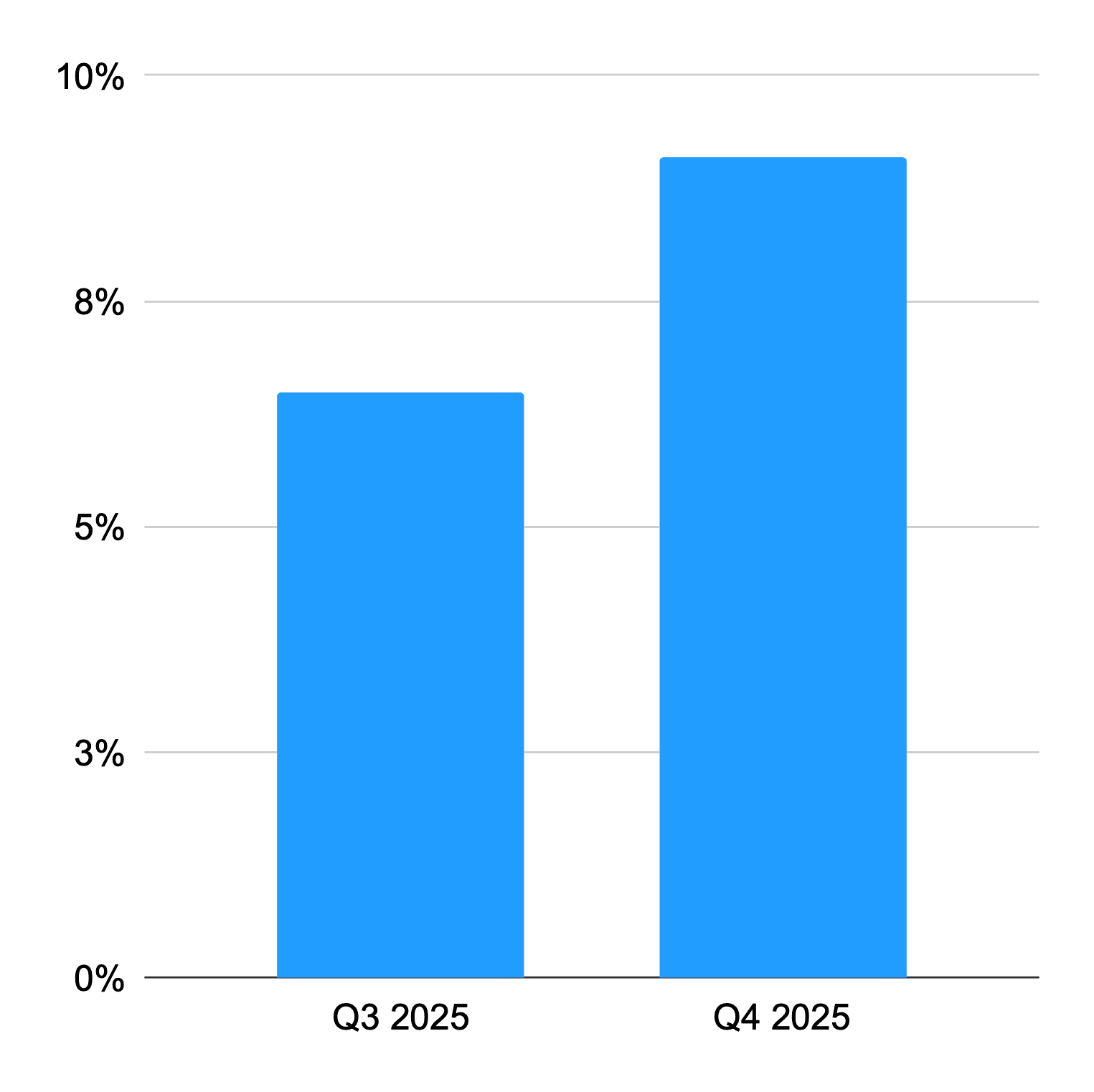
Not even the prospect of a credit card interest-rate cap could knock the technology off the investor docket this month, our analysis of 20 call transcripts shows. In our first edition of the year, TD Cowen analyst Steven Alexopoulos told us CEOs may shy away from AI talk as they worked out how to address the labor force (see: “Earnings preview,” The Brief, Jan. 8). He and fellow analysts made sure that didn’t happen: Roughly two-thirds of the AI conversation in this quarter’s calls so far has come from the Q&A portion rather than the prepared remarks.

IN THE NEWS
STRONG BUY
Capital One is buying Brex, a fintech that issues corporate cards and sells expense-management software, for $5.15 billion – less than half of its peak valuation in 2022. It’s an enterprise yin to the consumer-centric yang of last year’s Discover acquisition. And it has an AI upside: The company “built and deployed their own in-house AI agents for expense management and audit and are on the way to procurement, payments and accounting agents,” Capital One CEO Richard Fairbank said during earnings last week.
Lloyds generated £50 million of value from Gen AI in 2025 from 50 use cases in production, the bank announced during earnings Thursday morning. In 2026, it expects that number to rise to £100 million.
It was a big week for Chinese AI firms aiming to preempt the expected release of DeepSeek’s new model: Alibaba rolled out Qwen3-Max-Thinking, the latest update to its reasoning model, which “thinks” similarly to how OpenAI’s GPT-5-Pro or Gemini Deep Think do – without being locked behind a hefty paywall. And Moonshot AI launched Kimi K2.5, a model it says spins up “agent swarms” – the in-vogue terminology for teams of agents that work together to tackle complex tasks. These kinds of multi-agent swarms are critical as AI gets trusted to handle bigger and longer-running tasks, but Ethan Mollick has one note: ditch the “terrifying” name.
Neobank Revolut partnered with Eleven Labs to use the startup’s voice AI tools in customer support across 30 different languages. In the pilot, the firms reported cutting the time to resolution by a factor of eight. It comes in the same week that Revolut launched in Mexico, its first expansion beyond Europe.

Want to speak directly to tech decisionmakers at the biggest banks around the world? Our highly-engaged audience of more than 20,000 subscribers includes CIOs, CDAOs, CTOs and CEOs of the top banks and financial services companies. Sponsorship for 2026 is now open; secure your spot today.

BIG IDEAS
I CAN SHOW YOU THE WORLD
In this last installment of our series on the big ideas shaping AI in 2026, we’re looking beyond banking to the hottest topic in the wide world of AI: world models.
LLM-based agents – the kind banks are just starting to wrap their heads around – have captured the market’s attention. But a growing cohort of the very people that invented the tech that powers them now say they’re a dead-end for AI’s next phase.
For as good as LLMs have gotten at writing, they’ll never be able to “actually understand the physics of the real world,” Google’s Demis Hassabis said on a podcast this month. In other words, they can’t really anticipate what they need to do next. For that, AI visionaries like Fei-Fei Li and Yann LeCun are betting on an alternative called “world models.”
So, what are they? Think of it like a model that understands cause and effect the way our brains do. World models predict how the world will react when you do something, like taking a left vs. a right in a car. An LLM can suss out a pattern in text, but world models can link patterns to what’s happening in the real world. Imagine, for example, chess players: an LLM has read all the books and memorised the openings, but Li and LeCun are after an AI which understands the rules and figures out new moves for itself.
ENTER THE MATRIX
Wayve’s GAIA-3 world model can simulate the same scenario in different lighting conditions to test the response of their self-driving car.

That kind of understanding of consequences is critical in making things that need to react to the unpredictability of the world, like self-driving cars. World models let researchers test hypotheticals, like: What happens if I turn the wheel left right now? What if it starts raining? That lets startups like Wayve (see above) expose their cars to any number of simulations of different scenarios they might encounter on the road to understand how the agents making the decisions behind the wheel would respond. Because they can run in parallel there’s less of a need for risky real-world testing.
Bottom line: While LLMs mastered language, they still struggle to understand the physical world. We’re still in the early days of world models, but if they succeed, we won’t just have chatbots that can write poetry; we’ll have agents that can navigate, plan and act in the real world.
Catch up on the the rest of our Big Ideas series:

STAT OF THE WEEK

The growth in the number of software engineers – a profession often seen as being squarely in AI’s firing line – in the U.S. compared to three years ago, according to the Bureau of Labor Statistics. Bank CEOs have continued to sound the alarm on the labor force impacts of the technology, but a new study from the Economic Innovation Group out this week shows that AI may just be a scapegoat. The labor market is shifting, the researchers argue, but it started before ChatGPT was launched and is more likely a reflection of monetary policy and interest rates than the technology.
.svg&w=96&q=80)
TALENT MATTERS
NEW LEADS
Faraz Shafiq is joining Wells Fargo as head of AI products and solutions, reporting to Saul Van Beurden. Shafiq was previously a field CTO for Gen AI and agentic AI at AWS.
BNP Paribas hired Charles Holive as chief AI officer for the corporate and institutional banking arm. Holive joins from PepsiCo; before that he held multiple AI roles at JPMorganChase.
Two Sigma hired Francesco Maria Delle Fave to be SVP of AI and ML engineering. He was previously the team lead for EMEA applied AI at Goldman Sachs.
Peter P. Petrianni joined Capital One as chief of staff for AI/ML product engineering. He was previously acting chief of staff for the cybersecurity division of the U.S. Cybersecurity and Infrastructure Agency (CISA).
Iain Long was promoted to executive manager of AI strategy and partnerships at CommBank. Long joined the bank from EY in 2024.
WHAT'S ON
Weds 18 - Thurs 19 Feb
CDAO Financial Services, New York, NY
Tues 24 - Thurs 26 Feb
International Association for Safe & Ethical AI, Paris
Weds 15 - Thurs 16 April
AI in Finance Summit, New York
- Alexandra Mousavizadeh|Co-founder & CEO|[email protected]
- Annabel Ayles|Co-founder & co-CEO|[email protected]
- Colin Gilbert|VP, Intelligence|[email protected]
- Matthew Kaminski|Senior Advisor|[email protected]
- Kevin McAllister|Senior Editor|[email protected]
- Daniel Shackleford Capel|MD, Banking|[email protected]
- Maryam Akram|Senior Research Manager|[email protected]
- Zachary Groz|Reporter|[email protected]
- Andrew Haynes|VP, Innovation|[email protected]
- Alex Inch|Data Scientist|[email protected]
- Sam Meeson|AI Research Analyst|[email protected]
- Gabriel Perez Jaen|Research Manager|[email protected]
- Jay Prynne|Head of Design|[email protected]
- Marcus Gurtler|Junior Designer|[email protected]

