

DATA-DRIVEN INSIGHTS AND NEWS
ON HOW BANKS ARE ADOPTING AI
Davos to AI: 'Show me the impact'

Source: Adobe Firefly
22 January 2026
Greetings from Davos, where the talk of the town is ice – the slippery black kind that claims a few bones here every January, the government agency in judicial overdrive across the Atlantic, and most of all the ice on a certain island that starts with Green. But tech and finance are out in full force as well – and so are we. Alexandra and Matt bring you a dispatch from the Alps.
Also this week in the Banking Brief, a revelatory quarterly earnings report from PNC, a rare agentic use case, and in our Big Ideas section, a way to help AI remember better.
People mentioned: Jamie Dimon, Michael Roberts, Bill Demchak, Meg Hillier, Michael Ruttledge, Demis Hassabis, Mahya Knox, Brad Martin, Tammy Plummer, Brad Novak, Nima Khajehnouri, Bob Hoyt, Joseph Chan Ho-lim and others.
This edition is 2,076 words, a 7 minute read. If you were forwarded the Brief, you can subscribe here. We always want to hear from you at [email protected].
– Alexandra Mousavizadeh & Annabel Ayles

DAVOS DISPATCH
BIPOLAR AI
DAVOS, Switzerland – There are two kinds of conversations about AI that caught our ears here in Davos. The public ones that drive the headlines. Those mostly speculate about the impacts of this technological revolution – and swerve between euphoria and apocalypse. Then you have the private ones, at off-the-record events and the countless meals and cocktails held across this Alpine town this week, that are measured and grounded in the realities of the moment. Both tell an important story.
The eye-catching headlines first. Jamie Dimon captured his fair share with his warning about AI – which not surprisingly overshadowed his usual pitch of talking up his bank’s own vast investments in AI. Here’s the Guardian: “Rollout of AI may need to be slowed to ‘save society’, says JP Morgan boss.” Dimon said the bank would probably have fewer employees in five years, and if that plays out without guardrails across the economy “you will have civil unrest.” Anthropic’s Dario Amodei added to the mood of concern by saying that half of all entry-level white-collar jobs could be replaced by AI. This prediction is a kind of reality since it drives perceptions and deepens anxieties among employees and customers about AI. Executives have to pay attention.
HSBC’s Michael Roberts brought a different perspective that more closely reflects our own view based on what we are seeing every day in the banking industry. AI won’t lead to “massive layoffs,” he told CNBC. If anything the opposite is happening and likely to continue to, as banks that lean in most on AI are increasing their overall headcounts. The kinds of jobs they are filling are of course changing. But Nvidia’s Jensen Huang scored his share of headlines with the claim that the danger in the AI future won’t be mass layoffs as much as labor shortages. “AI empowers people, it lifts people, it closes the gap, the technology gap, and as a result more and more people are going to be able to do more things,” he said.
The other big debate was over AGI – or, in other words, when the machines will outsmart us for good. Amodei, who almost rivaled Donald Trump for how much press he got with his opinions in Davos, said artificial general intelligence would be here in three years. He had a prominent dissenter in Google’s Demis Hassabis. The two went at it face-to-face at a dinner hosted by the New York Times. Hassabis said we’re more like five to 10 years away. That scenario sounds more right given what we know is still missing from the current foundation models. Only when we are able to create fully self-learning capabilities will we be able to get there. We aren’t close yet.
These 36,000-foot, forward-looking and therefore speculative views on AI for sure influence how politicians regulate and executives communicate and one day if not immediately allocate resources to AI. But many, perhaps most, of the private conversations we took part in on AI here flew closer to the ground. These were practical about what’s working now. JPMC’s Proxy IQ, rolled out last month, was one of the use cases invoked in these sessions (See “AI kills the proxy firm,” The Banking Brief, Jan. 15). “What will other banks do to follow?” one analyst asked at a dinner on AI adoption, held under Chatham House rules.
The private conversations reflect a sharp shift in the debate over just a couple years here from speculation over AI to real-world applications. “The question now is how do you go from 1,000 flowers blooming to how to focus in on the things that get you returns on your investment,” this analyst said. An executive with a tech firm chimed in, “No one wants to be experimental. Everyone wants to do something that has been derisked. Show me the impact.”
– Alexandra Mousavizadeh & Matthew Kaminski

See where AI is delivering real ROI in financial services. The Evident Use Case Tracker is a database of over 500+ AI use cases announced by 50 of the world's largest banks.
Evident members can access the Use Case Tracker, along with a monthly Use Case Digest highlighting the most notable additions and emerging trends.
Not yet a member? Find out more about Evident membership.

TOP OF THE NEWS
SHOW AND TELL
America’s regional banks have started 2026 as they finished it: showing the “Big 4” (JPMC, BofA, Citi, and Wells Fargo) that they are not going to let them run away in the AI race. While Citizens Financial ended 2025 with a flurry of use cases (eight new use cases published in December), Pittsburgh-based PNC (ranked #42 in the Evident AI Index) has started 2026 by telling us it is increasing its AI budget.
In his earnings call this week, CEO Bill Demchak joined the few banks that have put concrete numbers on how much they plan to spend on AI in 2026. PNC’s current technology budget is roughly $3.5 billion and is expected to grow by about 10% this year, he said. “And inside that, you know AI is 20% of that increase, beyond what we spend already,” Demchak added. Across the sector, as we wrote last week, AI spending isn’t only going up but going up significantly as a share of the tech spend. (see “What Goes Up”, The Banking Brief, January 15)
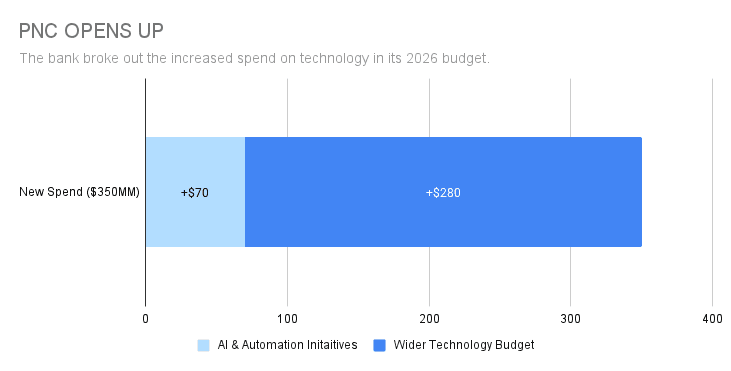
PNC’s rare candor works out to roughly a $70 million uptick in AI spending on top of existing budgets – a significant increase for a bank with $569 billion in assets. As notable is the detail Demchak provided about savings from adopting AI. Between 2022 and 2025, operating leverage (the gap between revenue growth and cost growth) improved by 30% as a result of company automation efforts – with AI investment predicted to drive another 40% improvement between 2025 and 2030.

NOTABLY QUOTABLE

USE CASE CORNER
AGENTIC GREEN SHOOT
Based on the January update to our Use Case Tracker, 7% of the 380 use cases announced by the 50 banks we track in the Evident AI Index are already classified as agentic. Despite this momentum, no bank has (publicly) rolled out fully autonomous agents for core banking functions such as customer onboarding or risk management. But some of the latest applications within support functions (e.g. complaint resolution, transactional servicing, and customer communication) demonstrate progress towards more end-to-end automation, as the following use case disclosed last month demonstrates.
Use Case: Complaint Handling Agent
Vendor: N/a
Bank: Citizens Financial
Why it’s interesting: It directly interfaces with customer communications. It requires high-volume, pattern-driven interactions where consistency is paramount. The resulting shift from “AI assists humans perform tasks” to “AI handles tasks with human oversight” represents a meaningful step forward in terms of capability (and potential ROI).
How it works: An agentic AI system automatically classifies incoming customer complaints and generates appropriate responses. Unlike traditional chatbots that route queries, this agent handles the full complaint lifecycle – from categorization to resolution drafting – with minimal human intervention throughout.
Bigger Picture: Banks are building trust in agentic systems through an incremental, iterative process: starting in narrow domains, validating outcomes, and then expanding the scope of deployment. Citizens Financial CIO Michael Ruttledge recently described this exact process by detailing how 90 “proofs of concept” were whittled down to the most promising candidates before entering production.

BIG IDEAS
LIFELONG LEARNING
In these first editions of the new year, we’re exploring the big ideas shaping AI in 2026. This week: Continual learning.
Current LLMs suffer from a severe case of amnesia. When you hire a human employee, they spend months absorbing institutional knowledge, like remembering that a specific vendor requires a unique invoice process. The LLMs powering AI agents, however, are transient. Every time an agent spins up, it starts from scratch. This forces them to solve the same problems repeatedly, limiting their ability to develop judgment over time. The solution might be continual learning.
Google's Demis Hassabis defines this as the ability to “online teach the system.” Unlike normal offline training, where a model is frozen after a massive, one-off training run, online training allows the model to permanently alter itself during deployment. That’s a route to learn new information, but critics warn it can trigger catastrophic forgetting: as the model learns new information, it may abruptly overwrite existing weights, potentially "unlearning" safety guardrails or core logic.
A potentially safer alternative lies in context graphs – external records of steps taken by previous agents to solve problems, which fresh ones can then reference. Context graphs could lead to faster, more predictable agents, and they can be audited to check agents are behaving as expected.
Bottom line: There is a ceiling on what AI models can achieve as long as they remain static. There is a race among AI researchers to solve continual learning, and this year we’ll see more and more fixes to get AI learning on the job.

Want to speak directly to tech decisionmakers at the biggest banks around the world? Our highly-engaged audience of more than 20,000 subscribers includes CIOs, CDAOs, CTOs and CEOs of the top banks and financial services companies. Sponsorship for 2026 is now open; secure your spot today.

STAT OF THE WEEK

The amount that KeyBank has cut call center expenses thanks to AI. Per CEO Christopher Gorman, calls taken by AI now cost the bank 25 cents each, whereas calls taken by human customer service reps cost $9 a pop.
.svg&w=96&q=80)
TALENT MATTERS
OZZIE AI
National Australia Bank appointed Mahya Knox its new chief AI officer. Knox comes over from Commonwealth Bank, where she also led AI strategy.
First National Bank named Brad Martin its new CIO, replacing Tammy Plummer in anticipation of her retirement.
Brad Novak joins Rathbones as CTO, bringing decades of experience in fintech with stops at Goldman Sachs, Credit Suisse, and Barclays.
Ex-Meta engineering VP Nima Khajehnouri joined the Board of Directors of neobank Dave, Inc.
IN THE NEWS
5 STORIES THAT CAUGHT OUR EYE
JPMC switched its classification of AI from “discretionary innovation” to “core infrastructure.” The move puts the tech in the same category as bread-and-butter budget items like data centers, payment systems, and risk controls.
HSBC is partnering with Harvey AI on a pilot program to improve workflows for its legal team. Per HSBC’s Chief Legal Officer Bob Hoyt, the new tech will help cut down on rote tasks, freeing up the bank’s lawyers to “spend more time on strategic, high-value work.”
Lloyds is launching an AI Academy for all 67,000 of the bank’s employees this month. The bootcamp will offer a range of courses tailored to each employee’s role, ranging from straight-ahead users of AI to “leaders, builders, and enablers.”
Cake Bank, a Vietnamese AI-first neo-bank with more than 100 use cases in production, managed to attract over six million customers in its first five years of operation, achieving profitability three-and-a-half years after launch. The bank has built its own in-house Vietnamese LLM and struck an expansive partnership with Google Cloud.
At the South China Morning Post’s Greater Bay Area conference last week, Joseph Chan Ho-lim, Hong Kong’s undersecretary for Financial Services and the Treasury, said that Hong Kong and Shenzhen will be combining their strengths in banking and technology to form a collaborative ecosystem.
CEOs and employees aren’t exactly on the same page when it comes to reporting productivity gains from AI. According to a survey done last fall of 5,000 white collar employees by AI consultancy Section, 2 in 5 workers thought AI had no effect on their efficiency, compared to 2% of execs.

WHAT'S ON
Mon 19 - Fri 23 Jan
WEF, Davos, Switzerland
Weds 18 - Thurs 19 Feb
CDAO Financial Services, New York, NY
Tues 24 - Thurs 26 Feb
International Association for Safe & Ethical AI, Paris
- Alexandra-Mousavizadeh|Co-founder & CEO|[email protected]
- Annabel-Ayles|Co-founder & co-CEO|[email protected]
- Colin-Gilbert|VP, Intelligence|[email protected]
- Matthew-Kaminski|Senior Advisor|[email protected]
- Kevin-McAllister|Senior Editor|[email protected]
- Daniel-Shackleford-Capel|MD, Banking|[email protected]
- Maryam-Akram|Senior Research Manager|[email protected]
- Zachary Groz|Reporter|[email protected]
- Andrew-Haynes|VP, Innovation|[email protected]
- Alex-Inch|Data Scientist|[email protected]
- Sam-Meeson|AI Research Analyst|[email protected]
- Gabriel-Perez-Jaen|Research Manager|[email protected]
- Jay Prynne|Head of Design|[email protected]
- Marcus Gurtler|Junior Designer|[email protected]

