

DATA-DRIVEN INSIGHTS AND NEWS
ON HOW BANKS ARE ADOPTING AI
Europe wakes up

Source: Adobe Firefly
12 February 2026
Welcome back to the Banking Brief from Evident – or as Business Insider calls us, “Wall Street’s AI scorekeeper.”
This week, European banks may just be getting that second-mover groove on AI. Goldman Sachs and Anthropic touted a big new agreement to develop agentic tools; we take a closer look. And in our Jargon section, please meet “skills.”
People mentioned in this edition: Slawomir Krupa, Andrea Orcel, Sergio Ermotti, Jean-Laurent Bonnafé, Marco Argenti, Jed Finn, Brian Chau, John Lee and others.
This edition is 1,512 words, a 5 minute read. Check it out online. If you were forwarded the Brief, you can subscribe here. We always want to hear from you at [email protected].
– Alexandra Mousavizadeh & Annabel Ayles

TOP OF THE NEWS
EURO-TORTOISES GET IN RACE
For years, North American banks snapped up talent en masse, published volumes-worth of research and spent billions on AI. However you might describe European banks’ approach – strategic, considered or lagging – they’re now making some moves.
As enterprise AI has matured, the barrier to entry has been lowered. Intentionally or not, by moving later, European banks are able to lean on tech vendors’ increasingly-capable tools, skip the costliest parts of the early build-outs and choose to create and scale tools only where AI has the most impact.
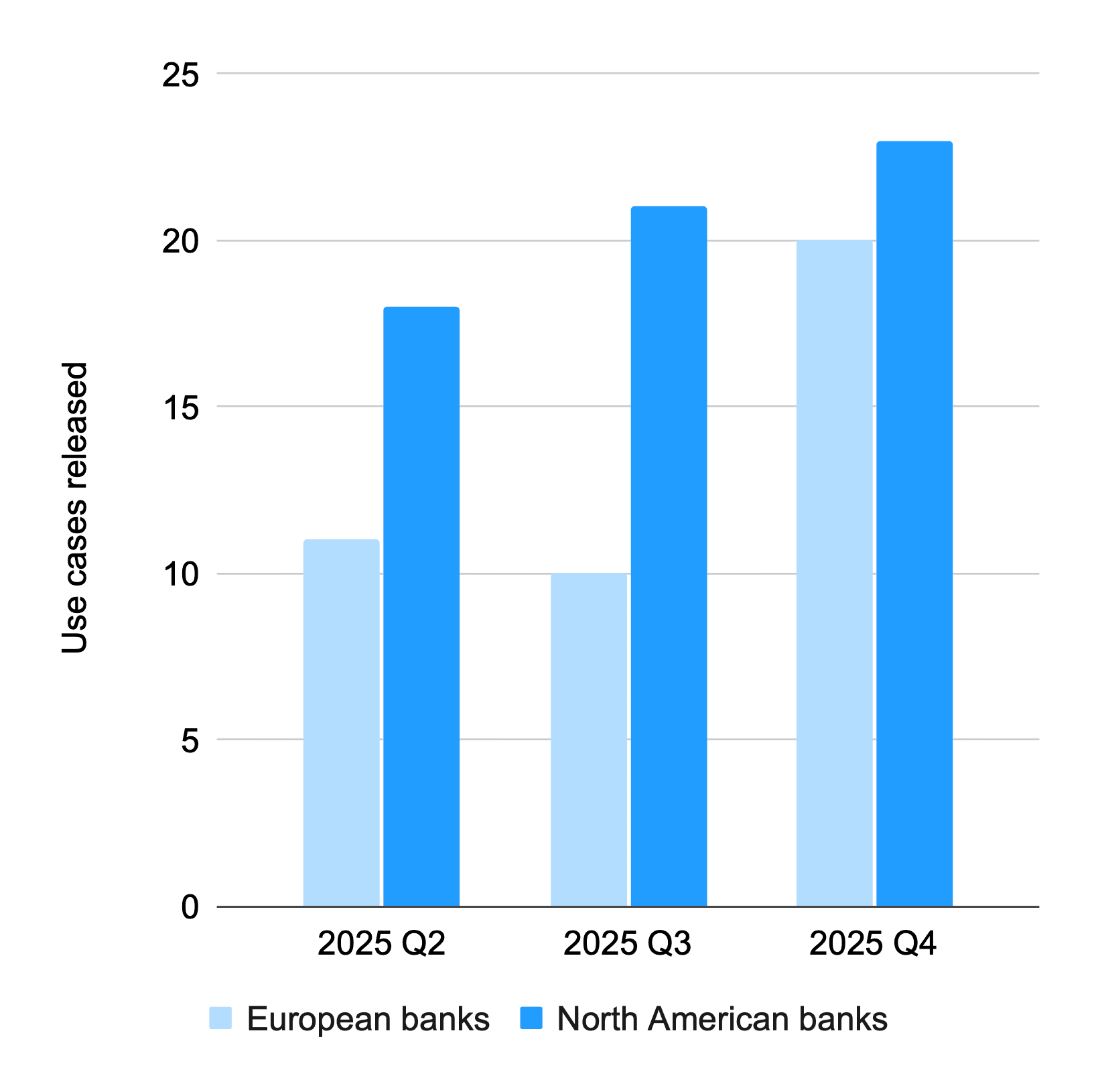
LATE BLOOMERS
The number of new use cases disclosed by European banks nearly matched that of North American banks last quarter, after trailing the previous two.
Let’s take Paris’ Société Générale for example. The bank initially poured years into developing an assistant called SoGPT. Last month, CEO Slawomir Krupa replaced it with Microsoft Copilot, saying “it was much more efficient to use an outside proven reliable tool” rather than continue to put money towards a problem Big Tech had already solved.
It’s hardly the only bank leaning in on buying. BBVA deepened its relationship with OpenAI last year, rolling ChatGPT Enterprise out to 120,000 employees. Through that partnership, the bank became one of the early users of Frontier, the agentic AI platform the lab launched this month. UniCredit is seeing similar benefits. The Italian bank inked a deal with Google last summer to get its data in order. The bank has now cut 30% off its IT costs, CEO Andrea Orcel said during earnings this week.
Just as important is what they’re choosing to prioritize. At UBS, CEO Sergio Ermotti told the bank’s financial services conference this week that “80% of the value I see in the next three to five years for us is back-end processes.” At BNP Paribas, the bank did a “comprehensive review of our support functions” to “implement AI on a larger scale” instead of just investing and hoping CEO Jean-Laurent Bonnafé said. With that approach, the bank expects to hit nearly $900 million in value from AI, primarily through revenue gains, he said.
Bottom line: European banks are applying lessons from early adopters in their dealings with vendors. The burden is now squarely back on North American banks to prove that they used their early start to build something that can’t simply be licensed from Big Tech.
NEW FROM EVIDENT
3 AI USE CASE TRENDS FROM Q4 2025

Gen and Agentic AI dominates deployments, developer tools go mainstream, and the vendor landscape shifts. Explore the latest findings from the Evident Use Case Tracker.

USE CASE CORNER
AGENTS MOVE BEYOND CODING
Goldman Sachs is working with Anthropic to roll out autonomous agents that can handle accounting for trades and onboarding clients, CIO Marco Argenti said in an interview last week. In this week’s “Corner” we look under the hood at what the tools will actually do.
Use Case: Compliance and post-trade agents
Vendor: Anthropic
Bank: Goldman Sachs
Why it’s interesting: The bank is passing more back-office responsibilities to autonomous agents after finding its work with coding agents, which kicked off this summer, successful. These digital coworkers, as Argenti describes them, will complete and hand off KYC processes from start to finish and do the post-trade accounting work to settle trades and transactions. It’s the highest-profile banking partnership yet for Anthropic, which has been siphoning off enterprise business from OpenAI in recent months (see: “Bye bye, OpenAI,” The Brief, Jan 29). If an end-to-end solution like this works, Argenti said the bank may begin to cut out third-party software providers.
How they did it: Anthropic sent engineers to work with the bank for the last six months to look at how to automate the back office tasks. Argenti said the bank focused on these two areas because they were “professions within the firm that are scaled, are complex and very process intensive.” Because Claude could “reason through complex problems, step-by-step, applying logic” the areas became a natural fit, he said.
By the numbers: The agents are launching “soon,” and promise to cut down the amount of time it takes to complete compliance checks and settle trades, Argenti said. The bank will then look to expand the use of autonomous agents to other functions, like employee surveillance or deck creation. Argenti said it was “premature” to determine whether headcount cuts were in store as the tech scales, but shedding jobs is broadly on the bank’s radar as part of the OneGS 3.0 plan it unveiled at the end of last year (see: “More cowbell,” The Brief, Oct. 16).
Bigger picture: KYC and post-trade accounting are two of the hottest areas for agentic AI in banking, our latest Use Case Trends analysis – available to Evident members this week – shows. UBS, for example, is developing a multi-agent KYC system to speed up the process of getting clients’ money into the bank, while the Bank of Singapore has a multi-agent system that handles source of wealth checks – one part of KYC (see: “Follow the money,” The Brief, Nov. 6). The focus makes sense: Every bit of time banks can shave off these processes translates directly to ROI. For Goldman Sachs – and peers like BNY, which has put a particular focus on agents – success will be driven by how much these tools actually act like “digital employees” that can handle multiple jobs without human intervention, as it’s the handoffs that slow the process most.

STAT OF THE WEEK
.png%3FupdatedAt%3D2026-02-12T13%3A14%3A35.023Z&w=3840&q=100)
The length of BNY’s employee-wide training on Eliza, the bank’s enterprise AI platform. Almost all of the bank’s 50,000 employees have completed the training, the bank reports. Compared to other banks, it’s an in-depth tutorial: The AI training Citi mandated for all 175,000 workers takes between 10 and 30 minutes.

IN THE NEWS
THREE-PHASE PLAN
Morgan Stanley’s head of wealth management Jed Finn laid out the bank’s approach to agents at UBS’ analyst conference this week: First the bank is tackling branch operations, creating companions that can “take actions, so move money, open accounts, change beneficiaries.” Then it’s focusing on agents that function like a team member that can interact with clients by sending tax documents or helping them understand their exposure to market events. Finally, it’s building “Jarvis from Iron Man, but for managing money,” Finn said. That’s the end-to-end experience that can onboard a new client, build them a portfolio and answer any question they may have.
French AI lab Mistral saw its revenues soar to above $400 million this year, up from $20 million last year, new data shows. The lab is following Anthropic’s playbook and pushing into the enterprise: It now has more than 100 large enterprise customers, including early investor BNP Paribas, which also signed a new three-year deal with the model-maker on Thursday to extend the partnership.
OpenAI approved the first AI app from an insurance provider on ChatGPT. The integration means Spanish customers will be able to get personalized quotes inside the app. It’s the latest new feature from an AI lab that has sent markets tumbling.

Want to speak directly to tech decisionmakers at the biggest banks around the world? Our highly-engaged audience of more than 20,000 subscribers includes CIOs, CDAOs, CTOs and CEOs of the top banks and financial services companies. Sponsorship for 2026 is now open; secure your spot today.
WELCOME TO THE JARGON
SKILLS PAY THE BILLS
Last week, Anthropic rocked the markets with a new release, lopping billions off the value of software giants like RELX and Reuters. It wasn’t a whole new LLM that caused the panic. All they did was teach their model a few new…
.png%3FupdatedAt%3D2026-02-12T17%3A01%3A49.843Z&w=3840&q=100)
Prompt engineering is out; skills – SKILL.md for our techier readers – are in. While a prompt is a one-off instruction you paste into a textbox (“Write me a poem”), a skill is a set of instructions on how to do a certain task, so the LLM doesn’t start from square one each time it gets asked to do something. Think of it like giving a junior employee a binder with standard operating procedures.
Most importantly, skills are simple (you can read one of Anthropic’s on variance analysis here). They’re just text files that the model reads and commits to memory. For example, before getting the skill above, your model might have tried to work out how to do variance analysis from scratch each time it was tasked to do it. Now, it has a set of guidelines it can refer back to. Some of our Evident colleagues have been testing skills for odd jobs, like telling agents which information to pay attention to in reports. Their take? The results are good, but only so far as it’s quick and easy to double check the agent’s work.
.png%3FupdatedAt%3D2026-02-12T13%3A17%3A05.153Z&w=3840&q=100)

NOTABLY QUOTABLE
“The experience that tech workers have had over the past year, of watching AI go from “helpful tool” to “does my job better than I do”, is the experience everyone else is about to have. Law, finance, medicine, accounting, consulting, writing, design, analysis, customer service. Not in 10 years. The people building these systems say one to five years. Some say less.”
– Matt Shumer, CEO of Otherside AI, in an essay, Feb. 1
.svg&w=96&q=80)
TALENT MATTERS
ON THE MOVE
Santander’s CIO Dan Griffiths left the bank to join USAA in the same role. Griffiths also previously worked at TD Bank.
Westpac CIO Scott Collary is retiring later this year. The Australian bank has been changing the tech guard since bringing chief data, digital and AI officer Andrew McMullan aboard from CommBank last year.
Scotiabank is hiring a head of data product and AI enablement to “own the end-to-end lifecycle of enterprise data platforms.
NatWest is hiring a head of AI content production to lead the bank’s work with Pencil Pro, which helps firms create AI marketing campaigns.

CODA
IP ON THE UP
Two big court rulings in the last week – one in the U.S. and one in the U.K. – just made AI patents easier to secure.
In both countries, AI patent applications often get dismissed as being “too abstract” if they aren’t tied to a broader product or practical application – a chatbot or a fraud platform, for example. The Desjardins ruling in the U.S. clarifies that improvements to AI models themselves can count as inventions, instead of needing to rely on having those extra components built around them. In the U.K., where patents have often faced even tougher scrutiny, the new ruling makes clear that AI patents can’t just be ruled out because they’re software-based.
To make sense of the U.S. ruling, we texted IP lawyer Brian Chau, who advises banks on AI patenting, and John Lee, head of patents at TD Bank, to tell us what the ruling actually is and what it means for banks:
.png%3FupdatedAt%3D2026-02-12T13%3A21%3A24.980Z&w=3840&q=100)
WHAT'S ON
Weds 18 - Thurs 19 Feb
CDAO Financial Services, New York, NY
Tues 24 - Thurs 26 Feb
International Association for Safe & Ethical AI, Paris
Tues 3 - Weds 4 March
Advanced Model Risk USA, New York, NY
Weds 15 - Thurs 16 April
AI in Finance Summit, New York
- Alexandra Mousavizadeh|Co-founder & CEO|[email protected]
- Annabel Ayles|Co-founder & co-CEO|[email protected]
- Colin Gilbert|VP, Intelligence|[email protected]
- Matthew Kaminski|Senior Advisor|[email protected]
- Kevin McAllister|Senior Editor|[email protected]
- Daniel Shackleford Capel|MD, Banking|[email protected]
- Maryam Akram|Senior Research Manager|[email protected]
- Zachary Groz|Reporter|[email protected]
- Andrew Haynes|VP, Innovation|[email protected]
- Alex Inch|Data Scientist|[email protected]
- Sam Meeson|AI Research Analyst|[email protected]
- Gabriel Perez Jaen|Research Manager|[email protected]
- Jay Prynne|Head of Design|[email protected]
- Marcus Gurtler|Junior Designer|[email protected]

