

DATA-DRIVEN INSIGHTS AND NEWS
ON HOW BANKS ARE ADOPTING AI
Meet the bank of the future

Source: Adobe Firefly
8 January 2026
Welcome back! Wondering what’s out and what’s in this coming year? We have the only list that you need for 2026 – at least for those who care about AI and finance. A lot of our work this year will be about imagining, and tracking and critiquing, what the bank of the future looks like. The Ins for 2026 are good guideposts for what we'll be looking for.
Earnings season is upon us, and a top analyst weighs in on what to expect starting next week. Some big talent moves Down Under. And we debut a new series on the big ideas that will shape 2026 in banking and AI.
People mentioned: Derek Waldron, Raymond Chun, Steven Alexopoulos, Kristin Milchanowski, Deepak Singh, Dan Jermyn, Vicki Wood, Gavin Munroe, Jamie Cowan, Rachel Sendrovic Feuer, Alison Chang, Thomas De Clercq and Zachery Anderson.
This edition is 2,183 words, a 5 minute read. Check it out online. If you were forwarded the Brief, you can subscribe here. We always want to hear from you at [email protected].
– Alexandra Mousavizadeh & Annabel Ayles

2026 INS AND OUTS
BANK OF THE FUTURE
There’s no better time – for people and businesses – to imagine the “new you” than early January. Here’s Evident’s list of what’s In for banks this new year and what ought to be left back in 2025 if they want to end the year better than they started.
OUT: Bigger armies
IN: Better generals
In the era of experimentation, a big AI workforce alone was enough. We ourselves focused a lot on “volume” in our tracking. But winning in the Year 3 CE (that’s ChatGPT Era) requires more than a swarm of engineers; it demands people with experience transforming organizations around tech. These are the kinds of systems thinkers who can “rethink end-to-end processes and what’s possible with AI” and get it scaled, as JPMorganChase chief analytics officer Derek Waldron put it last month. Now volume isn’t completely out. Hiring at the 50 banks we track grew 25% last year, and that momentum will continue into 2026. But banks that focus – like the leading Big Tech companies – on people with the vision to fully transform a legacy organization will come out better for it.
OUT: CEO boosterism
IN: CEO ownership
Talk – even AI talk – is cheap in 2026. CEOs this year need to be equal parts bank leaders and tech founders with that “founder mentality” (more on that in our Q&A below). Mentioning AI in an earnings call or annual report won’t cut it anymore; leaders have to be able to show and explain how deeply they’ve embedded AI into their operating model and how their investments from the past few years will fit together to deliver bigger gains. Or, as BNY CEO Robin Vince puts it, making sure “AI is for everyone, everywhere, everything.”
OUT: Rolling the dice
IN: Playing the odds
In 2025, innovation teams at banks moved to the cutting edge: Banks ramped up research (see: “3 faces of AI,” The Brief, Sept. 18) and became university fixtures. But in 2026, they’ll need to focus their academic pursuits and venture investments only on what can set their products apart from competitors. Models will only get better and cheaper to run in the new year. To differentiate themselves, banks will need their boffins to put all their weight behind building architectures and frameworks that let them take advantage of that increased performance – a process we saw already underway for leaders at the academic AI conference NeurIPS last month (see: “Paper trail,” The Brief, Dec. 4).
OUT: Winning a hand
IN: Winning the game
In 2025, banks got good at talking about the benefits of individual use cases (see more in the Coda, where we grade last year’s KPIs). Ending the year doing only that will be a failure. They’ll need to get more specific, not just about how a single tool impacts, say, productivity, but about how the fundamental changes they’re making to their organizations are making the bank function better as a whole. They’re off to a hot start: TD Bank CEO Raymond Chun told investors Tuesday the bank was able to cut 21% off its mortgage adjudication costs – not the result of a single tool, but rethinking the mortgage process around AI.
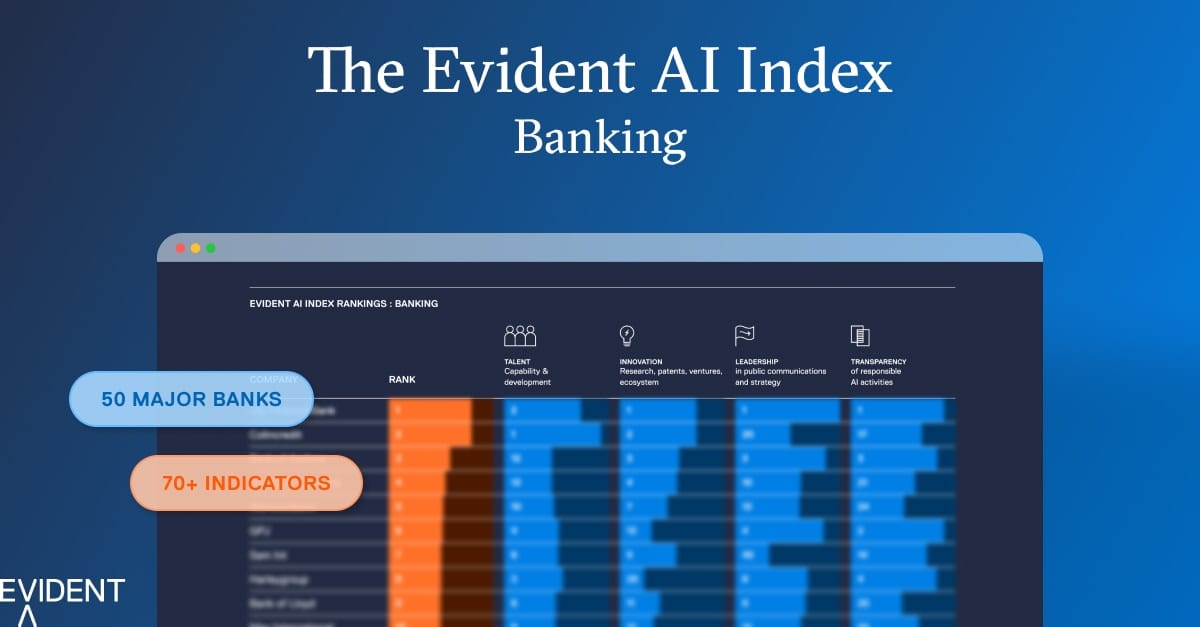
The Evident AI Index sets the global standard for measuring how banks are adopting AI, and in 2026 we're expanding our banking coverage with new Indexes focused on the Middle East and Africa and on Latin America.
Until then, check out our flagship ranking, the most comprehensive and trusted benchmark of its kind. We analyse 50 of the world’s largest banks and drawing on millions of publicly available data points across four critical pillars of AI capability: Talent, Innovation, Leadership, and Transparency.
.svg&w=96&q=80)
Q&A
EARNINGS PREVIEW

The big U.S. banks report earnings next week. We caught up with TD Cowen analyst Steven Alexopoulos yesterday to see what CEOs need to say about AI this time around to convince him and his peers they’re capitalizing on the tech. The following conversation has been edited for length and clarity.
EVIDENT: What about AI will you be listening for CEOs to say on next week’s calls?
ALEXOPOULOS: My expectations are for almost nothing. By that, I mean nothing in prepared comments. This not wanting to scare their workforce is tangible; the banks are not in a position yet where they have enough confidence in these models to have agents replace people. Eventually you’re going to reach that point; I don’t think that will be this year. If you were the CEO and you saw what's coming, how would you be messaging to the world where all your employees are listening? You have to manage that, which means you can’t be too vocal in the message.
When we looked at the share of time of bank earnings calls last year being dedicated to AI, there was a pretty big jump year-on-year. So you're expecting shyness purely because of the jobs question?
It's more you have to balance quantity with quality. Listen to the hyperscalers talk about this where they give concrete things investors can hang their hats on: How many agents do you have today? Where do you see headcount reductions coming over the next two years? If you're going to get shareholders more excited in your company, that's where it's going to come from. But you're not hearing a lot say that. But I'm telling you, when I talk to banks offline, they say don't write [about the jobs impact] because we don't want to scare our employees.
If they don’t end up talking in depth about AI, what’s going to convince you they’re making progress on AI in a meaningful way?
It's a lot of reading the tea leaves. This large bank versus small bank thing I think is totally wrong. It's a founder mentality. You have banks run by managers and banks run by founders. What founders do is they give the organization permission to take risks, lean into the technology. The problem is that the manager types all pay tons of money to consultants to say the same things as the founder types, so it's very hard to differentiate the two. There's going to be a couple of sleepers, a couple of companies in the group that do much better than we think, and others that we think are elite that you're gonna find out weren't.
But even with a founder mentality, these are legacy organizations. Building AI tools – let alone agentic tools that scale – means connecting systems, overcoming tech debt. What’s showing you that it’s not just talk?
What you just said is a complete excuse for why a bank won't change, right? Most of the CIOs I speak to have not held back. A lot of them have said to the board, AI is a key position. We need to pay up. Get somebody really good. I ask CIOs how often you talk to your board and management team? The range is like 10 times a day to once a quarter. Will the CEO and the board allow them to do what they need to do? Or are they afraid of their own shadow for some reason.

STAT OF THE WEEK

The number of European banking jobs that could be eliminated by 2030, according to an analysis of 35 lenders by Morgan Stanley.
But but but… The real story in the fine print: The jobs on the chopping block are concentrated largely in the back and middle office. As banks scale AI tools, the nature of the work they need humans to do will certainly change, but “banks will reallocate work to higher-value decisioning,” Kristin Milchanowski, BMO’s chief AI and data officer, told us last year (see: “Good, bad and provocative,” The Brief, Dec. 18). Some jobs may disappear, but AI is also creating jobs at leading banks, which are hiring up a storm (see: “Not Guilty,” The Brief, Nov. 6).

BIG IDEAS
PUT IT ON MY TAB
In these first editions of the new year, we’ll explore some of the big ideas we think will shape how banks approach AI in 2026. First up: Tabular foundation models.
Despite the generative AI boom, most of banks’ ROI from AI – in areas like credit scoring, pricing and risk – still rests on predictive AI techniques that have hardly changed in the last ten years. But tabular foundation models (TFMs) are now poised to change that.
TFMs are a new type of model that takes the key idea of LLMs – training a general model on enormous amounts of data – and applies it to bread-and-butter predictive AI. Where traditional models need to be trained from scratch, a TFM adapts to new datasets immediately, treating training data like the prompt in an LLM.
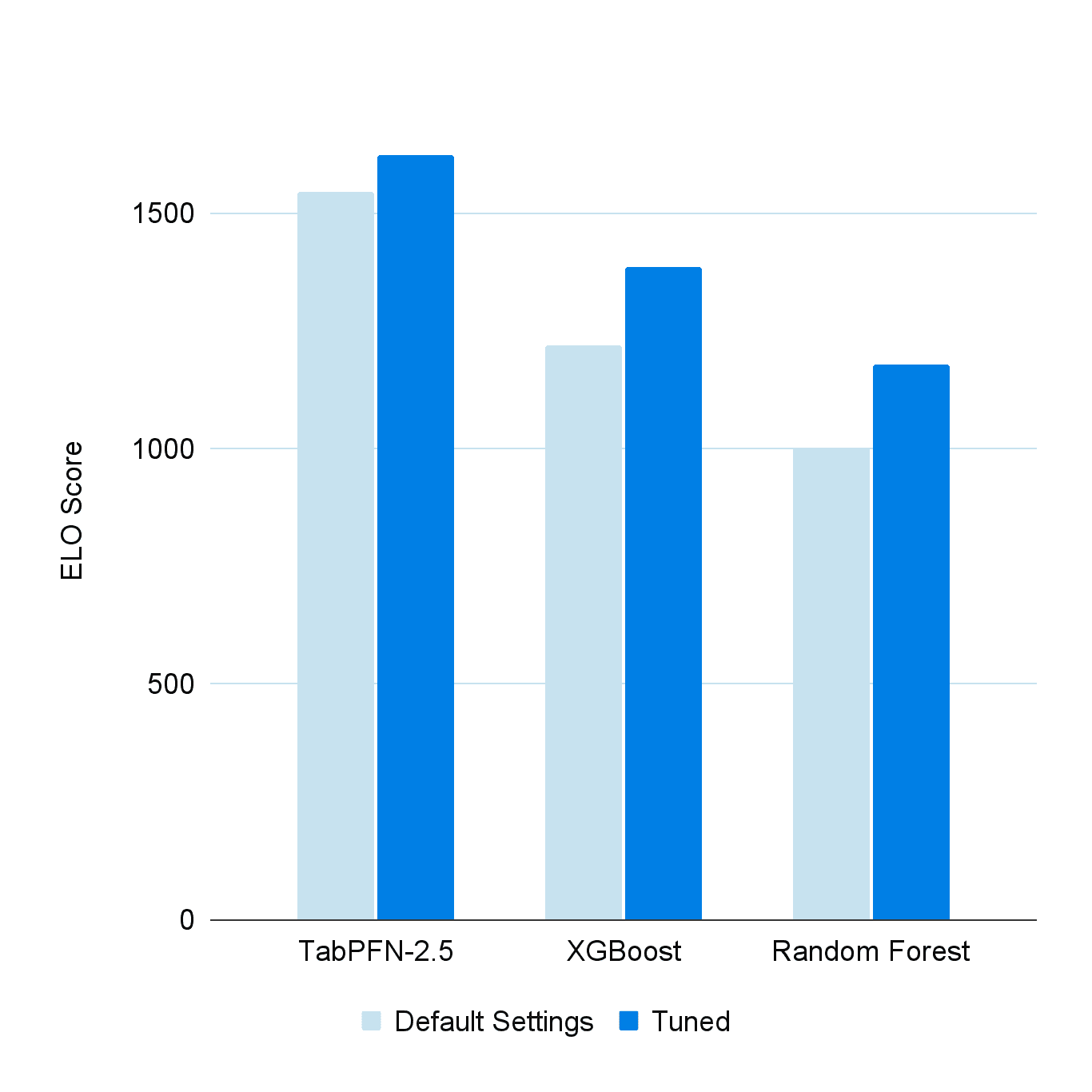
That adaptability comes with benefits: One model can be reused across use cases, potentially easing compliance; fresh data can be used to improve predictions without costly retraining; and the generality of TFMs makes them better at handling rare “out-of-distribution” events that can scupper traditional models. Plus they’re good: Prior Labs, a startup building these types of models, has shown that its TabPFN-2.5 model can outperform traditional methods on a range of modeling tasks.
EXCEL-LENT
Prior Labs’ tabular foundation model, TabPFN, consistently makes more accurate predictions based on smaller datasets than industry-standard ML models like XGBoost and Random Forest, both out of the box (default settings) and after some some adjustments to make it fit the data better (tuned).
The jury is out on whether they’re ready for primetime. Using a TFM remains pricier than traditional methods, and the models struggle with banking’s million-row datasets, although Prior Labs say new model variants address those issues. Either way, banks that crack TFMs will be able to do weeks of data science work in seconds. Behind the scenes at NeurIPS, the largest academic AI conference held in San Diego last month, numerous bank researchers told us just how urgent their efforts are, and that breakthroughs are expected. TD Bank, perhaps the most vocal about the topic, has already filed patents and even announced their own in-house model as they aim to get there first.
Bottom line: Flashy agents and LLMs will win the headlines battle in 2026, but the year ahead will be just as much about banks using advances like TFMs to boost the bottom line.

Want to speak directly to tech decisionmakers at the biggest banks around the world? Our highly-engaged audience of more than 20,000 subscribers includes CIOs, CDAOs, CTOs and CEOs of the top banks and financial services companies. Sponsorship for 2026 is now open; secure your spot today.

USE CASE CORNER
HELP YOUR DEVELOPER
AI tools for developers and engineers are hot right now. The 50 banks we track have launched four new developer augmentation tools in the last month, the most of any area. In the “Corner” this week, we look at how CommBank is piloting a tool that goes beyond code generation to tackle one of the most manual parts of the software development lifecycle.
Use Case: DevOps agent
Vendor: AWS
Bank: CommBank
Why it’s interesting: Bank IT teams are hit with a barrage of issues nearly every day. Each alert triggers a familiar drill: DevOps engineers are pulled in to find a needle in a haystack by tracing how systems connect and determining what broke before actually fixing it. The DevOps agent is designed to understand the context of how systems fit together and can handle that time-consuming investigation. That means engineers can spend less time diagnosing problems and more time fixing them.
How it works: The agent plugs into the tools banks use to monitor system performance and uses that historical data to build a profile of how its tech stack functions. When something goes wrong, it scans recent activity and works independently to identify likely causes for the issue before preparing a report with potential fixes. “You're giving them complex challenges that they may have to think about, try different solutions and get to the right conclusion,” said Deepak Singh, VP of developer agents and experiences at AWS during the company’s Re:Invent conference last month. “They should do that without intervention.”
By the numbers: During CommBank’s pilot, the agent was able to identify the root cause of a network issue that would’ve taken a human team several hours in under 15 minutes, the bank said.
Bigger Picture: Coding is Gen AI’s “killer use case” in banking. But the banks that can get AI to understand the systems it works within can transform the full process of software development, rather than just write code faster.
Want to know more about the specific ways banks are rolling out AI? Check out our Use Case Tracker – the inventory of all the AI use cases announced by the world’s largest banks available to members.

NOTABLY QUOTABLE
“The exciting part actually starts in 2026 when we start to layer in agentic AI on top of that.”
– Raymond Chun, CEO at TD Bank, during RBC’s investor conference, Jan. 6
.svg&w=96&q=80)
TALENT MATTERS
MORE COMMBANK CHANGES
Westpac poached two more executives from Australian rival CommBank: Dan Jermyn joins as chief AI officer and Vicki Wood as chief analytics officer. Former CommBank CIO Gavin Munroe also left the company late last year (see: “C-Suite shake-ups,” The Brief, Nov. 25).
Zachery Anderson joined JPMorganChase’s payments division as chief data and analytics officer. He was previously chief data and analytics officer at NatWest.
Jamie Cowan was hired by DBS as executive director and head of technology risk. Cowan was previously head of frameworks, governance and reporting for technology and operations at Standard Chartered.
Rachel Sendrovic Feuer is now managing director and U.S. head of model and AI risk management and global head of model risk at Barclays. She previously worked in the investment banking division.
RBC Capital Markets promoted Alison Chang to be director, AI and digital innovation and go-to-market strategy. Chang will lead go-to-market strategy for enterprise Gen AI products, she wrote on LinkedIn. The bank also brought Thomas De Clercq in as a vice president of AI product management, strategy and technology initiatives. He was previously at JPMorganChase

CODA
2025 KPIS IN REVIEW
Last January, we laid out our expectations for banks heading into 2025. Here, in the spirit of accountability, is the performance review for them (and a bit for us, the prognosticators, since we came up with the KPIs):
KPI #1: “Banks will shift hiring focus from data scientists and researchers to AI product managers and engineers.”
🟢 Exceeded expectations
- Banks did exactly this: AI talent at the 50 banks we track grew 25% in the last year, with a specific focus on people who could implement AI strategies and connect them to business goals.
KPI #2: “After an extended decline in venture capital dealflow, show a rebound in early stage investment that focuses on applications.”
🔴 Below expectations
- Not close: The number of investments by banks into AI companies declined by 17% this past year.
KPI #3: “Show how AI use cases are helping overall business performance.”
🟢 Exceeded expectations
- The number of banks reporting ROI of all AI use cases doubled. And the number reporting returns on individual use cases grew by more than 20%.
KPI #4: “Give Responsible AI talent brought on board in last year’s hiring surge the organizational backing to implement firmwide RAI frameworks.”
🟡 More data needed
- The number of banks with senior RAI leaders grew from 33 to 42. But “responsible AI” stopped being as important as practical governance. Ethics took a backseat to guardrails as banks focused more on how to scale AI.

WHAT'S ON
Mon 19 - Fri 23 Jan
WEF, Davos, Switzerland
Tues 20 Jan
Achieving the AI Advantage, Davos, Switzerland
Weds 18 - Thurs 19 Feb
CDAO Financial Services, New York, NY
Tues 24 - Thurs 26 Feb
International Association for Safe & Ethical AI, Paris
- Alexandra-Mousavizadeh|Co-founder & CEO|[email protected]
- Annabel-Ayles|Co-founder & co-CEO|[email protected]
- Colin-Gilbert|VP, Intelligence|[email protected]
- Matthew-Kaminski|Senior Advisor|[email protected]
- Kevin-McAllister|Senior Editor|[email protected]
- Daniel-Shackleford-Capel|MD, Banking|[email protected]
- Maryam-Akram|Senior Research Manager|[email protected]
- Zachary Groz|Reporter|[email protected]
- Andrew-Haynes|VP, Innovation|[email protected]
- Alex-Inch|Data Scientist|[email protected]
- Sam-Meeson|AI Research Analyst|[email protected]
- Gabriel-Perez-Jaen|Research Manager|[email protected]
- Jay Prynne|Head of Design|[email protected]
- Marcus Gurtler|Junior Designer|[email protected]

