

DATA-DRIVEN INSIGHTS AND NEWS
ON HOW BANKS ARE ADOPTING AI
🚨NEW: Evident AI Index | Payments🚨
Source: Adobe Firefly
26 February 2026
Welcome back to The Banking Brief. This week we launched the Evident AI Index for Payments, the first-ever ranking of the AI maturity of the largest payment networks and processors in North America and Europe.
Today, we break down the results and highlight the most innovative use cases. There are plenty of cross-over applications for other industries. Plus, meet five people to know in this sector. Want to learn more? Sign up for our roundtable with executives from the leading firms.
There’s plenty of news this week on banking and AI. Top of the list is JPMorganChase’s investor day.
People mentioned in this edition: Paul Fabara, Jack Forestell, Greg Ulrich, Ravi Radhakrishnan, Enrique Lores, Emily Glassberg Sands, Jamie Dimon, Marianne Lake, Mary Callahan Erdoes, Manuela Veloso, Ganesh Chandrasekar, Jen French, Andrew Haynes, Biswa Sengupta and others.
This edition is 1,866 words, a 6 minute read. Check it out online. If you were forwarded the Brief, you can subscribe here. We always want to hear from you at [email protected].
– Alexandra Mousavizadeh & Annabel Ayles

EVIDENT AI PAYMENTS INDEX
TALE OF THE TAPE
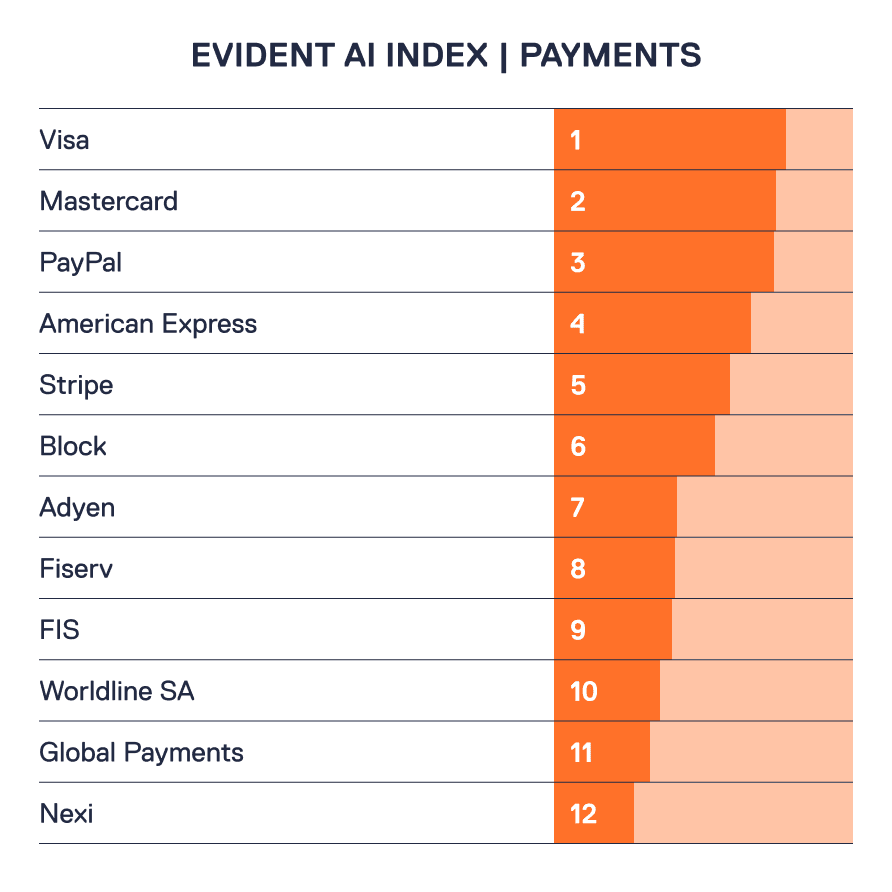
Visa leads the payments industry in AI maturity, according to the new Evident AI Index for Payments out this week. The card network edged out rival Mastercard, with PayPal taking third.
American Express and fintechs Stripe and Block round out the top half of the ranking, which evaluates the 12 largest payments companies in North America and Europe on their AI talent, innovation, leadership and transparency.
Payments firms sit at the heart of the financial system, shuttling money between banks, businesses and people at an enormous scale. For years, machine learning helped them play defense, flagging suspicious transactions and limiting fraud. Now they’re plugging Gen AI, and increasingly Agentic AI, directly into the systems that route and approve payments, betting that despite the risks, they’ll cut losses, lift approvals and rewire how their businesses actually run.
The gap between leading and lagging is already opening. The top three firms account for 54% of the use cases the 12 companies have publicly rolled out. While one-third of these tools report outcomes like financial uplift or efficiency gains, none of the payments firms disclose the total ROI of their AI activities yet – something most leading banks and more than 20% of the 50 lenders we rank in our Banking Index do. Still, the returns are coming through for early adopters.
Visa is seeing them across a growing suite of AI tools that spans authentication to risk controls to AI-powered shopping experiences. Its Scam Disruption practices, which use AI to map fraud patterns, identified more than $1 billion in new attempted fraud across 25,000 scam merchants in just a year. “In the past five years, we have spent around $500 million just on AI alone” to keep transactions safe, said Paul Fabara, chief risk officer during a December panel in Washington, D.C. “Our advantage lies in deploying AI not just to catch fraud after it happens, but to predict and prevent it,” he said separately.
Mastercard, meanwhile, brought Gen AI into its Decision Intelligence platform, which evaluates transactions in milliseconds at checkout. The company says fraud detection improved by an average of 20%, and by as much as 300% for some clients using it. And PayPal has rolled out a wide array of AI tools to simplify merchant onboarding and personalize checkout, along with coding assistants and automated testing systems it’s using to shorten the time it takes to develop new products.
Looking ahead: The landscape is changing. This week, Stripe expressed interest in buying PayPal, a move that would combine Stripe’s infrastructure – the pipes money flows through – with PayPal’s base of more than 430 million merchants and consumers. The combination of two disruptive platforms (founded 10 years apart) could create a new AI powerhouse, capable of mounting a more effective challenge to the sector’s incumbents.
OUT NOW: The Evident AI Index for Payments. Explore the full rankings and dive into the Key Findings Report to see how each company stacks up on Talent, Innovation, Leadership and Transparency.
%201.svg&w=96&q=80)
WHO'S WHO
5 PAYMENTS LEADERS TO WATCH
.jpg%3FupdatedAt%3D2026-02-26T14%3A14%3A44.035Z&w=3840&q=100)
🎯 Product Guru: Jack Forestell
Chief Product & Strategy Officer at Visa
The architect of Visa’s agentic commerce strategy. The payments platform launched its “Intelligent Commerce” platform last year, the infrastructure for a future where an agent buys things on a person’s behalf. “We think [agentic commerce] could be really important,” he said. “Transformational, on the order of magnitude of the advent of e-commerce itself.”
📊 Strategist: Greg Ulrich
Chief AI & Data Officer at Mastercard
The mind behind scaling Mastercard’s Data & AI organization. Ulrich sees the AI benefit in four buckets: safer (keeping transactions secure), smarter (routing them efficiently), more personal (giving clients tools to make better offers to customers) and stronger (improving internal operations). “I and my team from an enterprise-wide standpoint are looking at where we think the technology has the greatest opportunity to drive value,” he said. “I bring that to the business partners, in HR, in finance, in fraud securities, in open banking, in our core payments business, to talk about these opportunities.”
👥 People’s Champ: Emily Glassberg Sands
Head of Data & AI at Stripe
Spearheads Stripe’s push to embed AI into products and the firm’s development of the company’s Agentic Commerce Protocol, a standardized framework that lets agents transact across merchant and payment networks Stripe built with OpenAI. An advocate for the role foundational research and new grads play in unlocking insights in a broader organization. “We need everybody to be able to have high-quality, safe, easy access to LLMs,” she said on a podcast. “Not just for their own day-to-day work usage, but actually to build production-grade experiences.”
🏦 Businessman: Ravi Radhakrishnan
EVP & Chief Information Officer at American Express
The driving force behind a top-down push to bring AI into core enterprise platforms at American Express and align technology investments with business priorities. At the same time, he focused on expanding access to AI tools across the firm. “You need the right security rails, the flexibility to try out different LLMs. You need controls built in that enablement layer itself; you need a good clean data architecture,” he said. “We invested in those. It meant we went a little bit slower to begin with to go faster later.”
🆕 New Guy: Enrique Lores
Incoming CEO at PayPal
A five-year veteran of PayPal’s board, Lores will take the helm on March 1 after former CEO Alex Chriss was shown the door. In his capacity as HP’s outgoing chief executive, Lores launched Silicon Valley’s original startup’s AI-focused $650 million restructuring effort, aimed at generating $1 billion in savings by 2028. He’ll be expected to speed the “pace of change and execution,” the board said of his appointment. “The payments industry is changing faster than ever, driven by new technologies, evolving regulations, an increasingly competitive landscape, and the rapid acceleration of AI that is reshaping commerce daily,” Lores said in a statement.
JOIN US LIVE
Evident AI Index | Payments Roundtable

Greg Ulrich, Chief AI and Data Officer at Mastercard, joins Evident’s Alexandra Mousavizadeh for a virtual roundtable on Tuesday 10 March to unpack the results – and what makes a winner – in the inaugural Evident AI Index for Payments. More speakers to be announced shortly!

TOP OF THE NEWS
SHOW ME THE MONEY
Under pressure to justify nearly $20 billion in tech spending, JPMorganChase did something unusual: It downplayed its simplest proof that AI is working.
The 150,000 employees using LLM Suite every week to save four hours that’s been the envy of firmwide adoption? That’s old news, Jamie Dimon said this week. “It’s too vague,” he told the crowd. “We don’t see the four hours a day in terms of reduced headcount like that.”
In its place: revenue. On Monday the bank revealed that more than half of its AI gains now come from revenue uplifts. It’s exactly the number investors have been pressing for. But by giving it to them now, JPMC stripped away the cushion of softer productivity metrics that have bridged the gap while banks waited for bottom line benefits to come in.
The bank didn’t make the pivot empty-handed. In the corporate and investment bank, co-CEO Doug Petno talked up the tech’s impact on cash cow trading and lending workflows (see also: “Era of AI execution,” The Brief, Feb. 19). Marianne Lake, CEO of consumer and community banking, said putting AI into advisors’ desktops had delivered “twice as many net flows per advisor over the last five years.” And Mary Callahan Erdoes, CEO of asset and wealth management, said embedding AI into the decades of client history creates a moat. “How could I ever not be with you?” she said, putting herself in a client’s shoes. “Somebody else doesn’t have all that information and all that history.”
Even LLM Suite is getting a revenue-led makeover. CFO Jeremy Barnum described an “evolution” in the platform’s use, moving “beyond brainstorming and summarization to using our internal APIs to safely integrate Gen AI capabilities into business-aligned applications.”
Most banks are still not talking this way. Of the 50 lenders in the Evident AI Index, just 11 have reported a projected or realized value from AI. The vast majority still tie it mostly to efficiency gains, cost reduction and avoidance and fraud reduction. Santander, which yesterday held an investor day of its own, expects to generate €1 billion ($1.2 billion) in value from AI by 2028, roughly 70% of which will come from cost savings, executive chair Ana Botín said. RBC’s target of $1 billion CAD ($730 million USD) is also a blend of revenue and savings.
By putting such an emphasis on revenue, JPMC has narrowed its definition of success. If it can move the bottom line with AI this year – when the consensus among competitors is that real financial impact is still a year away – it’ll show just how far ahead it is. If it can’t, it’s made it harder to lean on softer metrics to tell the story.

STAT OF THE WEEK

The slice of Santander’s targeted cost-to-income ratio improvement riding on AI delivering $1.2 billion for the bank by 2028, according to its investor day Wednesday. The cost-to-income ratio – or efficiency ratio – measures how much a bank spends to generate each dollar of revenue. The bank aims to cut that ratio from 45.3% to 36% over the next three years. AI, the presentation said, will help the bank “gain primacy with customers” and let the bank cross-sell better across its businesses. It also credits some of the projected uplift to agentic commerce.

Want to speak directly to tech decisionmakers at the biggest banks around the world? Our highly-engaged audience of more than 20,000 subscribers includes CIOs, CDAOs, CTOs and CEOs of the top banks and financial services companies. Sponsorship for 2026 is now open; secure your spot today.
.svg&w=96&q=80)
TALENT MATTERS
JPMC AI RESEARCH HEAD MOVES ON
Manuela Veloso, the longtime head of AI research at JPMorganChase, is departing the bank. Veloso was hired from Carnegie Mellon University in 2018 by Jamie Dimon to bridge the gap between AI's academic potential and the bank's business. She led the most prolific AI research group in banking, which alone accounted for nearly 40% of all the AI research papers published by the 50 banks we track in our AI Research Tracker (see: “3 faces of AI,” The Brief, Sept. 18). In 2022, she was elected to the National Academy of Engineering, considered one of the most prestigious distinctions in the field.
Ganesh Chandrasekar joined Nordea as its head of AI portfolio delivery after nearly 10 years at JPMorganChase. His primary focus, he wrote on LinkedIn, is developing multiagent systems for the bank.
Barclays is hiring three quantum computing researchers as the British bank builds out a team to explore the technology’s applications in finance. It will look to partner with quantum computing companies as it establishes the team, Dimitrios Emmanoulopoulos, the bank’s head of AI/ML and quantum technologies wrote. Our quantum leaderboard last year showed JPMorganChase, HSBC and Intesa Sanpaolo as the banking sector’s leaders on the technology (see: “Banks Quantum Solace,” The Brief, March 20).
Standard Chartered’s group chief data officer Mohammed Rahim is leaving the company. He’ll “continue to research / write papers on data and AI” and will announce his next move soon, he wrote on LinkedIn.
Greg Mori, VP and RBC Fellow at RBC, announced that he would be one of the leaders of the Canadian bank’s new groupwide AI team (see: “Bay Street shuffle,” The Brief, Feb. 19).
Jen French is now general manager of AI acceleration and adoption at CommBank. French has been with the Australian bank since 2009.
Andrew Haynes, VP of innovation at Evident and one of the benchmarking firm’s first employees, is leaving the company at the end of the week. He shaped the creation of each of Evident’s flagship Indexes and contributed countless ideas to this newsletter. We wish him the very best!

IN THE NEWS
IS ANTHROPIC FRIEND OR FOE?
Anthropic put a target on finance jobs this week by unveiling a new set of plugins to teach Claude investment banking and wealth management tasks. Skills like these – the text files that give models shorthand for how to complete jobs – have been spooking the market this month (see: “Skills pay the bills,” The Brief, Feb. 12). Among the new tricks are financial research, PowerPoint creation and financial modeling.
Deutsche Bank and Goldman Sachs are using AI to track possible misconduct in trading. The German lender worked with Google to develop an LLM that could spot anomalies in orders and market moves, Bernd Leukert, the bank’s head of technology said. Goldman Sachs is developing tech for the same purpose, Bloomberg reported this week.
JPMorganChase filed four new patents it’s using to protect LLM Suite, Biswa Sengupta, LLM Suite’s chief AI technologist said on LinkedIn. He declined to share specifics, but told us that “secure orchestration across heterogeneous LLMs…real-time connectivity to proprietary data…compliance-aware guardrails…and increasingly, agentic workflows that can operate within the regulatory envelope,” are where he believes “original engineering lives.” The filings “reflect that conviction.”
CommBank launched a $90 million initiative to retrain its workforce to prepare for AI-led disruption. The new platform lets employees see other jobs within the bank where their skillsets would fit. Last summer, the bank faced backlash after replacing dozens of call center jobs with a chatbot. With this program, the bank is trying to engage with workers before they make changes, CEO Matt Comyn said.
WHAT'S ON
Tues 3 - Weds 4 March
Advanced Model Risk USA, New York, NY
Weds 15 - Thurs 16 April
AI in Finance Summit, New York
Tues 10 March
Evident AI Index | Payments Roundtable, Everywhere
- Alexandra Mousavizadeh|Co-founder & CEO|[email protected]
- Annabel Ayles|Co-founder & co-CEO|[email protected]
- Colin Gilbert|VP, Intelligence|[email protected]
- Matthew Kaminski|Senior Advisor|[email protected]
- Kevin McAllister|Senior Editor|[email protected]
- Daniel Shackleford Capel|MD, Banking|[email protected]
- Maryam Akram|Senior Research Manager|[email protected]
- Zachary Groz|Reporter|[email protected]
- Andrew Haynes|VP, Innovation|[email protected]
- Alex Inch|Data Scientist|[email protected]
- Sam Meeson|AI Research Analyst|[email protected]
- Gabriel Perez Jaen|Research Manager|[email protected]
- Jay Prynne|Head of Design|[email protected]
- Marcus Gurtler|Junior Designer|[email protected]

