

DATA-DRIVEN INSIGHTS AND NEWS
ON HOW BANKS ARE ADOPTING AI
Platform or bust

Source: Adobe Firefly
11 December 2025
Welcome back. This week in the Banking Brief, we look at why banks are talking a lot about their AI plumbing to investors. There's a KYC use case from the wider world of payments that can teach banks a lot. Also this week: What we learned from Canadian bank earnings and new faces at banks.
People mentioned: Richard Fairbank, Denis Coleman, Marianne Lake, Chrissie Cui, Christopher Phillippi, Jeff McMillan, Sarthak Pattanaik, Mike Dargan, Peter Lloyd-Brown, Paul Truax, Donald MacDonald and others.
This edition is 1,517 words, a 5 minute read. Check it out online. If you were forwarded the Brief, you can subscribe here.
– Alexandra Mousavizadeh & Annabel Ayles

TOP OF THE NEWS
GO BIG OR GO HOME
Banks are realizing the problem with telling investors that returns on AI investments will arrive one day in a hockey-stick curve: Until the upward bend comes, it’s hard to prove they’re on track to have it pay off.
Over the last three years, they've spun up pilots and created testing environments. Then came the rollouts of multiple use cases (10 deployed! Another 80 in the works!) demonstrating that AI could be deployed across the entirety of the bank. Missing was a way to move from point solutions to true scale (see: “Death of the use case,” The Brief, May 15).
The way leading banks are closing that gap? Architecture. At this week's Goldman Sachs analyst conference, bank executives described why a credible enterprise AI platform is what separates the serious players from the rest. Centralized AI platforms let companies take an assembly line approach and roll AI out wider and faster. Think shared data pipelines, built-in controls and reusable architecture. It’s the clearest signal yet that a bank is serious about scale and, in turn, better equipped to realize returns on their AI work.
Capital One CEO Richard Fairbank told the conference their platform was the product of years spent rebuilding the tech stack. It’s that shared infrastructure that lets teams around the bank explore how to customize AI tools to their own needs while keeping the bank in control. “The opportunities are expanding significantly…now that we have the technology foundation to be able to pull it off,” Fairbank said. “The magnitude of the AI revolution…is right there on par with harnessing fire.”
Others echoed this substantive pivot. Goldman Sachs CFO Denis Coleman stressed that the bank was “making sure we have the right investment in platforms.” What these platforms can turn into is becoming clearer, too: JPMorganChase’s consumer chief Marianne Lake said the bank now lets managers use its LLM Suite to create “small AI” – tools they can spin up to solve problems in their own businesses. And RBC’s confidence that it’ll hit its $1 billion AI value target rests on Lumina, the platform it “designed to drive innovation at scale.”
Bottom line: After a year of pointing to 2027 for AI returns, the first bend in the hockey stick looks to be coming sooner – but only for the few with the platform architecture robust enough to scale AI. The rest may find their timelines moving the wrong way.
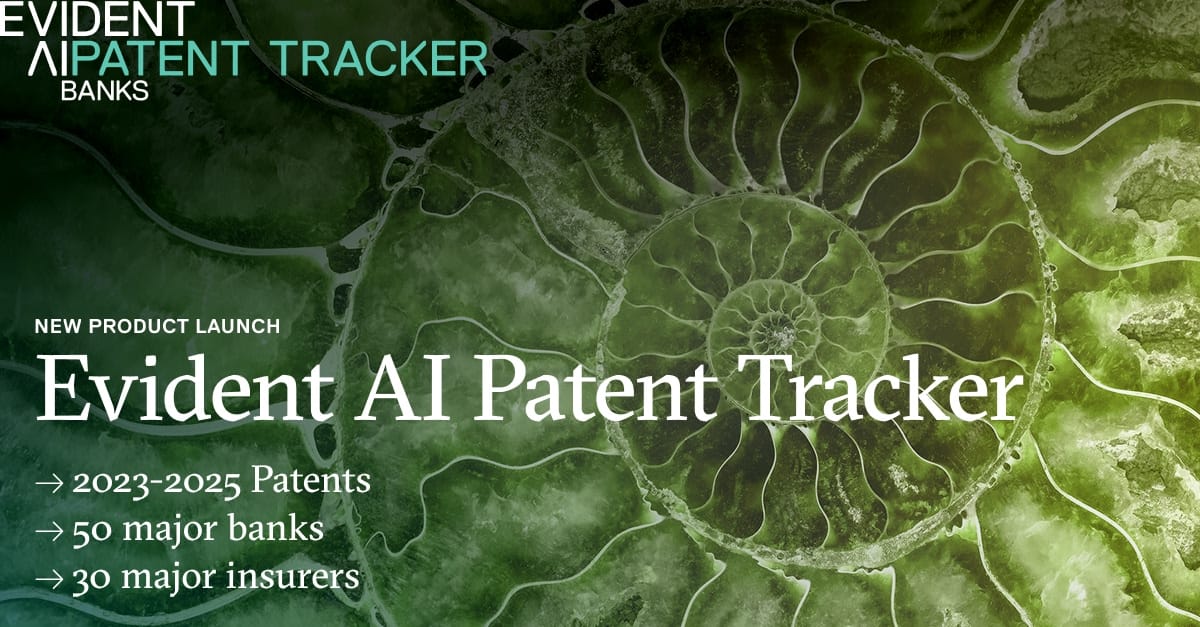
How are the world’s leading banks and insurers powering their AI strategies by advancing and protecting IP? In November we launched the Evident AI Patent Tracker, our member-only database of 1500+ AI patents filed by 80 major banks and insurance companies, alongside our analysis of the latest trends in how patents contribute to firms’ AI strategies.

USE CASE CORNER
KYC ON AUTO
If you go looking for KYC use cases in the Evident Use Case Tracker – our database of banks’ publicly-disclosed AI tools – you won’t find too many. That’s not for lack of interest. KYC is among the top areas banks want to automate because it can clearly unlock value. Every extra day spent verifying documents is another day the bank can’t bring in new funds and put them to work.
Wading through documents and pulling out the right information is well-suited for AI. But for complex clients that span geographies and have more complex financials automation proves a challenge. The human judgement and the nuance that goes into understanding how documentation from around the globe fits together is hard to build into a tool. The top banks can automate about 40% of the KYC process, but most can't do continuous KYC yet. That kind of monitoring and automation is critical in the year ahead. But they'll need to constantly iterate and rethink their workflows. In this week’s “Corner” we offer a case study from payments platform Stripe, which shows banks a way to deal with KYC bottlenecks.
Use Case: EDDie
Vendor: AWS
Bank: Stripe
Why it’s interesting: Stripe's human analysts struggled with two big things when doing KYC work: Analysts were wasting too much time gathering data and had “cognitive overload” when evaluating clients in different countries: “For each jurisdiction region, it requires a completely different mindset to decide what constitutes a risk…the definition of a safe business is not static,” said Chrissie Cui, Stripe’s head of ML data, observability and agentic infrastructure at last week's AWS Re:Invent conference. By offloading the heavy research to an agentic system, Stripe freed up analysts to make the judgment calls.
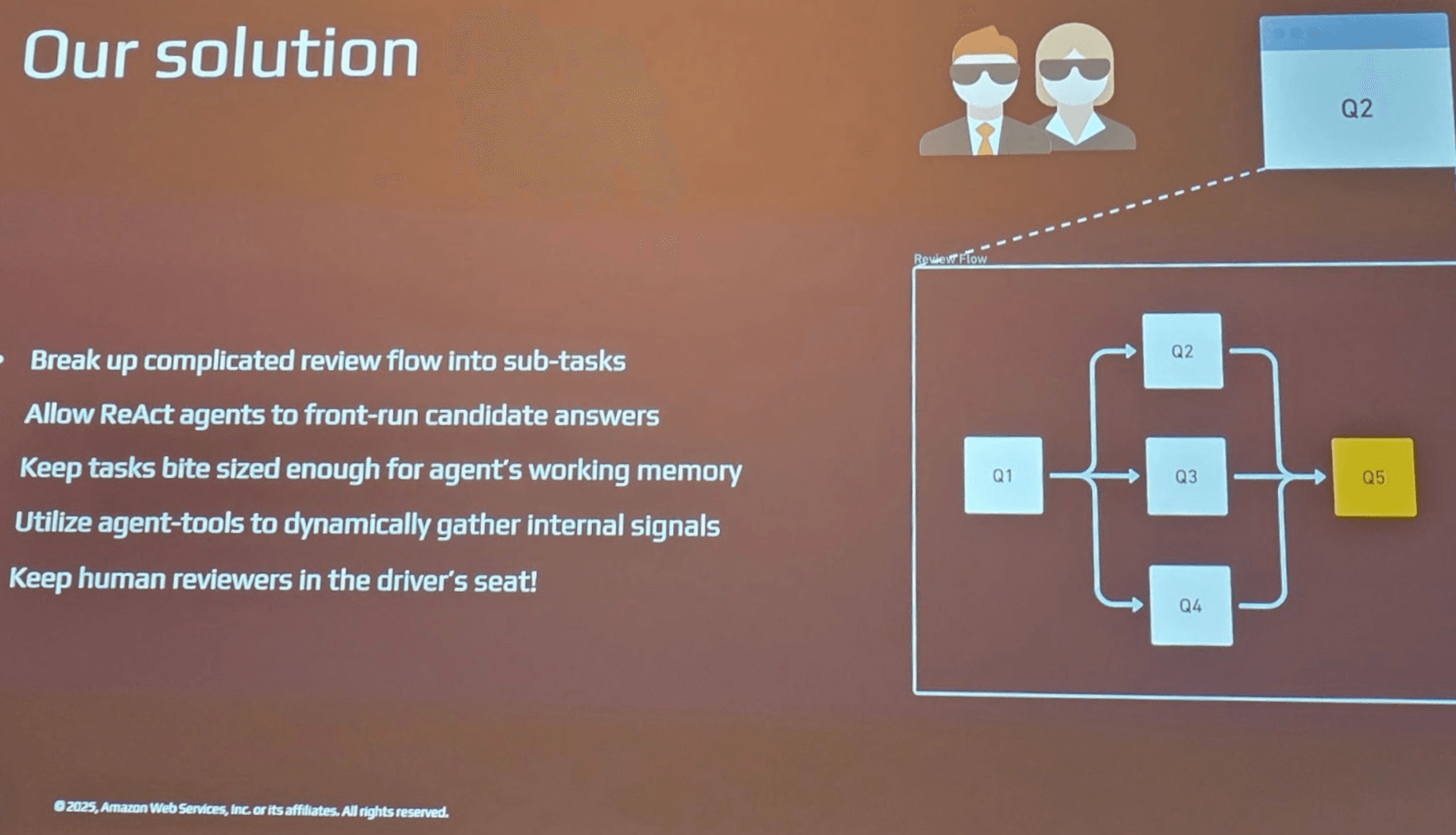
How it works: Stripe broke the KYC workflow into “bite size tasks size to actually fit in the agent’s working memory,” said Christopher Phillippi, a data scientist at Stripe. A swarm of agents can then do parallel processing, meaning it can “look into different aspects of the business in parallel, instead of sequentially like a human would do,” Cui said. Stripe uses “ReAct” agents – non-deterministic agents that decide what tools to call and which data to fetch – so they can troubleshoot messy parts of cases themselves instead of relying on strict operating rules. Humans then only need to intervene on the truly tricky judgment calls.
How they did it: Stripe had a working prototype within a month, Phillippi said, but it didn’t really fit within Stripe’s existing infrastructure. Their systems weren’t built for long agentic workflows like this. Engineers asked if “30 seconds” was a long enough timeout (how much time a tool is allowed to spin its gears before giving up).“We’re gonna need five, 10 minutes,” said Phillippi. Instead of trying to wedge the agents into their legacy system, they set up an “agent service” designed to handle this kind of work. “Do not be afraid to build new infrastructure, especially for agents,” he said. With that infrastructure, the team built traceability into the tool, so that every time it was used, they got a log of what decisions it made. And, to make sure costs didn’t spiral, they used Amazon Bedrock for “prompt caching” – a trick that prevents agents from wasting resources doing the same tasks over again from scratch. Still though, the main hurdle was making sure the KYC team actually trusted it. “It’s not just the agent unfortunately,” Phillippi said. “I wish it was that easy.”
By the numbers: KYC workers at Stripe say the agents are helpful 96% of the time, and they reduced case handling time by 26%, Phillippi said. That lets the analysts review three times the number of cases they could before the tool launched.
Want to know more about the specific ways banks are rolling out AI? Check out our Use Case Tracker – the inventory of all the AI use cases announced by the world’s largest banks available to members.

STAT OF THE WEEK
.png%3FupdatedAt%3D2025-12-10T22%3A39%3A05.323Z&w=3840&q=100)
The share of LLM prompts where a model gets asked to use a tool instead of just generating an answer, according to a new report from OpenRouter, a firm that operates an API that lets users access AI labs’ models. The company’s analysis of 100 trillion tokens-worth of AI interactions shows just how fast agentic has grown: When it did a similar analysis in January, the share was 0%. The growth reflects how banks are using tools: At this time last year, the 50 banks we track had only released two agentic use cases. That’s now grown to 25, according to the Evident Use Case Tracker.

Want to speak directly to tech decisionmakers at the biggest banks around the world? Our highly-engaged audience of more than 20,000 subscribers includes CIOs, CDAOs, CTOs and CEOs of the top banks and financial services companies. Sponsorship for 2026 is now open; secure your spot today.

IN THE NEWS
BNY RAMPS UP
BNY deepened its partnership with Google this week, announcing that the bank would embed new Gemini models into its AI platform, Eliza. The move “strengthens our multi-model strategy and accelerates the rollout of agentic AI across the firm,” wrote Sarthak Pattanaik, the bank’s chief data and AI officer, on LinkedIn. It’s another win for Google, which sent OpenAI into a “code red” last week after Gemini 3 smashed academic benchmarks. And it’s a public embrace of model agnosticism for BNY, which signed a multi-year partnership with OpenAI earlier this year (see: “Age of promiscuity,” The Brief, May 29).
As you read above, RBC talked up AI’s enterprise value during earnings; it wasn’t the only Canadian bank to do so as results season kicked off: TD Bank said it implemented 75 AI use cases that generate $170 million in value. Next year, the bank expects that value to grow to $200 million. Others pointed to adoption: BMO said 80% of employees are now active users of AI tools, though the bank didn’t specify if they were monthly, daily or weekly.
UBS launched the Oxford-UBS Center for Applied Artificial Intelligence, a new 20-person lab at the University of Oxford’s Saïd Business School “to foster pioneering AI research and develop practical tools and solutions that can be implemented at scale across our firm,” said Mike Dargan, the bank’s chief operations and technology officer. It’s the latest bank to push deeper into campus life as they woo tech talent: BNY established a similar lab with Carnegie Mellon in September. Want more on AI research? Evident’s Research Tracker shows how banks are building research capacity and compiles all the research they’re putting out.
CommBank launched a new program with OpenAI to help small businesses in Australia use AI. It comes as the fourth-ranked bank in the Evident AI Index makes a broader push to court new business lending clients and improve its market share.
Banks aren’t the only financial institutions leaning into AI platforms. This week reinsurance company Swiss Re announced that it will partner with Palantir to build an AI platform that can “convert its extensive data holdings into actionable insights.” The announcement to buy instead of build comes as new data from Menlo Ventures shows that 76% of enterprise AI solutions are now bought as opposed to built internally, up from 53% last year.

NOTABLY QUOTABLE
“If you have $100 to spend right now…I would spend 90 of that [on education] before I would even spend it on building any technology”
– Jeff McMillan, head of firmwide AI at Morgan Stanley, on a podcast, Dec. 4

TALENT MATTERS
SYSTEMS RETHINK
Paul Truax joined JPMorganChase to lead servicing technology. He previously led “a 205-person engineering organization at Amazon,” where he “applied AI/ML at industrial scale,” he wrote on LinkedIn.
Donald MacDonald, head of the group data office at OCBC, left the Chinese bank to launch an advisory firm. MacDonald walked us through the Bank of Singapore’s agentic KYC use cases last month (see: “Follow the money,” The Brief, Nov. 6).
Lena Mass-Cresnik joined Rockefeller Capital Management as head of AI strategy. She was previously the global head of Gen AI strategy and acceleration at AWS and served as Moelis’ chief data officer before that.
Barclays elevated Peter Lloyd-Brown to managing director and head of cloud programs. He has been with the bank since 2018.
WHAT'S ON
Mon 19 - Fri 23 Jan
WEF, Davos, Switzerland
Weds 4 - Thurs 5 Feb
AI & Big Data Expo, London
Weds 18 - Thurs 19 Feb
CDAO Financial Services, New York, NY
- Alexandra-Mousavizadeh|Co-founder & CEO|[email protected]
- Annabel-Ayles|Co-founder & co-CEO|[email protected]
- Colin-Gilbert|VP, Intelligence|[email protected]
- Andrew-Haynes|VP, Innovation|[email protected]
- Alex-Inch|Data Scientist|[email protected]
- Gabriel-Perez-Jaen|Research Manager|[email protected]
- Matthew-Kaminski|Senior Advisor|[email protected]
- Kevin-McAllister|Senior Editor|[email protected]
- Sam-Meeson|AI Research Analyst|[email protected]
- Jay Prynne|Head of Design|[email protected]
- Marcus Gurtler|Junior Designer|[email protected]

