

DATA-DRIVEN INSIGHTS AND NEWS
ON HOW BANKS ARE ADOPTING AI
2026 AI Index sneak peek

Source: Adobe Firefly
1 October 2026
We’ll be live shortly with Rohan Ramanath, Nubank’s general manager of AI, talking about the ins and outs of its AI operation. Watch here at 11:30 a.m. EDT. Also, don’t forget to register for the webinar we’re doing with Nvidia next Thursday on platform architecture and AI’s enterprise impact.
This week in what someone wants to call the “SI” world: We preview what makes a winner in next week’s Evident AI Index for Banks. Then, how banks are fighting back against disruptive agents. Plus: We get the inside story on Bank of America’s big AI ROI reveal.
People mentioned in this edition: Gill Haus, Nastassja Hagan, Saul Van Beurden, Brian Moynihan, Torsten Slok, William Chalmers, Eric Young, Don Vu, Sigrid Rouam, Nelli Zaltsman, Bir Abhimanyu, Armando Benitez, Elizabeth Iwasawa, Javier Morillas, Rajah Chacko, Paolo Molesini and others.
This edition is 1,905 words, a 6-minute read. Check it out online. If you were forwarded the Brief, you can subscribe here.
– Alexandra Mousavizadeh & Annabel Ayles

FROM THE EVIDENT AI INDEX
2026 SNEAK PREVIEW
You’ll need to wait until Tuesday to see who leads our annual ranking of the top 50 banks on AI (sign up here to get it directly in your inbox). But we can tell you this: It’s a tighter race than ever.
The spread between the score of the top-ranked and the 10th-ranked bank is 25% smaller than it was last year, our data will show. The average gap separating each firm has shrunk by nearly 10%. To put that progress in perspective: This year’s 20th-ranked bank has a score as high as last year’s 10th-place finisher.
Banks have hit the gas in the last 12 months, making some of the old hallmarks of a good AI bank – say, a big team or a long list of use cases – less useful for telling who’s really ahead. At the top today, the distinction is less about how much AI a bank has and more about how much that AI is changing its business.
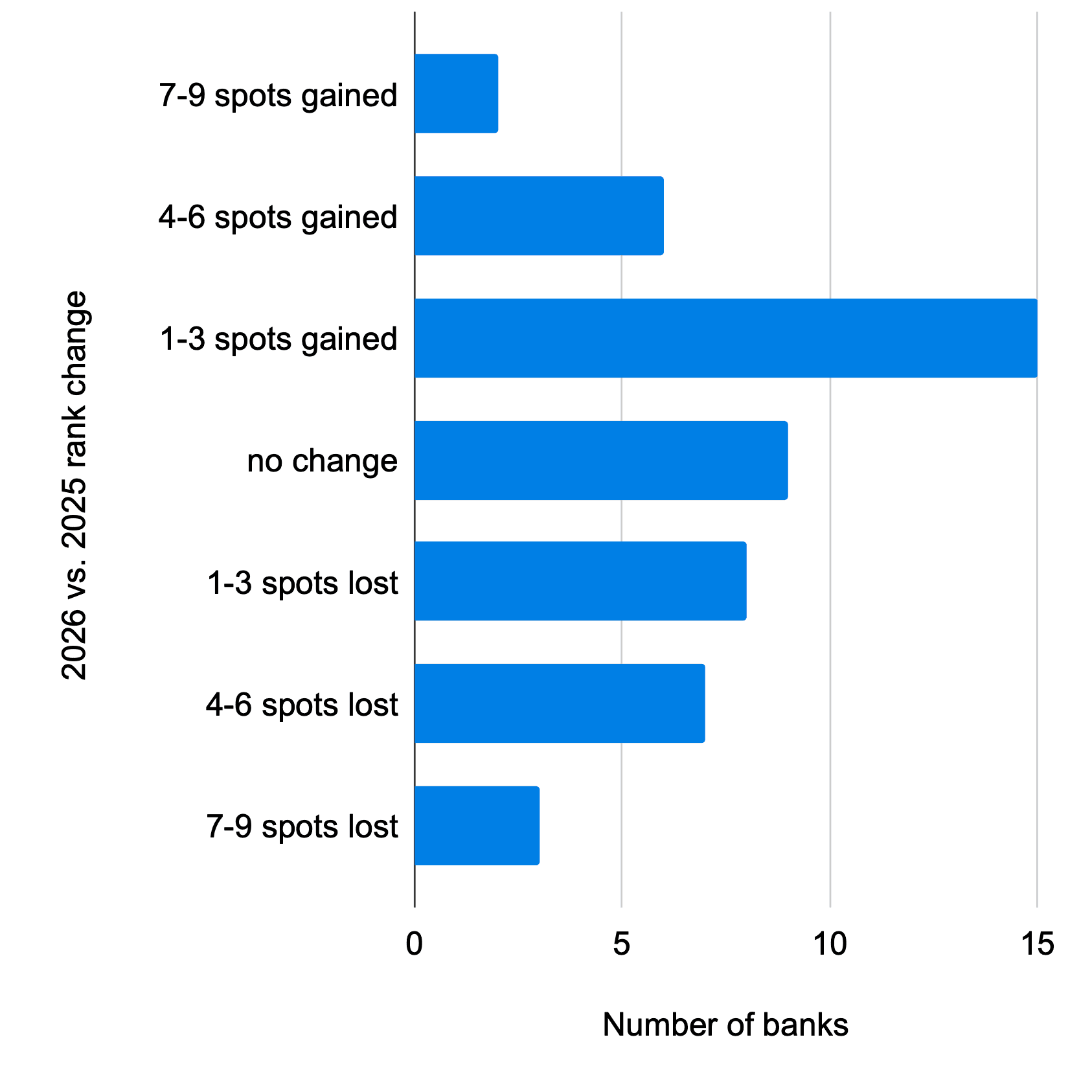
MUSICAL CHAIRS
Of the 50 banks ranked in the Evident AI Index, 15 moved up between one and three places this year.
Leading banks – and our assessments of them – now focus on proving what all the AI investment these past couple of years actually gets them. In engineering, that means “good” isn’t just whether developers can use tools to complete their code, automate testing or write up documentation. The bar is whether those tools are helping them clear backlogs faster and, increasingly, whether the tools banks build can handle whole tasks from start to finish. At each of the top three banks (which we’ll reveal Tuesday), more than 80% of engineers use AI tools like these regularly. And six of the top 10 can now put a specific number on how much time they’re getting back, giving a clearer picture of the capacity AI is actually adding.
“There are many things that we just leave on the floor that we would love to get to,” said Gill Haus, CIO of the consumer banking arm at JPMorganChase, the top finisher in our Index last year. “Now we can get to more of that.”
The same shift is playing out across the wider workforce. A year ago, banks were handing out copilots that could draft emails, summarize documents or prep employees for meetings. This year has shown which ones were good enough to stick. At each of the top three banks, more than three-quarters of staff use one regularly. And four of the top five have put a number on the time those tools are saving.
“People don’t view AI as optional, and we’re not really having to establish that it’s important,” said Nastassja Hagan, head of applied AI at BNY. “It’s more about execution of the hard problems where we’re really focused.”
At the heart of this evolution is the so-called AI platform, a kind of central nervous system for AI that lets banks scale faster by reusing code and guardrails and get a better read on usage, performance and cost. At least 14 banks now have one, our analysis shows. That includes four of the five highest-ranked lenders in this year’s Index.
Still, the ultimate test is when – or whether – this all hits the bottom line. On that, there’s still work to be done. Banks have rolled out roughly 1,100 use cases that show some kind of impact in the last five years, our new analysis shows. Just 1% of them show a specific financial benefit. The tide may just start to be turning, though: This year’s top 10 accounts for half of that tiny sliver of tools.
“We want to give you the keys of the use cases that you think you need to do,” said Saul Van Beurden, head of AI at Wells Fargo. “But you need to show to us that these are the highest-impact use cases in terms of ROI.”
LIVE EVENT | OCTOBER 13
EVIDENT AI INDEX | BANKS 2026 | RESULTS

Five editions in, how far has AI in banking come, and who's leading the way? Join our virtual roundtable with the team behind the Index, Alexandra Mousavizadeh, Colin Gilbert, and Daniel Shackleford, as they walk through the 2026 results, including how the world's largest banks are scaling AI, what's changed in the past year, and what sets the leaders apart.

STAT OF THE WEEK

That’s the annual value Bank of America has created from Gen AI on a $400 million investment, CEO Brian Moynihan told investors. It’s not stopping there: “We expect to double the expense budget for it next year,” Moynihan said. The firm now has 130 Gen AI use cases in production, up from 114 in July, when the bank last reported earnings (see: “Between the bottom lines,” The Brief, July 16). The returns coming in are a combination of revenue gains and cost savings, according to the company.
Zoom out: Bank of America is now the 13th bank in the Evident AI Index for Banks to report realized or projected returns from its AI portfolio, up from eight at this time last year. Lloyds took a similar approach of breaking out Gen AI value earlier this year: The U.K. lender estimated it would generate some $133 million in 2026 – roughly 0.5% of its 2025 revenue. Bank of America’s equivalent figure is about 0.7% of revenue, around 40% higher. With its announcement, Bank of America becomes one of the only banks to say publicly that it’s in the black: A year ago Jamie Dimon said JPMorganChase had broken even. CommBank said it would achieve that if it hit its AI targets next year (see: “Bare ROI,” The Brief, Aug. 13).

TOP OF THE NEWS
BANKS VS. AGENTS
There’s been plenty of news recently about AI behaving badly. Banks may have just as much to worry about when agents do exactly as they’re told, Torsten Slok, chief economist at Apollo, warned this week.
The risk is that agents – like Meta’s Muse or OpenAI’s dots – eventually get trusted to manage people’s money, hunt for higher rates and move money to accounts that give customers a better return. That, in turn, could drain banks of the cheap deposits they rely on to fund loans. And, in the extreme, trigger a bank run.
There’s a long way between where AI adoption stands today and the threat Slok describes. But long before any run, customers who previously couldn’t be bothered could be transformed into savvy rate shoppers and take a bite out of banks’ bottom lines.
AN OFFER HE CAN’T REFUSE
Fintechs and neobanks in the U.S. offer higher-interest accounts to customers, which Apollo says agents might be more likely to take advantage of than humans.
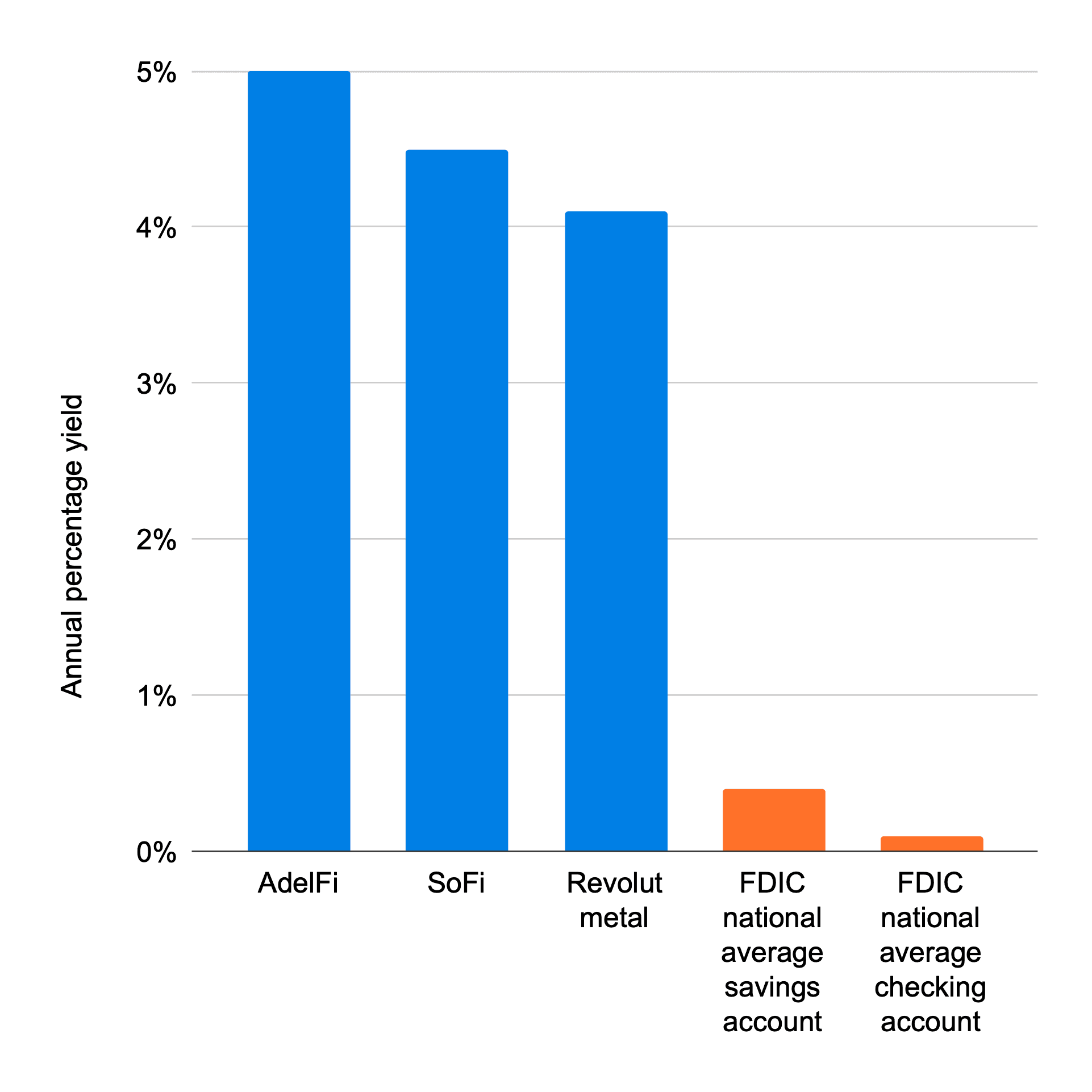
That’s pushing banks to find new ways to avoid being what Goldman Sachs now calls “consumer inertia” companies – firms that benefit from customer laziness. At Lloyds, that means becoming more attractive to their clientele, agentic or not. AI will surely make rate-shopping easier, CFO William Chalmers told investors two weeks ago. “Our response to that, of course, has to be to offer value,” he said. That means making pricing more competitive, but also upping security, creating AI-enabled reward programs and personalizing pricing, he said.
JPMorganChase, meanwhile, is trying to beat the third-party agents to the punch. The bank, as CEO Jamie Dimon has touted multiple times this year, is building a Smart Cash tool designed to move funds between checking accounts and higher-paying investments automatically. Eventually, AI will help predict bills and cash needs as well. It’s a bet that scouring its own four walls for the best offers will be enough to keep customers from looking to outside agents for help.
Still, this is all some ways away. A recent Experian survey found that 54% of respondents were comfortable with agents applying for credit on their behalf, but just 5% would give them full autonomy. And 75% would feel more comfortable using AI connected to a financial institution they already trust.
That attitude gives banks some breathing room. But it doesn’t mean customers will always go to their bank directly to manage their financial lives in the future (just ask China). It’s up to banks to use the head start the public is affording them to remind customers why they were loyal in the first place.
“I think the experience of downloading a bespoke app for everything you need to do in your life is not the feature that lasts for the long term, and I think the reality is agentic interfaces,” said Nubank CTO Eric Young this week. “But we think to do this in the financial services space, the brand has to have deep trust.”
HAPPENING THIS MONTH
THE 2026 EVIDENT AI SYMPOSIUM

This month, join the sharpest minds in technology and finance in New York City on October 22 as we tackle what it actually takes to deploy AI across global financial institutions today, and surface the trends shaping what comes next.
Take a look at the speakers announced so far, and check out the full agenda.
.svg&w=96&q=80)
TALENT MATTERS
JPMORGAN HIRING SPREE
Don Vu joined JPMorganChase as head of applied AI for the Payments and Global Banking unit. Vu had been chief data and analytics officer at New York Life until March of this year. It’s not the only hire the payments unit made: Nelli Zaltsman joined the AI transformation team as an executive director. Zaltsman spent the past eight years working on blockchain at the bank.
Sigrid Rouam joined JPMC as APAC head of AI capability. In the role she’ll “focus on translating our regional business needs into developing innovative and practical, AI solutions to address those needs,” she wrote on LinkedIn. She was previously global chief AI officer at EFG Private Bank in Singapore and served as global head of data science and analytics and AI solutions at Credit Suisse before that.
Bir Abhimanyu is now head of enterprise data solutions at Nordea, where he’ll be “working to enable enterprise data by enabling data products, and automating governance, data quality, lineage, and help enable runways for AI capabilities,” he wrote. He’s been with the bank for nearly eight years and was previously working as the data product hub lead.
BMO Capital Markets appointed Armando Benitez its new global head of AI. Benitez had previously been chief data and analytics officer and head of AI for the business.
Australian banks are all in on scientists: NAB named Setu Chokshi its head of AI science. He was previously a senior engineering manager of the AI platform at Zendesk. In April, NAB put McKinsey vet George Mathews in charge of a new AI science unit. And CommBank named Mary-Anne Williams its first chief AI scientist in May (see: “It’s academic,” The Brief, May 21).
RBC hired Elizabeth Iwasawa as director of quantum, where she'll “lead a team of quantum researchers and developers and manage the development and buildout of the bank's quantum strategy,” the bank said in a release. The bank also signed two academic partnerships – one with the University of Waterloo’s Institute for Quantum Computing and one with the University of Toronto – to set up talent pipelines and foster research initiatives.
Javier Morillas is now head of AI platform security at BBVA. He’s been with the bank since 2023 and has worked as data security architecture team lead. Prior to that, he was a security consultant for AWS.
Rajah Chacko is now AI dev lead at Wells Fargo, “leading the development of AI-driven pipelines to streamline and automate bankruptcy processing workflows,” he wrote. He was previously a senior software development engineer at Bank of America.

NOTABLY QUOTABLE
“We spend a lot of time talking about the risks of AI, but not enough time talking about the risk of people not using it. Many teams still suffer from what I call Stockholm Syndrome with spreadsheets. We know the process is manual. We know it's inefficient. Yet we stick with it because it's familiar.”
–Colin Wan, head of internal audit at OCBC Malaysia, on LinkedIn, Sept. 27

IN THE NEWS
AI BANK HEIST
Voice AI may have finally broken through – just not in the way vendors pitching the tech to Wall Street would’ve hoped. Reuters revealed this past week that fraudsters had made off with more than $100 million from Intesa Sanpaolo’s private banking arm, Fideuram, thanks to a voice AI scam. Back in February, Paolo Molesini, then-chairman of Fideuram, got a WhatsApp message from someone impersonating Intesa Sanpaolo CEO Carlo Messina asking for urgent help on an overseas transaction. Then, using AI, the fraudsters cloned the voice of a senior partner at a law firm and called Molesini repeating the instructions. Molesini bought it and transferred the funds to a series of foreign accounts. In the months since, authorities have recovered some $60 million of it – but it’s a reminder that these kinds of social engineering attacks can leave even people who know each other vulnerable. “Criminals are increasingly using technologies such as generative AI to create more convincing impersonation, phishing and social engineering attacks, making fraud harder to detect and easier to scale,” Julie Gerdeman, executive platform owner, global payments and trade at BNY, said this week.
Barclays and Anthropic signed a new partnership that will expand Claude access across the bank. Barclays expects Claude Code adoption among developers to hit 50% by the end of this year, “rising to a majority of software engineers in 2027,” the bank said. Bank engineers have been using Claude indirectly through its Colleague Knowledge Assistant, a tool that helps pull policies and data, since 2025. It’s the 12th strategic AI agreement between a bank and an AI lab or hyperscaler signed this year, forthcoming analysis from Evident will show. It follows last week’s tie-up between TD Bank and Cohere (see: “Canadian Wedding,” The Brief, Sept. 24).
HSBC rolled out a new way for outside agents to access banking data, called HSBCnio. The bank’s corporate and institutional clients can now use their own agents to check cash balances or track payments, the bank said. It works a bit like an API for agents and means clients can use their AI of choice rather than requiring HSBC to roll out its own tool. Vipul Patel, head of programs and readiness at HSBC, said that gives clients more freedom over how they can use their data. “The Walkman took music out of the living room and put it in our pockets. The next evolution of banking is similar: taking banking out of the bank and bringing it into the flow of business,” he said. “That's my thinking about HSBCnio.” It’s not the only bank to open the door to outside agents: Morgan Stanley over the summer gave clients’ agents permission to access data from their employee stock compensation plans.
WHAT'S ON
Weds 7 Oct.
Bank of America Technology Innovation Summit, San Francisco
Thurs 8 Oct.
From Announcement to Adoption: The Real State of AI in Banking, Virtual
Thurs 22 Oct.
Evident AI Symposium, New York
Sat 14 Nov. - Tues 17 Nov.
ICAIF - ACM International Conference on AI in Finance, Milan
- Alexandra Mousavizadeh|Co-founder & CEO|[email protected]
- Annabel Ayles|Co-founder & co-CEO|[email protected]
- Colin Gilbert|VP, Intelligence|[email protected]
- Matthew Kaminski|Senior Advisor|[email protected]
- Kevin McAllister|Senior Editor|[email protected]
- Daniel Shackleford Capel|MD, Banking|[email protected]
- Maryam Akram|Senior Research Manager|[email protected]
- Alex Inch|Data Scientist|[email protected]
- Sam Meeson|AI Research Analyst|[email protected]
- Gabriel Perez Jaen|Research Manager|[email protected]
- Jay Prynne|Head of Design|[email protected]
- Marcus Gurtler|Junior Designer|[email protected]

