

DATA-DRIVEN INSIGHTS AND NEWS
ON HOW BANKS ARE ADOPTING AI
'Agentflation'

Source: Adobe Firefly
16 July 2026
This week in the Banking Brief: Four takeaways from the start of earnings season. Brazilian banks are using AI to combat the country’s dicey economic situation. And Morgan Stanley is using AI to gauge the blast radius of its code changes.
People mentioned in this edition: Jamie Dimon, Charlie Scharf, Brian Moynihan, Mark Mason, Jane Fraser, Tushara Fernando, Sergio Ermotti, André Duarte Oliveira, Alisha Lehr, Jacki McKinnon and others.
This edition is 1,894 words, a 7-minute read. Check it out online. If you were forwarded the Brief, you can subscribe here.
– Alexandra Mousavizadeh & Annabel Ayles

TOP OF THE NEWS
BETWEEN THE BOTTOM LINES
In this week’s monster earnings, executives offered fresh clues about how the tech is remaking the banks. Here are our four takeaways:
#1 DIMON SAYS: JPMorganChase CEO Jamie Dimon is breaking with his peers on AI. First, on whether the tech itself will give banks a lasting edge. On BNY’s call, CEO Robin Vince called AI “an increasingly important source of differentiation.” Dimon’s view: “You don’t uniquely benefit from AI” because competitors will have access to the same underlying models.
He’s also taking a different line on AI cash management. Analysts have pointed to a threat that a third-party tool may one day choose to pull customers’ money out of banks in search of better deals. U.S. Bank CEO Gunjan Kedia has brushed the threat off, saying that the “noise is far outpacing any observed behavior,” at an investor event earlier this year. PNC CEO Bill Demchak said a tool like that “sounds like somebody made that up on a sound bite,” at the same event. JPMC, meanwhile, is developing Smart Cash, its own agentic tool that will automatically move money between accounts and investments to maximize their returns. “You’ll see something this year,” Dimon told analysts on Tuesday.
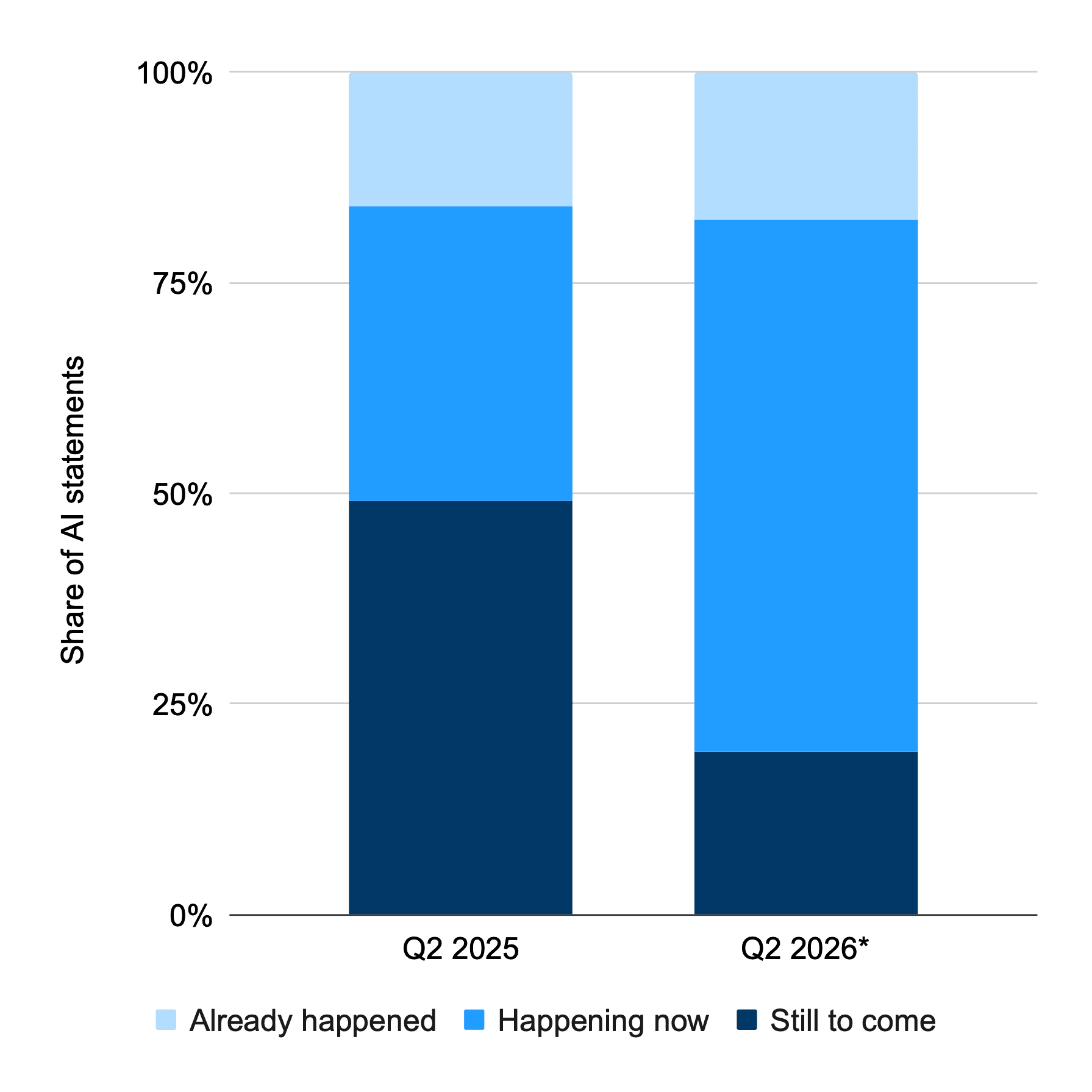
#2 PRESENT TENSE: Leading banks have been talking about AI as something that is changing their business rather than something that will for some time. The rest of the field is catching up. We used AI ourselves to sort every statement executives made about the tech by the tense they used: promises for later, work happening now or results already showing up. A year ago, about half landed in the “still to come” bucket. This quarter, that’s down to 20%.
Last July, Citi CFO Mark Mason said some productivity “will be enabled by AI.” This week, CEO Jane Fraser said AI is “helping us bring products to market significantly faster.” Bank of America made the same jump. “We’re starting to see, at the beginnings, the AI practices that we develop pay off,” said CEO Brian Moynihan a year ago. This week, he pointed to 114 Gen AI tools already live around the bank which “improve productivity, consistency, and client service” for relationship managers, bankers and coders.
HERE AND NOW
The share of AI statements in this quarter’s U.S. earnings calls that were made in the present tense nearly doubled compared to last year.
#3 DUALITY OF MAN(POWER): Top-line headcount is becoming a messy indicator of how much AI is reshaping bank workforces. Of the eight U.S. lenders in the Evident AI Index for Banks that have reported earnings, half grew their headcount in the last year and the other half shrank it. Those that grew: JPMorganChase, Goldman Sachs, Morgan Stanley and PNC.
There are more signals pointing to AI as a job creator: Jamie Dimon said JPMC hollowed out some teams by as much as 40% through AI use, but he moved those affected to different jobs so the bank could do more. The bank’s headcount is up 1% in the last year. Wells Fargo, on the other hand, cut 7% of its workforce in the last year. But CEO Charlie Scharf made a point that the firm was still “adding branch bankers, investment advisors, commercial banking relationship managers, investment bankers, and traders,” despite the cuts. “It’s not a moment for a structural rework of our human capital footprint,” said Goldman Sachs CFO Denis Coleman during the bank’s call. “It’s a moment to invest and utilize this new technology.” Translation: As CEO David Solomon wrote in May, AI will be a job creator – not the apocalypse that Anthropic CEO Dario Amodei warned of (and has since walked back).
#4 TOMORROW, TOMORROW: Banks’ actions still haven’t caught up with their words when it comes to agentic AI, our new analysis shows.
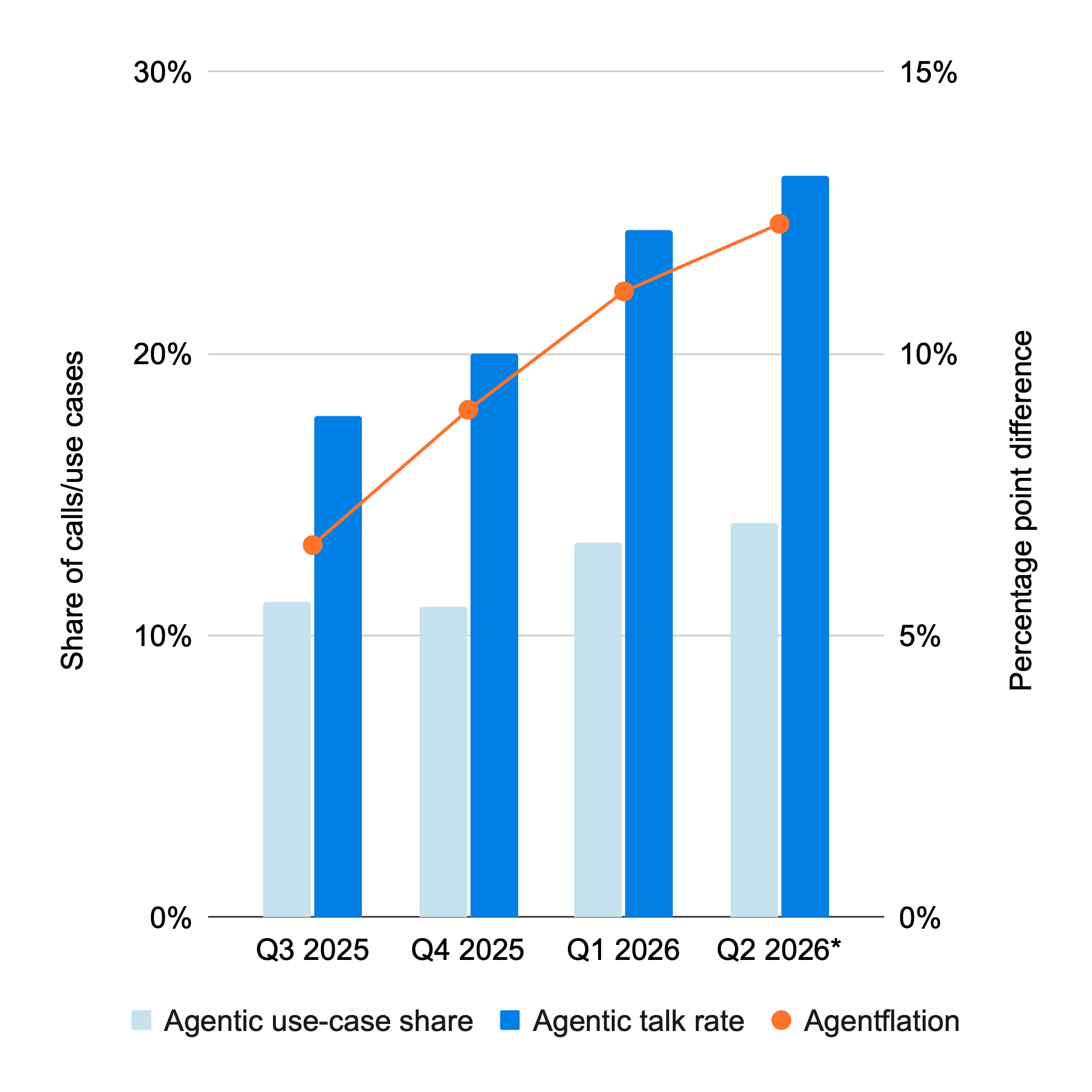
We wanted to measure how far the agentic sales pitch has run ahead of the rollout. To get a read on the rhetoric, we used an LLM to go through the earnings calls of 15 U.S. banks in the Evident AI Index dating back to the beginning of last year. Agentic AI is still new, so one noisy earnings season could throw off the picture. Instead, at each point in time, we looked across calls from the quarter and the two before it, calculating the share where banks discussed agents. Then we looked at what percent of those 15 banks’ public use cases were agentic. The difference between those two numbers is a newly-created (and slightly tongue-in-cheek) metric we’re dubbing “Agentflation.” As the chart below shows, it’s on the rise: The difference between the share of calls mentioning agents and the share of tools using them has doubled in the past year. That may not matter while banks are making money hand over fist, but the more the tools lag the talk, the harder the questions about value will eventually become.
WORDS NOT DEEDS
Our “Agentflation” metric shows the gap between how much banks talk about agentic AI and how much they roll out has gotten almost twice as wide in the last year.
LAUNCHING NEXT WEEK
EVIDENT AI INDEX FOR BANKS - LATIN AMERICA

On 21 July we’re launching our inaugural AI Index for Banks in Latin America, ranking the 20 largest banks across the region. Who’s leading the race? What’s holding others back? And where does the real opportunity lie? Explore the banks featured in the Index, and register now to get the results straight to your inbox on launch day.

LATIN AMERICA
EXTRA CREDIT
Brazilian banks are leaning harder into AI to manage credit risk than lenders globally, according to new analysis in the Evident AI Index for Banks - Latin America, out next week. With debt adding up for businesses and consumers alike, they’re about to find out how good those systems actually are.
Brazil is the only Latin American country where the number of businesses and consumers falling behind on their loans is growing simultaneously, a report from UBS BB last month found. More than 3% of corporate loans are now more than 90 days overdue, more than double the closest comparable U.S. rate. Brazilian consumers are also spending 30% of their income servicing debt, an all-time high.
That fraught situation is the backdrop for one of the region’s biggest AI pushes. Banco Bradesco and Itaú Unibanco, two of the biggest banks by assets, account for more than half of the public financial risk management use cases rolled out by the Latin American banks in our Index. Following Nubank’s lead, the incumbents’ bet is that better models can help them keep lending without letting losses run away.
RISKY BUSINESS
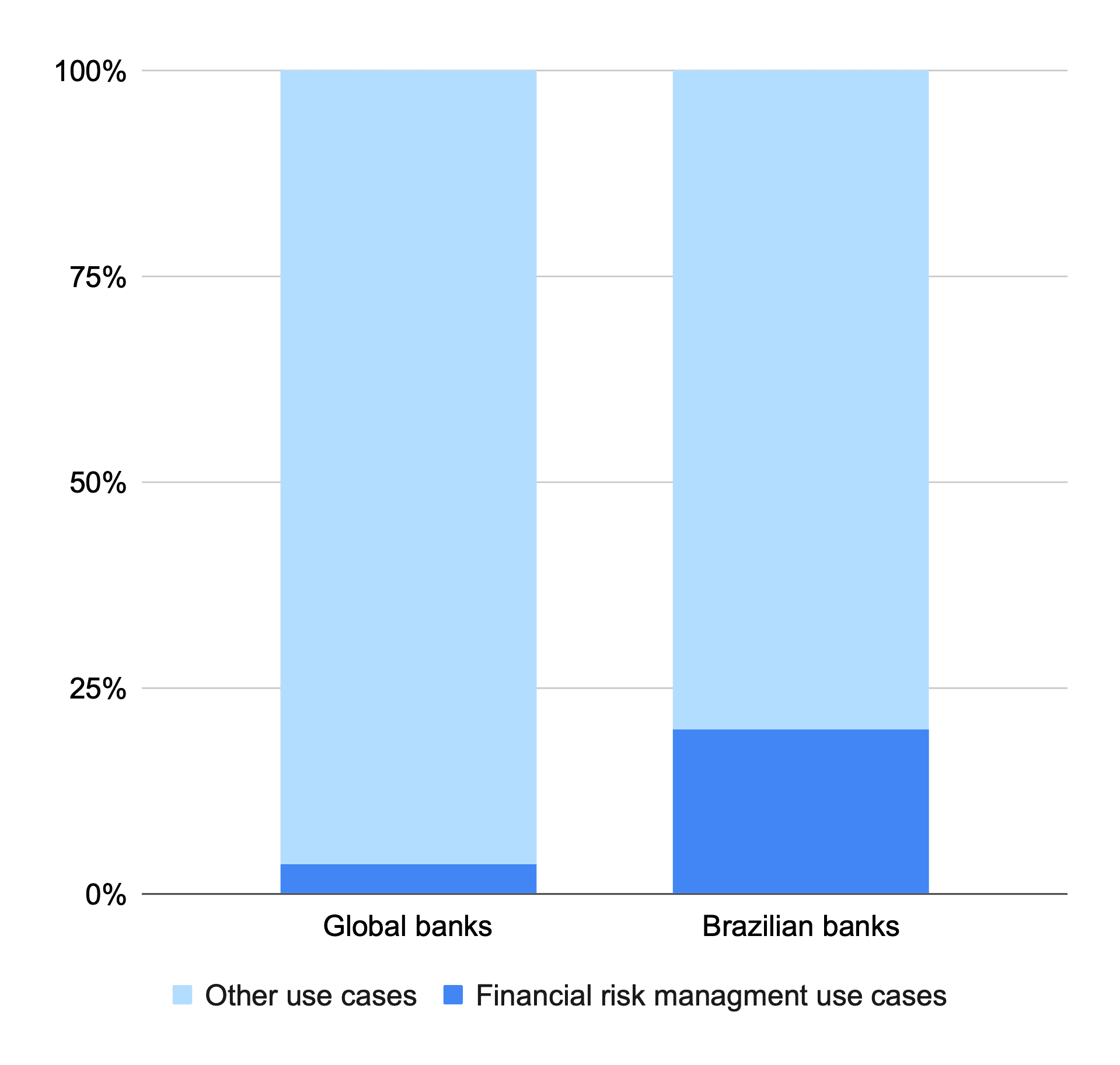
Risk management use cases make up 20% of Brazilian banks’ AI portfolios, compared to just 4% for the 50 banks in Evident AI Index for Banks
Bradesco’s approach shows how. The bank built an Income Estimation Model to avoid needing to take customers at their word as they apply to borrow money. The tool looks at transactional data, credit history and other signals to predict a person’s net income and repayment capacity. Using AI in credit modeling will produce at least $50 million in financial benefits for the firm, André Duarte Oliveira, Bradesco’s head of credit, said earlier this year.
Itaú’s approach has been to go directly to an AI lab to help sharpen its models. The bank invested in NeoSpace, a Brazilian startup building foundation models for finance. One of the flagship products is a credit model that has been shown to improve accuracy by 30 to 50% compared with traditional approaches by producing more consistent predictions of customers’ abilities to pay money back. As part of the deal, the bank got exclusive use of NeoSpace’s AI for a year.
In the last year, both Itaú and Bradesco grew their loan books by 9%, their earnings reports show. The rates of non-performing loans at each bank have remained stable. There’s not proof yet that AI deserves the credit. But if the country’s financial condition worsens and the incumbents’ loans hold up better than their peers’, the case gets stronger.
NEXT WEEK: We’re launching our inaugural Evident AI Index for Banks - Latin America, covering 20 lenders across the region. Register your interest to be the first to read the report.

NOTABLY QUOTABLE
“For the first time, the personalities and approaches of the leading models are diverging in significant ways…you can no longer just drop in the smartest model into a harness and expect it to behave similarly to any other model of similar ability levels. This is starting to look a lot more like hiring for a role.”
– Ethan Mollick, co-director of the Generative AI Lab at Wharton, on LinkedIn, July 11

PAT SIGNAL
BUTTERFL-AI EFFECT
In this segment, we explore how a bank’s patent advances its AI strategy. This week: Morgan Stanley’s patent (granted July 2026) for an AI-powered search system shows engineers just how far their code changes will travel around the business.
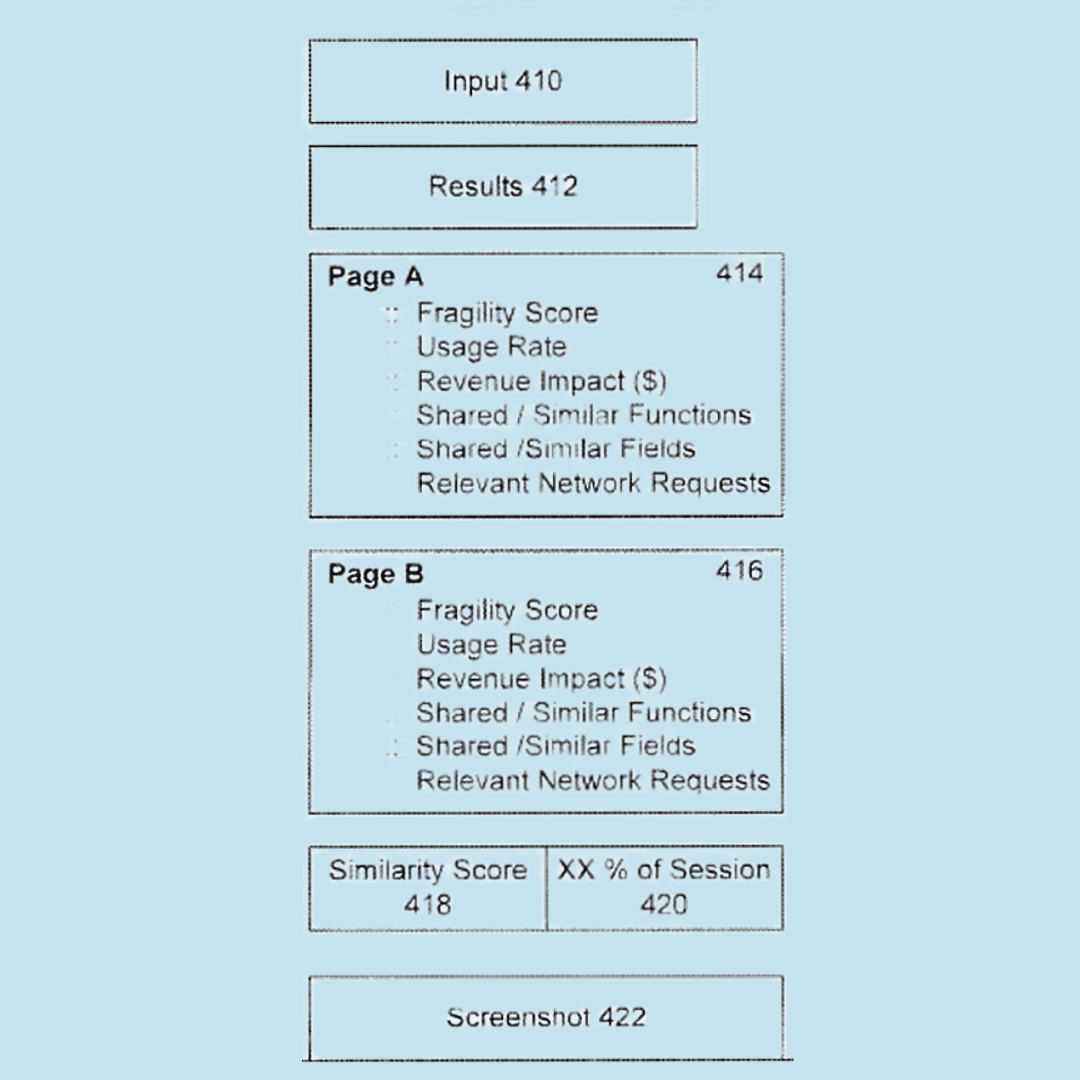
The patent, explained: AI coding tools can write new code in seconds, but working out what that code might break is much harder. A small change can upend a trading system, customer deposit service or application. Morgan Stanley’s system maps the blast radius before a change goes live. As applications are tested, the system builds up a picture of how they work, linking each page and action to what happens behind the scenes. Engineers can then see what will be affected by a change. It works the other way, too: If someone comes across an error, they can upload an image of the issue and the system can trace it back to the code that’s most likely the culprit.
What the bank can do with it: Finding those knock-on effects earlier could help the bank target testing more precisely, fix faults faster and prevent small changes from becoming big failures.
BOOK YOUR SPOT
EVIDENT AI SYMPOSIUM 2026

The Evident AI Symposium is our annual, invitation-only gathering of 300 senior AI leaders in finance. We come together each year to get real answers on how to drive AI transformation forward.
Over the course of the day, we’ll exchange insights on what it takes to deploy AI in global financial institutions today while surfacing the ideas and trends that will define what comes next.

IN THE NEWS
MARKET-BEATING AI
JPMorganChase built AI agents that read market signals and decide how to split a portfolio between stocks and bonds. Tested over two decades, the agents beat a traditional 60/40 portfolio by 0.7 percentage points annually and had less volatility, the bank said. The agents first assess the type of market – Goldilocks, reflation, stagflation or risk-off – and switch how it holds money based on the condition. The catch: Because its performance was based on historical data rather than in a live market, it’s not proof (yet) that AI can consistently outperform the market, the tool’s creators said.
Man Group’s AI token consumption jumped 86-fold since January, Tushara Fernando, head of data and AI, said on a podcast last week. To cope with that growth, Fernando said the hedge fund has found ways to be more efficient, like using tools that sit between a coding agent and a coder that make sure only relevant information gets put into the system. It’s also meant working through the right model for the right task – something it can do more effectively thanks to efforts to add extra data labels and AI instructions to its data. “You take a data set like credit card data, for example, AI can look at that, it can see the columns, it can see the rows, but it doesn’t really understand the nuances of it,” he said. “What we’re having to do is invest in trying to add extra color, extra metadata to that information.” Bridgewater has taken the same approach and cut costs: The firm worked with Thinking Machines on data labels and built an AI tool using the Chinese open source model Qwen that outperformed the frontier labs (see: “Cheap AI’s catch,” The Brief, July 9).
Visa is launching an AI financial assistant it says banks can embed into their apps without any custom development. The bot will send proactive nudges about spending habits and answer customer questions about spending, the firm said. It can also guide customers through actions such as reviewing subscriptions or activating offers. Big banks have been building this functionality into their apps for some time (see: “Comeback kids,” The Brief, April 2). Visa’s offering may give smaller banks a shortcut, but the lead is still defined by how many actions customers can take inside the chatbot experience, and that may be limited if the bot can only control Visa’s part of a customer’s banking experience.
Stripe (#5 in the Evident AI Index for Payments) made a $53 billion offer to buy rival PayPal (#3) The move was initially floated back in February, though PayPal denied being in sale talks at the time. If the offer were accepted, a combined firm that connected Stripe’s infrastructure – the pipes money flows through – with PayPal’s base of more than 430 million merchants and consumers could mount a serious challenge to Visa and Mastercard. The combined entity would also likely top our Index for both AI talent and innovation.

STAT OF THE WEEK

That’s how much more likely coders are to use (and stick with) AI tools at work if more than one-quarter of the people on their team are also using it, new research from Microsoft shows.
Bigger picture: Engineering is one of the places where AI’s results are clearest, but banks are trying to recreate that peer pressure effect across the rest of their firms. UBS this week told all 103,000 employees at the firm to spend one hour per week learning how to use AI. “Wherever you are on your AI journey, this is time reserved for you to learn and use AI in a systematic way directly in your own work,” wrote CEO Sergio Ermotti in a memo. Bank of America in this week’s earnings said 200,000 employees were using AI tools, and Citi said 90% of its staff use its AI tools. Still, getting people to log in is the easy part. The numbers banks need now are how much more business AI helps a banker win, how many more client assets it helps a wealth manager bring in and whether each AI use saves enough time or money to justify its bill.
.svg&w=96&q=80)
TALENT MATTERS
SUMMER SHUFFLE
Alisha Lehr, chief operating officer of firmwide AI at Morgan Stanley, is leaving the firm after nearly a decade. Before her current post, Lehr was head of market innovation and technology business development. She worked on Watson product management and strategy at IBM before joining the bank.
Jacki McKinnon was promoted to head of data and AI practice at Westpac. McKinnon has been with the Australian lender since 2024 in other data strategy roles and spent nearly eight years with CommBank earlier in her career.
David Westera, VP of AI product and research at JPMorganChase, is leaving the firm. He focused on “the productization of AI research within JPMorgan’s AI research division,” he wrote on LinkedIn.
Ally Financial hired Mark Mathewson, CIO of retail, commercial and emerging merchant at Capital One, to be its chief information and data officer, where he "will create the future of AI-driven technological transformation," CEO Michael Rhodes said in the release. He was previously CIO of retail, commercial and emerging merchant divisions at Capital One.
Monzo ex-CEO Tom Blomfield joined Anthropic to work on the compute team. Blomfield has served as a general partner for Y Combinator since 2023.
State Street is hiring a managing director of data platform enablement, Manoj Bohra, the bank’s chief data and AI officer wrote. The job doesn’t focus on just managing systems, but on “solving complex platform challenges, building high-performing teams, and creating an environment where engineers can do their best work,” he wrote.
JPMorganChase hired Zara Davis to be managing director of B2B agentic commerce, where she’s working “to enable AI agents to safely transact on behalf of businesses,” she wrote on LinkedIn. She spent more than a decade at McKinsey.
Coinbase rejigged the way it hires engineers now that nearly all of the crypto exchange’s code is AI-generated, a new blog by the firm revealed. The firm’s new interview process has AI embedded at every step – traditional coding assessments were swapped for tests of how candidates use AI to code and, once candidates reach the final stage, they get an “AI fluency rating” based on how well they use the tech before offers go out.
WHAT'S ON
Tues Aug 4 - Thurs Aug 6
Ai4, Las Vegas
Tues 8 Sept. - Weds 9 Sept.
AI in Financial Services Europe, London
Weds Aug 19
Agentic AI in Finance Summit, virtual
- Alexandra Mousavizadeh|Co-founder & CEO|[email protected]
- Annabel Ayles|Co-founder & co-CEO|[email protected]
- Colin Gilbert|VP, Intelligence|[email protected]
- Matthew Kaminski|Senior Advisor|[email protected]
- Kevin McAllister|Senior Editor|[email protected]
- Daniel Shackleford Capel|MD, Banking|[email protected]
- Maryam Akram|Senior Research Manager|[email protected]
- Alex Inch|Data Scientist|[email protected]
- Sam Meeson|AI Research Analyst|[email protected]
- Gabriel Perez Jaen|Research Manager|[email protected]
- Jay Prynne|Head of Design|[email protected]
- Marcus Gurtler|Junior Designer|[email protected]

