

DATA-DRIVEN INSIGHTS AND NEWS
ON HOW BANKS ARE ADOPTING AI
Agentic slowdown

Source: Adobe Firefly
6 August 2026
Banks are shipping AI tools at a record clip, but their biggest agentic bets will still take time, our new data shows. Then, how banks are dealing with AI tools that can break free. Plus: A look inside a bank’s AI usage bill.
People mentioned in this edition: Faraz Shafiq, Tan Su Shan, Nimish Panchmatia, Brij Kishore Pandey, Younghwa McLean, Chris Patterson, Derek Waldron, Brendan McManus, Michael Ran, Santi Weight, Demis Hassabis, Christopher Herringshaw, Miki Van Cleave, Xi Chen, Tobias Coetzee, Aman Thind and others.
This edition is 1,858 words, a 6-minute read. Check it out online. If you were forwarded the Brief, you can subscribe here.
– Alexandra Mousavizadeh & Annabel Ayles

FROM THE EVIDENT AI INDEX
MIA-GENTS
Banks launched more AI tools in the last three months than any other quarter on record, new data from our Use Case Tracker shows. Their agents, meanwhile, largely stayed in the lab.
The number of use cases the 50 banks we track publicly rolled out in Q2 grew more than 40% compared to the previous quarter. The share of those tools that were agentic got cut nearly in half.
AGENTS AWOL
The share of new AI tools rolled out by the 50 banks we track that were agentic dropped from 30% in Q1 down to 17% this past quarter.
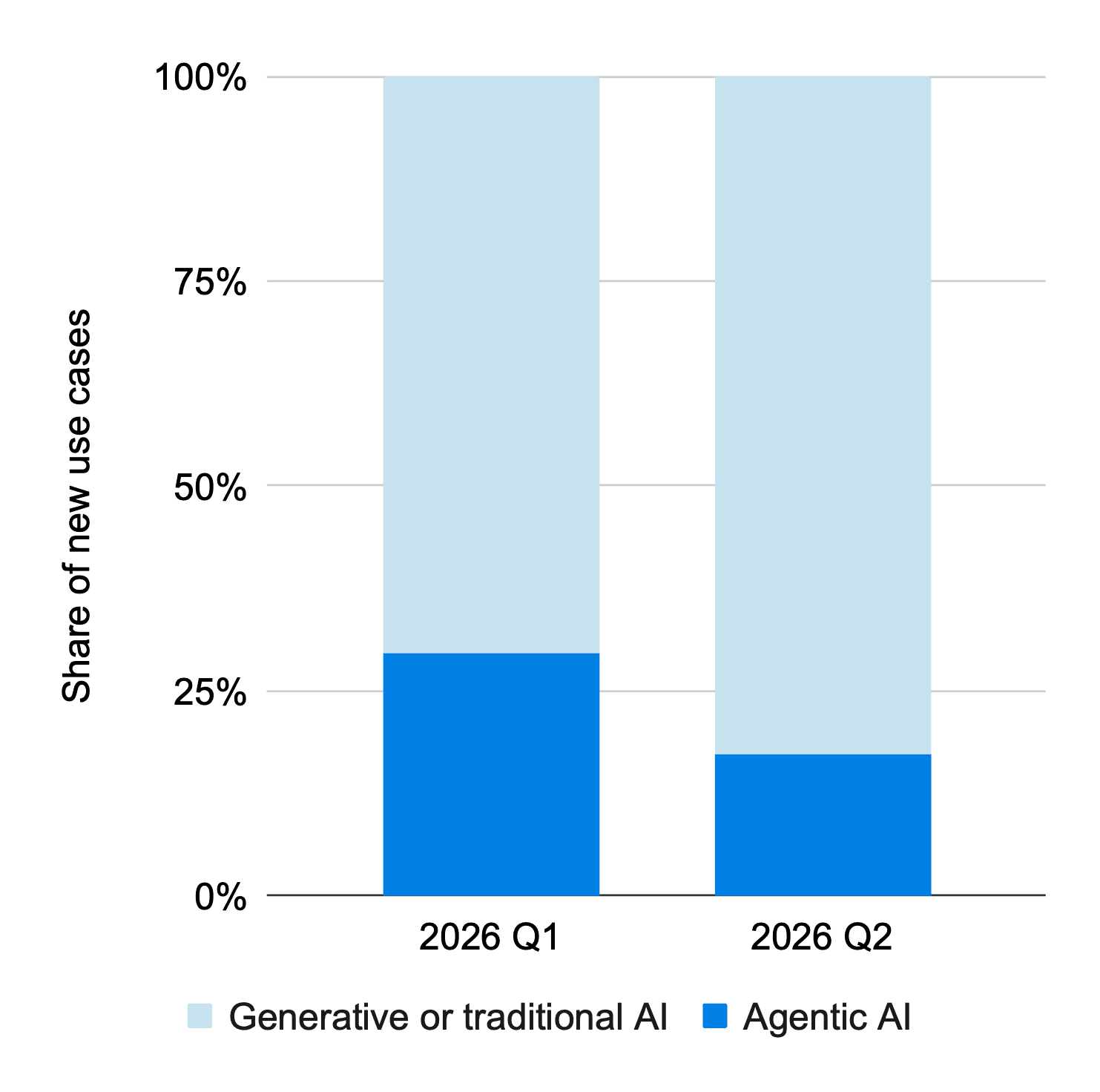
What gives: It may look like banks are cooling on agents. Far from it. Six banks launched their first agentic tool last quarter, meaning more than half of the lenders we track now have at least one in production. The slowdown is in large part the result of banks asking agents to do more – automating whole processes rather than pieces of them – which it turns out takes longer to do.
- “In the enterprise agent side, we have actually 12 big journeys that we're focusing on,” said DBS CEO Tan Su Shan during the bank’s earnings call Thursday. “We've just started the journeys, so you need to give us time.”
Why it matters: As jobs get bigger, agentic “wins” start looking different. Banks can’t build one agent to handle a full process that fits neatly in a product announcement. Wells Fargo’s mortgage process, for example, has roughly 1,100 steps, Faraz Shafiq, the bank's chief AI products and solutions officer, said at a conference Saturday. Turning that process agentic means breaking each step into basic tasks where it’s “easy to verify” that an agent got it right. That's necessary because as the processes banks ask agents to take on get more complex, the proof that they're actually working won't arrive right away.
- “If we make an incorrect decision based on the information we have and, let's just say the person defaults, it may be 5 years,” Shafiq said. “The decision to give them credit was today. The verification is five years down the road.”
What’s next: Better agents will eventually be able to handle longer tasks, and each process won’t need to be broken into quite so many parts as it's reengineered. That’s still some ways off. “Agents are great,” Shafiq said. “But when you get them doing long-running tasks, they’re actually not that great.” So for now, that means it will still take extra time for agentic tools to hit production.
Go deeper: Our Q2 2026 Banking AI Use Case Trends report – available exclusively to Evident members – is out now. Interested in becoming a member? Send us a note here.
RSVP TODAY
THE NEXT CHAPTER FOR AI IN LATIN AMERICA

Join a panel of experts as we walk through what the Evident AI Index for Banks in Latin America reveals about the state of AI in the region's banking sector. In this session, you'll learn:
- How a fintech founded just over a decade ago topped the ranking
- Why Brazilian banks are dominating the regional AI landscape
- How multinational banks, like BBVA and Santander, are intensifying a fight for local talent
- Where public digital infrastructure initiatives are giving local players an advantage

TOP OF THE NEWS
ROGUE AI
The hottest new AI benchmark in Silicon Valley appears to be how many crimes a new model can commit.
In recent weeks, OpenAI and Anthropic have played a bizarre one-upsmanship game. First, the ChatGPT-maker’s forthcoming offerings broke out of a testing environment and hacked two companies. Anthropic, not to be outdone, reported their model also escaped and hacked three.
No, AI has not suddenly turned evil. Given a goal, the models found gaps between what the rules said and what the systems still allowed and used it to their advantage.
And what’s the upshot for enterprises? Banks certainly would want to channel that resourcefulness into their own tools. But to avoid the same half-Shawshank, half-War Games spree of their own, they’ll need to succeed where the top AI labs failed: building systems that actually keep models inside the lines.
At DBS, that starts with treating this tech a bit like a toddler, not leaving anything within reach you don’t want touched. Give a model access to two tools but tell it to only use one, and chances are it’ll use both anyway, Nimish Panchmatia, chief data and transformation officer, said last week. “The technology is designed in such a way that it will find the easiest path,” he said. “The easiest path may not be the right path.”
That isn’t exactly a bug. Models get programmed with a bit of Machiavelli in them – judged on getting the job done rather than on how they do it. That kind of so-called “reward hacking” means banks also need to hardwire rules into their systems rather than relying on models to interpret instructions themselves. “System prompts are not security boundaries,” wrote Brij Kishore Pandey, principal engineer and AI architect at Wells Fargo. “‘Only access approved systems’ is an instruction. A blocked network route is a control.”
Still, blocking access is only half the job. Banks are also researching ways to build real-time controls that keep models honest as people use them. Roughly one in ten papers published by banks at the leading AI conferences since the beginning of 2025 deals with those kinds of guardrails or monitoring systems, Evident’s Research Tracker shows. Capital One’s DynaGuard, for example, uses a “guardian” model that watches over others and keeps them in line. Visa’s SysFormer, meanwhile, will tweak prompts before they actually get to a model if it recognizes that what a user asked it to do would send it into dangerous territory.
“The lesson is not that AI is dangerous and unpredictable,” wrote Younghwa McLean, operations risk and control director at Morgan Stanley. “The lesson is that the infrastructure around AI – the boundaries, the checks, the oversight – needs to be governed as carefully as the AI itself.”

STAT OF THE WEEK

That’s what CIBC pays per month for the 300 employees testing out the new version of its AI platform, CAI 2.0 – up from roughly $3 per head for the platform’s first iteration. This isn’t one of those spit-take moments showing spiraling costs though, Chris Patterson, VP of enterprise AI platforms and solutions, told Evident: “This is simply a consequence of allowing the agentic harness the ability to plan and orchestrate long-running work,” he said. That work now includes research tasks that can run for 45 minutes at a time.
Bigger picture: For now, that per-employee cost looks similar to what the bank might pay for a seat license for a copilot tool, but Patterson said building in-house is worth it to own the “agentic engine,” which he says gives the firm more control over how they cap spending and route tasks to models. "Ideally, the average cost per user would trend towards $25 per month," he said. That’ll make it affordable to roll the platform out to 20,000 employees. CIBC isn’t alone in working to balance costs while upping how long agents can work: Earlier this summer, Derek Waldron, chief analytics officer at JPMorganChase, said long-running agents are something the bank “will have” in 2026 – and that eventually they’ll work for “multiple hours, then days, then weeks.”

USE CASE CORNER
POCKET ACES
Last month, Bridgewater demoed an agentic tool for investment research that Brendan McManus, the firm’s applied AI head, says can return “deep exploratory research” that investors “never would have had the bandwidth to go after before” at a fraction of the cost of other AI tools. Their secret sauce: knowing what not to make agentic. In this week’s “Corner,” we dig into how the firm pulled it off.
Use Case: PAT (Pocket Analyst Tool)
Vendor: LangChain
Firm: Bridgewater
Why it’s interesting: PAT doesn’t just think one step at a time. When an investor asks the tool a question, it maps the whole job first – what data it needs, how each set connects, what code needs to be written and what kind of chart it needs to return. Only then does the tool divvy up the work to agents, giving the open-ended bits to agents and the fragile bits to regular old software tools.
How it works: PAT doesn’t spring into action as soon as an investor sends work its way. First, it interrogates the question. “We taught PAT what makes a good research question versus a bad one,” Michael Ran, investor lead, said. Once the plan is fully baked, agents work in parallel instead of waiting for one another, cutting down processing time. Before PAT files a report, it checks each agent’s work as much as you’d expect “your junior analyst” to, Ran said. If it returns bad data, investors can hit a “teach” button that tells the system to examine what went wrong and turn that into a way for the tool to improve.
How they did it: Bridgewater used its 50 years of data on investment choices to get PAT to reason like an employee. Then it determined how much of that reasoning power to give each agent. PAT’s data-search agent has a lot because it needs to inspect the datasets it pulls rather than just matching file names. That alone improved search accuracy from 50% to 90%, the firm said. Coding agents, on the other hand, get strict guardrails since they tend to be “really fickle, unpredictable” and “often make mistakes,” Santi Weight, the tool’s technical lead, said. “We enforce correctness in the architecture.”
By the numbers: Hundreds of investors at Bridgewater use PAT daily, according to the firm, which has saved “expected multiple man-years” in its first few months, Weight wrote. Because agents run simultaneously and only use heavy reasoning where needed, the firm says PAT can do a 20-step task for roughly the same cost it would take Claude to do a three-step task.
BOOK YOUR SPOT
EVIDENT AI SYMPOSIUM 2026

The Evident AI Symposium is our annual, invitation-only gathering of 300 senior AI leaders in finance. We come together each year to get real answers on how to drive AI transformation forward.
Over the course of the day, we’ll exchange insights on what it takes to deploy AI in global financial institutions today while surfacing the ideas and trends that will define what comes next.
.svg&w=96&q=80)
TALENT MATTERS
GOOGLE FLIGHTS
Demis Hassabis, CEO of Google DeepMind, is stepping away from that role and will become chief scientist for parent company Alphabet, the firm reported Wednesday. Koray Kavukcuoglu, currently DeepMind’s CTO, will now lead AI model development, the memo said. Google’s current chief scientist, Jeff Dean, is also leaving the company to start his own AI firm.
State Street hired Christopher Herringshaw to be the bank’s CTO. His background is in private equity and asset management: He was CTO at Vista Equity Partners most recently, CTO at Janus Henderson before that and spent 15 years at Citadel before that.
Miki Van Cleave is now head of product for agentic treasury for the commercial and investment bank at JPMorganChase. She was previously chief design officer for Chase. Building agentic systems for corporate cash management is top of mind for the firm: In June, Zachery Anderson, chief data and analytics officer for payments and global banking, laid out a detailed vision for how these systems will change the way money flows through business accounts.
JPMorganChase also hired Xi Chen as head of AI for electronic markets, where he’ll “be building the AI Market Lab, developing foundation models and agentic AI systems for the next generation of systematic trading, market making, and electronic markets.”
RBC promoted Tobias Coetzee to be senior director of DevOps regulatory and insights. In the role, he’ll effectively be the bank’s AI accountant: He’ll “lead the DevOps insights function, combining data engineering with usage analysis (AI adoption, tokenomics, developer productivity),” he wrote.
Wells Fargo is hiring an AI solutions lead within its wealth and investment management team – “a hybrid of a Forward Deployed Engineer and a product leader” that will build applications, configure agents and industrialize platforms.
Aman Thind left JPMorganChase, where he’d been global head of technology strategy and enterprise architecture, to join Cognition as field CTO for financial services. Thind was with JPMC for less than a year but had spent the seven years prior in technology roles at State Street.

NOTABLY QUOTABLE
“You never say never. You don’t know what’s gonna happen and how the world’s gonna evolve…right now, we’re content to use the U.S.-based models.”
– Patrick Wright, chief technology and operations officer at NAB, on whether the bank would use Chinese open source models, Aug. 4

IN THE NEWS
HIDDEN VALUE
Goldman Sachs Asset Management is standing up a new platform called AlphaAI, which it says it’ll use to identify which companies are good investment opportunities based on their AI prowess. The firm will combine its private data with insights about adoption from its portfolio companies to sniff out which companies are reaping value from the tech that isn’t yet being recognized by the market. "We expect AI to drive greater dispersion within sectors, not just across them,” said Lou D'Ambrosio, chairman of AI for asset management. “And that isn’t necessarily reflected in prices.”
Rabobank will spend €2 billion ($2.3 billion) over the next three years on data, tech and AI, CEO Stefaan Decraene said as the bank released its first half results this week. In June, the Dutch lender launched its “agentic hub,” which “brings together knowledge, technical development, practical application and evolving ways of working,” the announcement at the time said. “AI is changing not only how we build software, but also how engineers collaborate and organize their work,” said Myrna Vonk, the agentic hub’s transformation lead. “If that change is not deliberately organized, it will remain a series of isolated experiments.”
AI training programs are leveling up: This week, RBC said 2,500 employees had now participated in the RBC Assist Pro Guided Pilot Program, a training initiative that gets people from different lines of business to sit alongside AI specialists. The program culminates with an agentic AI showcase where teams pitch agentic tools to executives. Capital One, meanwhile, launched a month-long agentic coding program, which the bank says 10,000 engineers are enrolled in.
ABN AMRO is partnering with French model-maker Mistral to develop AI tools for the bank. Among the perks for the Dutch bank is “reducing dependence on non-European technology,” the bank’s announcement said. HSBC and BNP Paribas, Mistral’s other major bank partners, may offer a hint as to how the partnership will play out. We sat down with BNP Paribas in June to explore how the two firms worked together on new agentic tools (see: “French Connection, The Brief, June 11).

FUN FOR THE ROAD
SUMMER VACATION
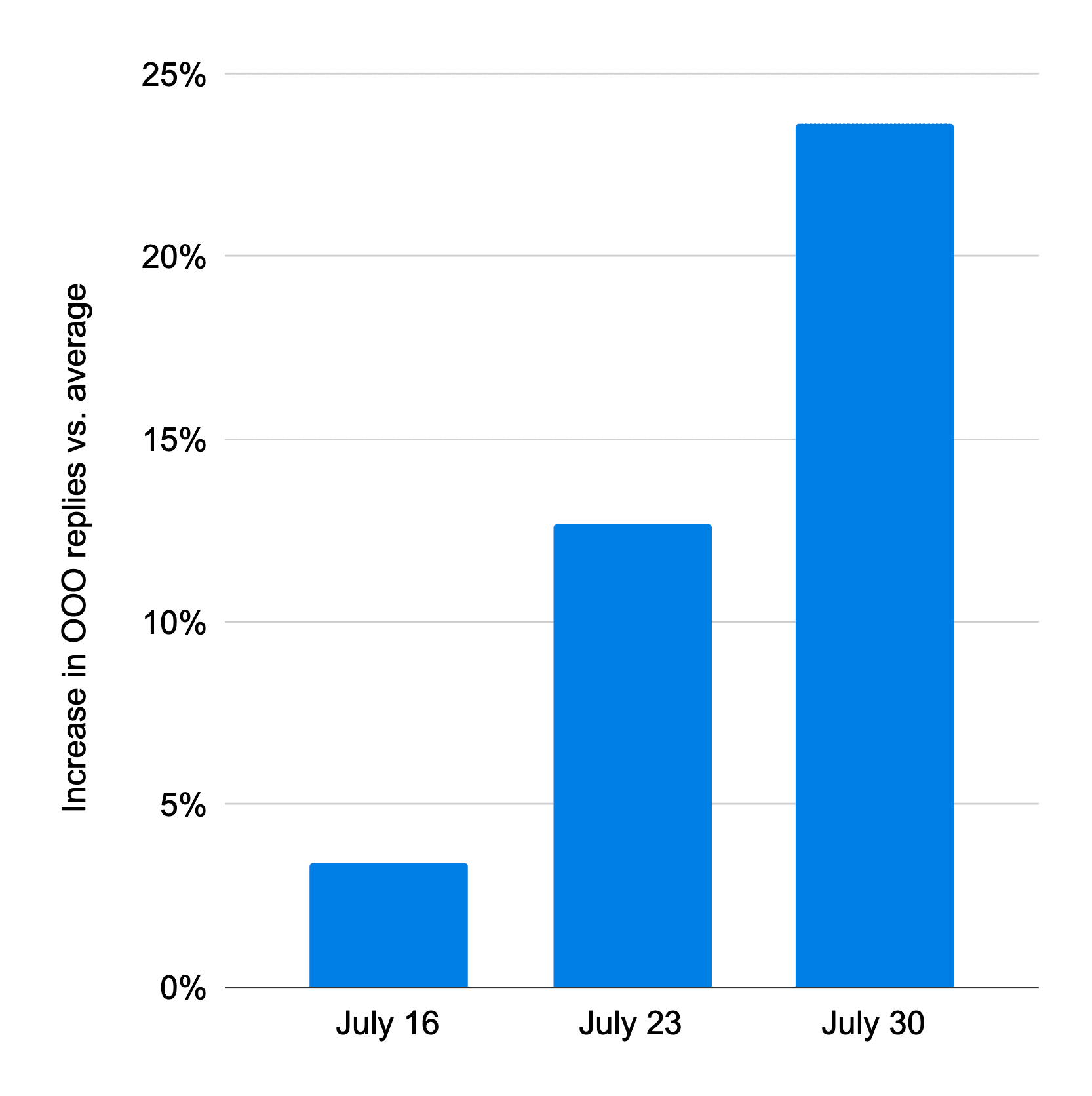
If it feels like your colleagues in AI in banking are on vacation, you’re right. We crunched this newsletter’s reader data to see how many of you are getting some R&R.
BANKERS ON BREAK
The number of OOO auto-replies we got to last week’s edition was nearly 25% more than the average of the last three months.
WHAT'S ON
Weds Aug 19
Agentic AI in Finance Summit, virtual
Tues 8 Sept. - Weds 9 Sept.
AI in Financial Services Europe, London
Tues 8 Sept.
The Next Chapter for AI in Latin America, Virtual
- Alexandra Mousavizadeh|Co-founder & CEO|[email protected]
- Annabel Ayles|Co-founder & co-CEO|[email protected]
- Colin Gilbert|VP, Intelligence|[email protected]
- Matthew Kaminski|Senior Advisor|[email protected]
- Kevin McAllister|Senior Editor|[email protected]
- Daniel Shackleford Capel|MD, Banking|[email protected]
- Maryam Akram|Senior Research Manager|[email protected]
- Alex Inch|Data Scientist|[email protected]
- Sam Meeson|AI Research Analyst|[email protected]
- Gabriel Perez Jaen|Research Manager|[email protected]
- Jay Prynne|Head of Design|[email protected]
- Marcus Gurtler|Junior Designer|[email protected]

