

DATA-DRIVEN INSIGHTS AND NEWS
ON HOW BANKS ARE ADOPTING AI
AI layoff bubble

Source: Adobe Firefly
5 March 2026
Welcome back to The Banking Brief! This week: Why big AI-driven headcount cuts might be, for now, a sign of panic rather than prowess. An inside look at a new agentic tool that keeps an eye on traders. Plus, exclusive data on AI adoption at CIBC.
People mentioned in this edition: Jack Dorsey, Andrew Ng, Jamie Dimon, John McGinn, Sanjay-Kumar Tripathi, Chris Patterson, Stephen Gill, Katherine Hainsey, Dennis Suppe, James Holdorf, Avril Miranda Fernandes, Kelly Mulrooney, Daniel Belfer, José Manuel de la Chica and others.
This edition is 1,749 words, a 5 minute read. Check it out online. If you were forwarded the Brief, you can subscribe here. We always want to hear from you at [email protected].
– Alexandra Mousavizadeh & Annabel Ayles

TOP OF THE NEWS
BLOCKHEAD
By cutting 40% of Block’s staff in the name of AI last week, Jack Dorsey handed every bank board a tempting comparison: “If he can do it, why can’t we?”
Banks, after all, have spent the past year talking up their agentic tools: CommBank has one that can fix network issues (see: “Help your developer,” The Brief, Jan. 8). Goldman Sachs is building them for compliance work (see: “Agents move beyond coding,” The Brief, Feb. 12). Deutsche Bank – as you’ll read below in Use Case Corner – is using them to keep traders honest.
These are the kinds of tools that Citrini Research argued will hollow out the white-collar workforce and turn every CEO into Jack (Dorsey) the Ripper. What's happening inside banks shows just how wrong that is. We’re still in the foothills of the enterprise transformation that agentic AI is capable of delivering. Cutting the heart out of an organization now would make it harder, maybe impossible, to get agentic AI right.
MANY HANDS MAKE AGENTIC WORK
The top 15 banks in the Evident AI Index grew their headcount at three times the rate of the average bank in 2025, while laggards contracted their workforces.
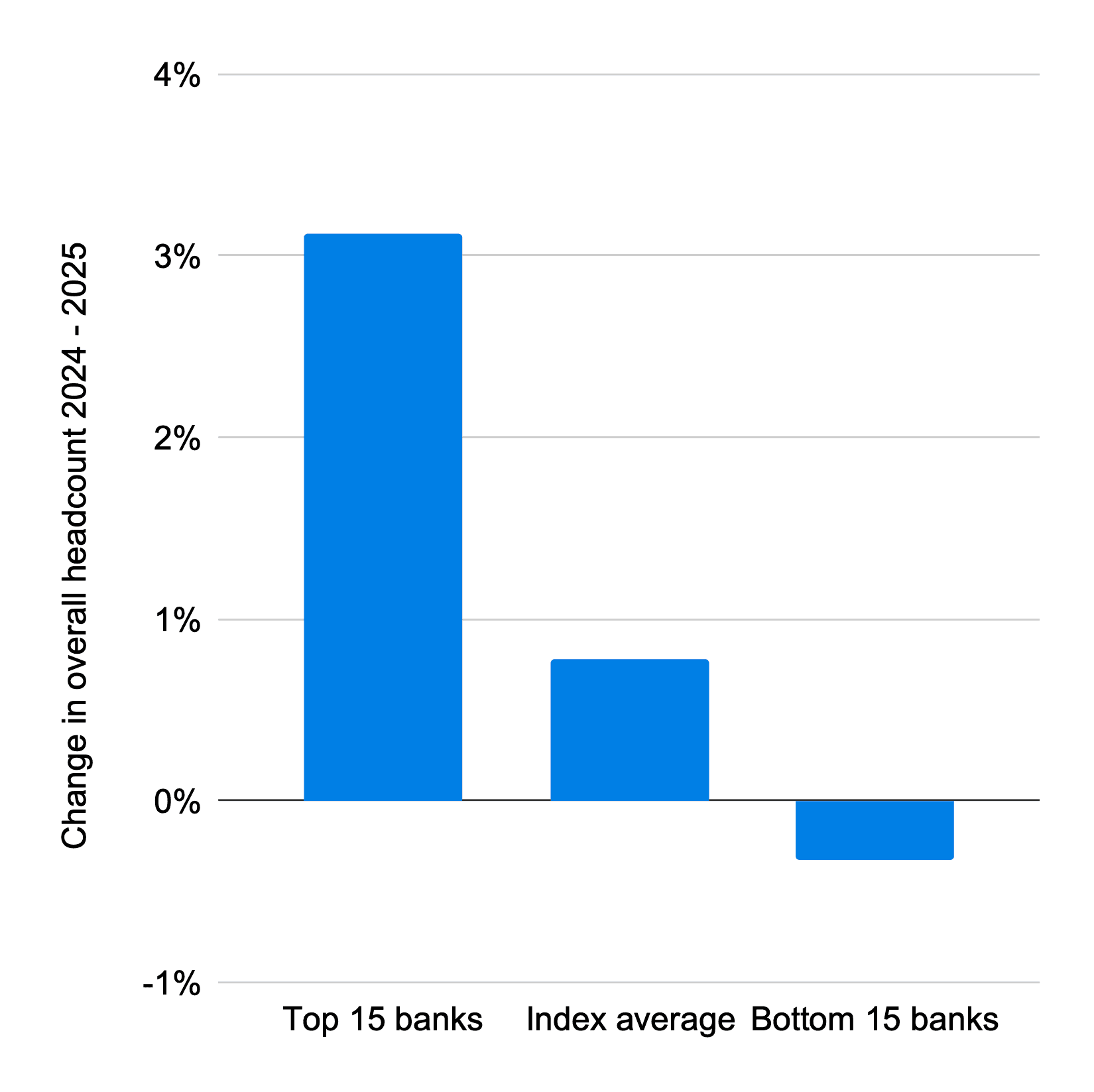
That conviction shows up in the data: Eight of the top 10 banks in the Evident AI Index grew or maintained their headcount in 2025, according to annual reports. Those 10 banks also accounted for more than 40% of the agentic tools launched publicly last year by the 50 banks we track, Evident’s Use Case Tracker shows.
The next step is shifting from developing agentic tools to redesigning processes around them. For that, the human layer – and a bank’s institutional knowledge – remains critical. Recent research shows why: In a study last month, unsupervised agents broke every security and privacy rule as soon as they could act autonomously. Another AI benchmark found that, while models are getting good at making money through a simulated vending machine, they can’t seem to do it without forming illegal price cartels.
Without humans to guide agentic transformation, those outcomes are a feature, not a bug. “An agent operating on incomplete context doesn't malfunction — it performs exactly as designed, on a fraction of the information it needs,” José Manuel de la Chica, AI research head at Santander, wrote this week.
Banks are still in the early stages of giving agents the context that can reshape how work gets done. The end result of that may be a bank with fewer employees. For now, they aren’t ready to lose the brains that can make those agentic tools more effective: “We have displaced people from AI, and we offered them other jobs,” JPMorganChase CEO Jamie Dimon said last week. CommBank, meanwhile, is making the same push to move workers around rather than cut them as it rebuilds full workflows around agentic AI.
“If AI automates just one step in a process, it might save an hour of human work and reduce costs. That’s useful and worth doing, but it doesn’t fundamentally change the business,” AI pioneer Andrew Ng said this week. “To unlock real value, companies need to look beyond optimizing individual tasks and start reimagining entire workflows.”
Good luck doing that if 40% of a firm’s knowledge exits the building.
JOIN US LIVE
Evident AI Index | Payments Roundtable

Top executives from Mastercard, J.P. Morgan Payments and PayPal will be joining us next week to unpack the results from the inaugural Evident AI Index for Payments. On the agenda:
- Where the payments sector stands on AI maturity – and who's pulling ahead
- The highest-impact use cases and where the greatest ROI opportunities lie
- How the rise of Agentic Commerce is reshaping the competitive landscape

USE CASE CORNER
BLUE HORSESHOE LOVES AI SURVEILLANCE
Investigating trades and communications are some of the most labor-intensive jobs in bank compliance. Surveillance systems cast a wide net, which means a lot of alerts – and a lot of false positives. But every flagged trade or communication still has to be investigated.
In this week’s “Corner”, we sat down with John McGinn, Deutsche Bank’s head of compliance controls and insights, and Sanjay-Kumar Tripathi, the bank’s global head of surveillance technology and cloud and AI transformation lead for compliance tech. They gave us an inside look at the bank’s new agentic trade surveillance tool, which cuts down the manual work of compliance teams.
Use Case: dbSherpa
Vendor: Google (Gemini)
Bank: Deutsche Bank
Why it’s interesting: Surveilling electronic communication has traditionally relied on keyword-based lexicons, systems that flag when traders use certain phrases or behaviors associated with potential misconduct. “That comes with a very, very high preponderance of false positives,” McGinn said. With every trade surveillance alert, “a lot of time is spent aggregating data” such as trading records, market data and trader communications. By introducing an LLM – and agents – to the trade process, the bank can gather evidence faster and recognize patterns better, which cuts down on the number of false positives the system throws up.
How it works: Sherpa sits inside the bank’s surveillance stack, which monitors trading activity, voice calls and electronic communications. Trade surveillance alerts get triggered when potential market abuse gets detected, like spoofing (placing fake trade orders), wash trades (making trades and their inverse simultaneously to drive up demand) or price ramping (a pump-and-dump). Once an alert fires, Sherpa takes over the investigative groundwork. Different agents can handle different parts of the process: One may focus on “gathering data and aggregating data,” McGinn said. Another would be responsible for “writing the commentary that leads to a decision.” It frees analysts from manually stitching together the evidence, leaving them to handle “any escalations or alert closing,” McGinn said.
How they did it: “Mostly we are using Google-provided model Gemini’s…out-of-the-box capabilities,” Tripathi said. The engineering lift was focused around the workflow that lives around the model. Tripathi said the bank uses a technique called “loop architecture,” which uses a “critic agent concept,” that “cross-questions multiple times” the outputs it spits out before sending the result to an analyst – like using an LLM as a judge. The bank also avoids using an LLM when it doesn’t have to: “Anything deterministic in nature in terms of data points, we are implementing tools rather than blindly using LLM,” said Tripathi. “You don’t need to ask an LLM if two plus two is equal to four or five.” Those architecture choices cut down hallucinations and improve reliability, the bank says.
By the numbers: The system processes “millions of messages and trades a day” and can “see the wood for the trees,” McGinn said. It helped the bank cut false positives by 25%. “There is an efficiency play here…but even the efficiency play is geared at making us more effective,” he added. Over time, the bank says it plans to hand more surveillance tasks over to agents.
OUT NOW: Want to know more about the specific ways banks are rolling out AI? Check out our Use Case Tracker – the inventory of all the AI use cases announced by the world’s largest banks available to members.

STAT OF THE WEEK

The uptake of CIBC’s CAI platform – its general purpose AI tool – according to Chris Patterson, head of enterprise AI platforms and solutions, who shared the figure with The Banking Brief exclusively this week. That’s nearly triple the number of DAUs the tool had last July, growth that Patterson credits, in part, to a push to get employees to use it for “micro-automations” for their daily work rather than just ad-hoc questions and a 2,000-strong group of AI champions encouraging adoption (see: “AI in the Vein,” The Brief, July 10).
Zoom out: What’s more critical is how usage of general AI tools translates into productivity gains – though banks don’t report this uniformly. During its earnings presentation, CIBC reported saving 1.2 million hours with CAI in the first quarter. The back-of-the-envelope math would suggest that each of the bank’s 50,000 workers then save roughly two hours per week. BBVA reported that the 11,000 employees that were piloting ChatGPT Enterprise last year before the bank took it firmwide were saving three hours per week with the tool. JPMorganChase says its employees use LLM Suite to save four hours per week.
.svg&w=96&q=80)
TALENT MATTERS
PROMOTION SEASON
Stephen Gill is now executive director of product design for global employee agentic AI experiences at JPMorganChase. He will be “leading the design of agentic AI experiences that transform how employees work,” he wrote on LinkedIn.
JPMC also promoted Katherine Hainsey to be managing director and head of product data, analytics and AI for consumer and community banking.
Dennis Suppe is now managing director of workplace services and AI enablement engineering at Charles Schwab. His teams “own the strategy for flattening cost growth — delivering more capability without proportional cost increases through AI tooling,” he wrote on LinkedIn.
Chris Cox joined Lloyds as director of data and AI architecture. He was most recently head of data and AI for global financial services at AWS. The bank also promoted Kelly Mulrooney to be data and AI culture strategy manager.
James Holdorf is now senior director of product, AI acceleration and enablement for Capital One’s retail bank. He’s been with the bank for 16 years.
Wells Fargo is hiring a Gen AI digital senior lead product leader for agentic delivery execution. The hire will “stand up Observe to Agent (O2A) capability” for the bank, which is a process where AI observes how humans work and translates their workflows into directions that agentic tools can understand.
Avril Miranda Fernandes is now executive director, AI lead investment management at Morgan Stanley. She’s been with the bank since 2016.

Want to speak directly to tech decisionmakers at the biggest banks around the world? Our highly-engaged audience of more than 20,000 subscribers includes CIOs, CDAOs, CTOs and CEOs of the top banks and financial services companies. Sponsorship for 2026 is now open; secure your spot today.

ON THE HORIZON
SELF-HEALING AI
In this segment, we explore how a bank’s AI research advances their AI strategy. This week: Santander’s AI lab – led by José Manuel de la Chica – has a new research proposal for exploring how to get agentic systems to function like Roman concrete and fix cracks on their own.
The idea, explained: The bank is exploring what “antifragility,” the idea that systems get stronger under stress, would look like in AI. When agents encounter uncertainty or disagree, they usually resolve the problem and move on. Santander is looking into whether those moments where AI faces conflicting information can be used to make the system better the next time it encounters a similar problem.
How the bank can use it: Multi-agent systems increasingly rely on agents that play different roles. In trading, for example, one agent might push to execute a trade quickly, while another might warn it could increase risk exposure. The system would weigh the pros and cons of each approach before deciding what to do. Santander’s research proposal looks at what happens before that decision gets made. The idea is to capture that friction and study whether the disagreements can help agents refine how they reason and challenge each other over time.
The bigger picture: Santander isn’t the only bank looking for ways to use failure to its advantage. Researchers at Intesa Sanpaolo mapped how multi-agent systems break down in practice to find common points of failure, like miscommunications between agents. But Santander’s approach could take that a step further sometime down the line. “I don't know if any architecture will show true antifragility,” José Manuel de la Chica wrote on LinkedIn. “That's why it's an experiment.”

NOTABLY QUOTABLE
“A core tenet of our AI strategy is to build once and use many times, scaling AI through repeatable patterns that lead to faster AI deployments and reduced cost of delivery.”
–Raymond Chun, CEO at TD Bank, during the company’s earnings call, Feb. 26

IN THE NEWS
AGENTS HOLD PURSE STRINGS
Santander and Mastercard completed “Europe’s first live end-to-end payment executed by an AI agent” this week. It comes roughly a month after CommBank and Westpac processed Australia’s first agentic transactions – movie tickets and a vacation accommodation. And earlier this year, DBS and Visa partnered to facilitate agent payments. As agentic commerce – where agents make purchases on people’s behalf – grows, banks are increasingly jockeying to preserve their place in the value chain. In case you missed it: Last week, we launched the Evident AI Index for Payments, the first-ever ranking of the AI maturity of the largest payment networks and processors in North America and Europe.
Japanese AI lab Sakana continues to be a favorite of banks, with Citi the latest to make a strategic investment into the startup. Santander and MUFG invested in the firm’s $135 million series B back in November (see: “New week, new model,” The Brief, Nov. 20). Mizuho, which this week announced an AI-led reorganization, also previously invested in the firm.
Swiss private bank J. Safra Sarasin is buying 70% of Denmark’s Saxo Bank as a part of a broader AI push as the tech becomes more of a part of wealth management. "Saxo is all about the technology architecture," J. Safra Sarasin's CEO Daniel Belfer said. "It's all about the agility to make changes that are coming to the market and adapting to customer demands quickly." The consolidation comes just weeks after JPMC said that AI disruption would cause more mergers and acquisitions among smaller banks.
WHAT'S ON
Tues 10 March
Evident AI Index | Payments Roundtable, Everywhere
Weds 15 - Thurs 16 April
AI in Finance Summit, New York
Mon 27 - Tues 28 April
Momentum AI New York 2026, New York, NY
- Alexandra Mousavizadeh|Co-founder & CEO|[email protected]
- Annabel Ayles|Co-founder & co-CEO|[email protected]
- Colin Gilbert|VP, Intelligence|[email protected]
- Matthew Kaminski|Senior Advisor|[email protected]
- Kevin McAllister|Senior Editor|[email protected]
- Daniel Shackleford Capel|MD, Banking|[email protected]
- Maryam Akram|Senior Research Manager|[email protected]
- Zachary Groz|Reporter|[email protected]
- Andrew Haynes|VP, Innovation|[email protected]
- Alex Inch|Data Scientist|[email protected]
- Sam Meeson|AI Research Analyst|[email protected]
- Gabriel Perez Jaen|Research Manager|[email protected]
- Jay Prynne|Head of Design|[email protected]
- Marcus Gurtler|Junior Designer|[email protected]

