

DATA-DRIVEN INSIGHTS AND NEWS
ON HOW BANKS ARE ADOPTING AI
AI manifest destiny

Source: Adobe Firefly
15 October 2026
Welcome back. Next Thursday, we’ll be in New York for the Evident AI Symposium. Want to be considered for a last-minute invite or get the livestream link straight to your inbox? Register here. The Brief will be dark, but we’ll be back the week of Oct. 26.
Today: Top banks are showing where and how they’re scaling AI next. What JPMorgan’s revised AI spending shows about the state of AI ROI. Plus: Which banks are raiding Silicon Valley for AI talent?
People mentioned in this edition: Charlie Scharf, Raymond Chun, Brian Moynihan, Jeremy Barnum, Jamie Dimon, Paul McEwen, David González, Tim Brophy, Mike Frank, James Patterson, Cory Lazzarato and others.
This edition is 2,257 words, a 7-minute read. Check it out online. If you were forwarded the Brief, you can subscribe here.
– Alexandra Mousavizadeh & Annabel Ayles

TOP OF THE NEWS
STARSHIP ENTERPRISE AI
With the use cases they’re now rolling out, top banks in the Evident AI Index for Banks appear to have a new mission: to boldly go where no AI has gone before.
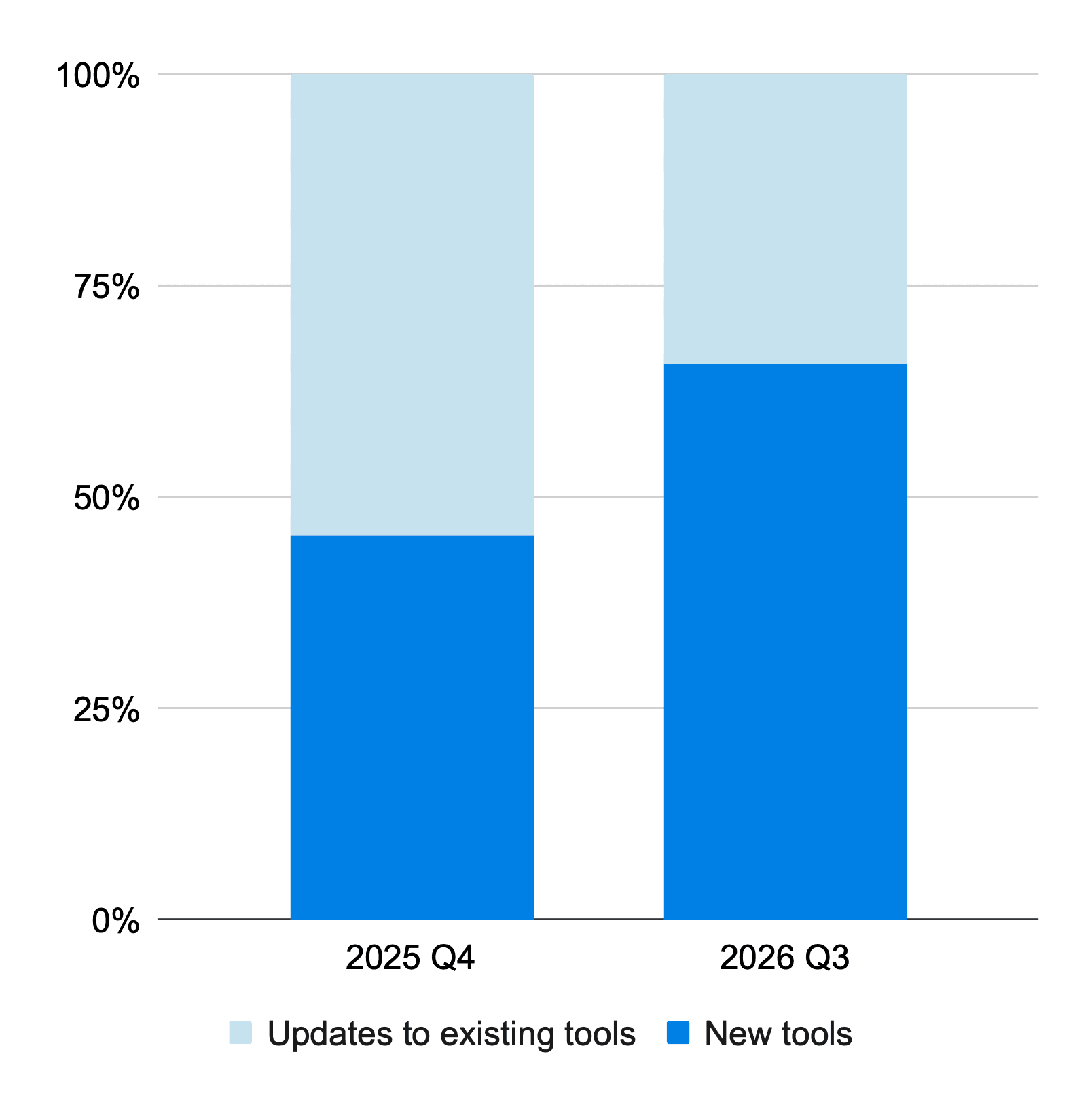
Nearly two-thirds of the use cases rolled out this past quarter by our Index’s top 10 lenders broke new ground inside those firms – either the first use of AI in a new line of business or the first time AI was handling a new task. That’s up from 45% compared to Q4 last year, Evident analysis shows.
It’s not a case of these banks merely playing catch-up. These 10 lenders already account for one quarter of the 1,100 use cases lenders have rolled out publicly since 2021. Instead, their rapid push into new areas suggests the architecture they’ve built to help them reuse tech is finally helping them bring new tools into production at warp speed. Now they just need to prove the returns stack up that fast, too.
SHINY OBJECTS
Nearly two-thirds of the AI tools rolled out by the top 10 banks in the Evident AI Index were new to the bank, up from 45% in Q4 last year.
That’s closer than ever, banks insist. “There's this underappreciation for the benefits that those with scale have when it comes to AI,” Charlie Scharf, CEO of Wells Fargo (#5 in the Evident AI Index for Banks) told investors Tuesday. “We can go build an agent that can do the work in our call centers…but deploy it over a very large part of the company here.”
TD Bank (#10) is showing what that looks like in practice. Earlier this year, the Canadian lender spent eight months building a virtual assistant for its contact centers. This summer, it reused the underlying technology to roll out a similar tool for bank branch employees in just two months. And it’s not just chatbots. This week, the bank rolled out new agents for mortgage funding and discharge – getting loans paid out and wrapping up the paperwork when mortgages are paid off – that were built on the work the bank did this spring to roll out an agentic tool for the pre-adjudication process (see: “House rules,” The Brief, May 28).
“A core tenet of our AI strategy is to build once and use many times, scaling AI through repeatable patterns that lead to faster AI deployments and reduced cost of delivery,” said Raymond Chun, TD Bank’s CEO, during earnings earlier this year.
NEW FRONTIERS
IT and security, compliance and investment banking are among the lines of business top banks are aggressively moving into through the first nine months of 2026.
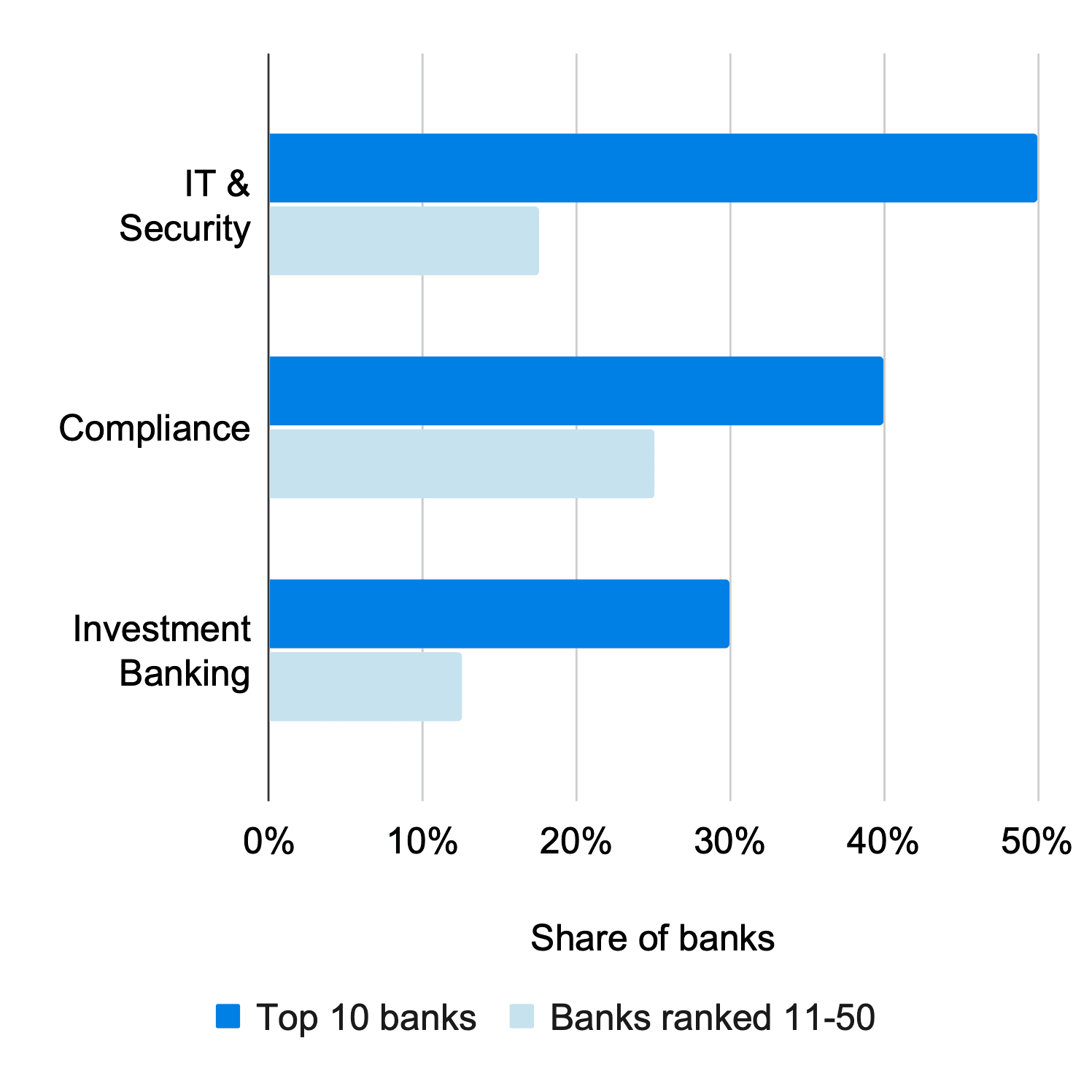
Being faster means banks can spend more time pushing AI into the parts of the business where AI use is more closely tied to saving or making the bank money. That’s happening more, as you see in the chart above. Five of the top 10 banks have rolled out their first security and IT tools so far in 2026. Some are using the tech – like Capital One (#2) is – to fix vulnerabilities across “thousands of repositories” and save potentially millions in damages from hacks (see: “The art of cyber war,” The Brief, July 23). Three have moved AI into investment banking this year.
But if banks want AI returns to come through fully, they don’t need a blockbuster tool; they need a portfolio full of them. Until that happens, the gains won’t be quite as visible as they’d like – even as the new reseases cover more ground.
“The benefits [of AI] aren't observable in our current quarterly earnings,” JPMorganChase CFO Jeremy Barnum said this week. “As important and dramatic and exciting as this theme is, it takes a long time to really do things that are visible at an institution of our size.”
GO DEEPER: Today we launched our latest Use Case Tracker trends deck for banking. Members can read our full analysis here.
LAST CHANCE TO REGISTER
THE 2026 EVIDENT AI SYMPOSIUM

Next Thursday, the Evident AI Symposium returns to New York City, bringing together the AI and tech leaders building the future of finance for a full day of conversations, demos and debates.
There are still a few spots available. Register your interest to attend in-person or to watch the livestream.

STAT OF THE WEEK

That’s what JPMorganChase is – er, maybe – spending on AI annually, CFO Jeremy Barnum told investors this week, revising a previous estimate of $2 billion last year. AI is “pretty well diffused inside the whole institution,” he said, making AI costs hard to pin down. The $2 billion in benefits, however? That’s still “accurate and correct,” though it includes savings from old-fashioned ML, not just the flashy agents the bank’s been rolling out. Barnum is tired of counting, though: “I'm just very reluctant to spend a lot of energy quantifying [AI returns],” he said. “It winds up wasting a lot of people's time inside the institution.”
Between the lines: The timing here is convenient. Bank of America last month reported $800 million in annual benefits from $400 million spent on Gen AI, a twofold return (see: “Stat of the week,” The Brief, Oct. 1). JPMC’s revised figures put its returns closer – however reluctantly the bank says they were offered – to threefold. The one-upsmanship doesn’t appear over. On Bank of America’s call the day after JPMC’s, CEO Brian Moynihan said his returns were actually “two to three times” the expense.
Zoom out: Capital One has long warned against treating AI like a short-term ROI contest. “Focus on short-term ROI is why many companies never make the technology transformation that unlocks long-term ROI,” Prem Natarajan, the bank’s enterprise AI chief, told us last year. Now JPMC sounds much the same. But it’s hard to imagine that staying the case as more banks share their returns. Citi CEO Jane Fraser, for example, said this week that its AI benefits “significantly outweigh” this year’s investments. Fraser pointed to its adoption of coding tool Devin as a way to insource work and cut 30% from its tech vendor spend. If the bank came out and said its overall return from AI was fourfold, it’s hard to imagine the rest of Wall Street content to let that be the last word.

NOTABLY QUOTABLE
“We're not against agents or for agents, something like that. They're tools. You use them for customers.”
–Jamie Dimon, CEO at JPMorganChase, during earnings, Oct. 13

FROM THE EVIDENT AI INDEX
SILICON VALLEY SHOPPING SPREE
Banks are raiding tech companies to build out their AI workforce, new data from Evident shows.
Since last year, Silicon Valley firms have been the biggest feeders to bank AI teams, outside of other financial institutions. Tech companies leapfrogged consulting firms and academia this year, two of Wall Street’s traditional poaching grounds for AI talent.
POACHED EGGHEADS
The top five banks for AI hiring from tech companies all finished in the top 15 of this year’s Evident AI Index.
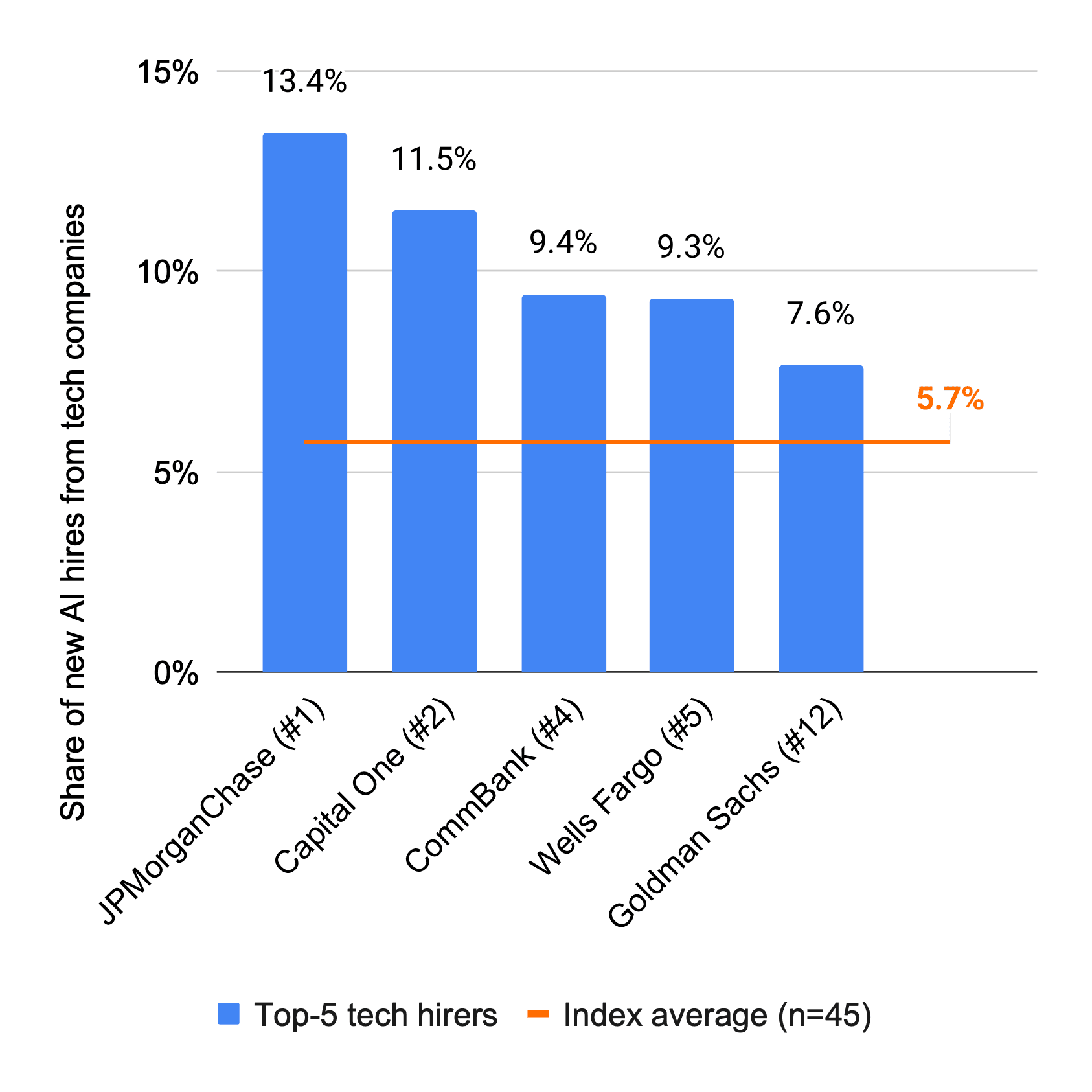
Banks are increasingly looking for people with the technical know-how to turn transformation plans into actual bottom-line gains. Goldman Sachs offers the clearest view of what that looks like in practice. The bank has been “hiring a bunch of engineers from the outside to complement our already excellent team,” CFO Denis Coleman told investors this summer. It’s started using them to reinvent the way its developers work.
A year ago, the bank hired Matteo Pelati, a co-founder of AI startup LangDB, to work on agentic software development. He’s since built AgentGraph, a tool that maps the relationships between different parts of the codebase so AI agents can make changes without inadvertently breaking something else. In July, the bank added Ravi Teja, a Microsoft AI engineering veteran, as its global head of agentic AI. And Mehul Jain, an Oracle alum who oversaw the firm's developer assistant, Oracle Code Assist, joined as a managing director in August.
But Goldman isn’t confining new recruits to engineering. In July the bank hired Farhan Baluch, a former Microsoft executive who worked as a forward deployed engineer and “delivered multi-million-dollar efficiency gains,” as its head of AI for global banking and markets. In the same month, it hired Evan Kotsovinos, a VP of privacy and security at Google, to be head of asset and wealth management engineering.
Other banks are taking a similar approach to getting tech talent into both engineering and the business lines: Wells Fargo hired Faraz Shafiq from AWS to oversee AI product development and Andre Mansour to head up AI within wealth management. At JPMorganChase, former Google execs Jason Gelman and Dror Ayalon lead AI product development across the bank and in investment banking respectively.
“We don’t hire engineers to write code,” said Gill Haus, CIO of JPMC’s consumer arm, describing the shift in what banks are now looking for from tech hires. “We hire them to know what code to write."
LAST CHANCE TO REGISTER
THE 2026 EVIDENT AI SYMPOSIUM
Next Thursday, the Evident AI Symposium returns to New York City, bringing together the AI and tech leaders building the future of finance for a full day of conversations, demos and debates.
There are still a few spots available. Register your interest to attend in-person or to watch the livestream.
.svg&w=96&q=80)
TALENT MATTERS
FILLED SHOES
Citi hired Paul McEwen as CTO and head of infrastructure. He was previously global head of technology services at UBS. McEwen’s role was previously held by David Griffiths, now Citi’s group head of AI.
BBVA hired David González as chief scientist and head of AI innovation. He was previously data, analytics and AI director at El Corte Inglés, one of the world’s biggest department store groups. González replaces Jon Ander Beracoechea, the bank’s former chief scientist, who departed for Santander over the summer.
Truist promoted Tim Brophy to chief data and governance officer. He’s been with the bank since 2025 as the chief data risk officer and served as head of technology and cybersecurity risk for employee platforms at JPMorganChase before that. The bank also hired Mike Frank to lead AI core engineering delivery, where he’ll be “helping turn the promise of artificial intelligence into meaningful, scalable capabilities across the enterprise,” he wrote. Frank was previously head of quality engineering, developer experience and insights at Wells Fargo.
James Patterson was appointed global head of data analytics for HSBC’s corporate and institutional banking arm. The remit is to bring together “HSBC’s data, our technology and engineering capabilities, and the potential of AI to create a genuine competitive advantage for our clients,” he wrote on LinkedIn.
Cory Lazzarato is now director of strategy, planning and value within RBC’s AI group. He was previously at Deloitte.

IN THE NEWS
MODEL AVALANCHE
The AI race is getting crowded again. This week, Meta launched a pair of models, including Muse Wonder Full, a closed-source entry that independent evaluator Artificial Analysis said is faster and cheaper than Anthropic’s Fable 5.1 with nearly-equal performance on intelligence benchmarks. Cohere earlier this month released North 2, the sequel to its enterprise AI platform. And Mistral launched a new LLM it’s affectionately calling “Le Chonk.” The competition is good news for banks, at least those that know their way around model routing, the process of sending tasks to the models that can complete them in the fastest and most cost-effective way. JPMC has one “coming on,” Jamie Dimon told investors. It’s part of the bank’s strategy of “minimizing lock-in and maximizing optionality,” CFO Jeremy Barnum said.
Bank security chiefs' worst nightmare has come true: Cybersecurity firm CrowdStrike said South Korea’s Shinhan Bank was likely hacked by a single China-based actor armed with an AI agent. It’s the threat bankers have feared since Anthropic released Mythos this spring (see: “Much ado about Mythos,” The Brief, April 16). The hack wasn’t of the bank directly, but the agent found a way in via a third party, authorities said of the incident. It’s a reminder that the cybersecurity line item in next year’s budget isn’t going anywhere: Bank of America, for example, has brought on 1,000 consultants for “Mythos remediation,” CEO Brian Moynihan said this week.
CaixaBank deepened its partnership with Google Cloud, expanding Gemini Enterprise access to a wider chunk of the business. The Spanish bank will be using Google’s tech for data analytics and agentic AI as well as for hybrid infrastructure, the release said. The new deal comes on the heels of a reorganization around AI. The firm created a new AI and Data department led by Jorge Arandilla, a McKinsey veteran who joined the bank last year. So far, the team is made up of 40 specialists who are working across business and technology teams to identify new opportunities.

ON THE HORIZON
BANKING BUDDIES
We can’t predict every turn AI will take in 2027. But as the dust settles from this year’s Index, we’re watching a few things closely. Last week, we looked at why AI hardware might matter even more in the coming year. This week: how banks deal with personal agents.

The bet, explained: Personal agents like Meta’s Muse and OpenAI’s dots may not be ready to trigger an agentic bank run just yet (see: “Banks vs. agents,” The Brief, Oct. 1). They can’t even move money between bank accounts. But if the buzz of the past two weeks continues and new capabilities get rolled out, banks will have to figure out how to let these agents operate safely – or figure out how to get their own products to do the agent’s job just as well.
What we’re seeing: Banks are taking different approaches. JPMorganChase is blocking outside agents that try to access accounts with a person’s login credentials, the bank said during earnings. “We’re not going to allow just any outside agent to come in,” Dimon said. That bank, however, is rolling out its own Smart Cash tool, which moves money on customers’ behalf. On the other side, Bank of America, BBVA and Wells Fargo joined the Personal Agent Protocol this past week, a new initiative led by Sierra and Meta to give agents their own credentials. The idea behind it: Rather than letting agents impersonate customers or blocking them outright, give banks a way to identify who is actually making a move.
What’s next: We’re watching how quickly banks open their doors to outside agents and the terms on which they do it. For now, they’re skeptical it’ll be a big factor in their businesses this year. “There's no question that agents will become a part of the way people interact,” Wells Fargo CEO Charlie Scharf told investors this week. “But the idea that that's going to contribute to mass movement to higher rate alternatives, I think, is completely overdone.”
WHAT'S ON
OUT NOW
Evident AI Index for Banks 2026
Thurs 22 Oct.
Evident AI Symposium, New York
Weds 4 - Thurs 5 Nov.
Open Source in Finance Forum, New York
Sat 14 - Tues 17 Nov.
ICAIF ‘26, Milan
- Alexandra Mousavizadeh|Co-founder & CEO|[email protected]
- Annabel Ayles|Co-founder & co-CEO|[email protected]
- Colin Gilbert|VP, Intelligence|[email protected]
- Matthew Kaminski|Senior Advisor|[email protected]
- Kevin McAllister|Senior Editor|[email protected]
- Daniel Shackleford Capel|MD, Banking|[email protected]
- Maryam Akram|Senior Research Manager|[email protected]
- Alex Inch|Data Scientist|[email protected]
- Sam Meeson|AI Research Analyst|[email protected]
- Gabriel Perez Jaen|Research Manager|[email protected]
- Jay Prynne|Head of Design|[email protected]
- Marcus Gurtler|Junior Designer|[email protected]

