

DATA-DRIVEN INSIGHTS AND NEWS
ON HOW BANKS ARE ADOPTING AI
AI Ozempic

Source: Adobe Firefly
2 July 2026
Welcome back to the Banking Brief, and happy Fourth of July to our American readers. This week: Banks are looking for new ways to slim down their token consumption. New bots arrive for Singapore’s rich. Latin American banks need to get creative with AI recruiting. And in our talent section, JPMorganChase’s AI head is leaving.
People mentioned in this edition: Suky Singh, Karthik Ramamoorthy, Ananth Hegde, Tan Teck Long, Teresa Heitsenrether, Scot Baldry, Olivier Crespin, Richard Heeley, Jason Barron, David Hardoon and others.
This edition is 1,878 words, a 7-minute read. Check it out online. If you were forwarded the Brief, you can subscribe here.
– Alexandra Mousavizadeh & Annabel Ayles

TOP OF THE NEWS
THE COMING AI DIET
As the bills for AI token usage pile up, banks are looking at their bulging waist lines and, like many of us, starting to look into dieting options. But first they need to figure out how much they’re actually eating.
New data from RBC shows that more than half of CIOs are spending more on tokens – the measure of how much AI is being consumed – than they’d budgeted for in 2026. Three-quarters said their spend would go up at least another 25% over the next year.
The bills aren’t just getting tougher to swallow. They’re getting harder to read. Executives can see how much money is going out. As tools get more authority to act on their own, which model or use case is behind a spike – and why – is often buried, if it can be found at all.
For now, agentic tools – those most likely to create that kind of AI sticker shock – only make up about 11% of all the AI use cases publicly rolled out by the 50 banks we track. That number is bound to climb, and banks are racing to develop new ways to predict the effect on token bills and fix them before a shocking invoice lands on the CFO’s desk.
That starts with understanding what’s actually being used. Many banks set up a “tenancy system” for AI, meaning they can track individual employees’ usage, said Suky Singh, who worked at HSBC on AI cost strategy until last month. But finding the source of the bill isn’t the same as knowing whether to cut it. There’s a lot of detective work – in this case FinOps, or financial operations work – needed to determine whether a large bill came from someone being very productive or from sloppy AI design. “Every use case is very unique,” Singh said. “You need to sit down with each individual workload owner to understand what it is they’re doing.”
Only then can banks decide where to slim down. At Goldman Sachs, getting more efficient means making sure the bank isn’t paying models to reread the same instructions or spit out extra information, wrote Karthik Ramamoorthy, the firm's global head of gen AI and machine learning platform architecture. That gives the bank a clearer read on what the actual returns are and how much they’re being eaten away. “If you can’t answer ‘tokens served vs. saved, per agent, per task, per model tier,’ you have hope, not controls,” he wrote.
The extra weight also shows up in how people choose which models to use. People building with AI often default to using the best available model for everything, even when that’s not necessary, Singh said. It leaves banks “paying a massive premium for intelligence that remains completely untapped,” wrote Ananth Hegde, head of data products at JPMorganChase. “When we ‘over-model’ these tasks, we aren't just burning through our AI budget; we are creating a culture of model misuse.”
That’s the risk as AI scales: It’s not that employees will use too much of it, but that early waste becomes standard practice around the bank. Lenders don’t want to slow adoption down, but unless they figure out how to tame tools’ appetite, it’ll be much harder to make the gains stick.
“A tool might generate 100k of savings, but you spent a million [on tokens], so what was the true value of that?” Singh said. “It's going to become really problematic, and that's why you need to build as much visibility now.”
JOIN THE ROUNDTABLE
Raising the Bar: Inside the 2026 Evident AI Index for Insurance
.jpg%3FupdatedAt%3D2026-07-02T13%3A18%3A31.875Z&w=3840&q=100)
Join Akhil Lalwani, chief data officer at Allianz UK, Andreas Bayerstadler, head of AI at Munich Re and Tony Marron, managing director at Liberty IT and global engineering capability lead at Liberty Mutual Insurance as we unpack the second edition of the AI Index for Insurance.

USE CASE CORNER
WAYNE’S WORLD
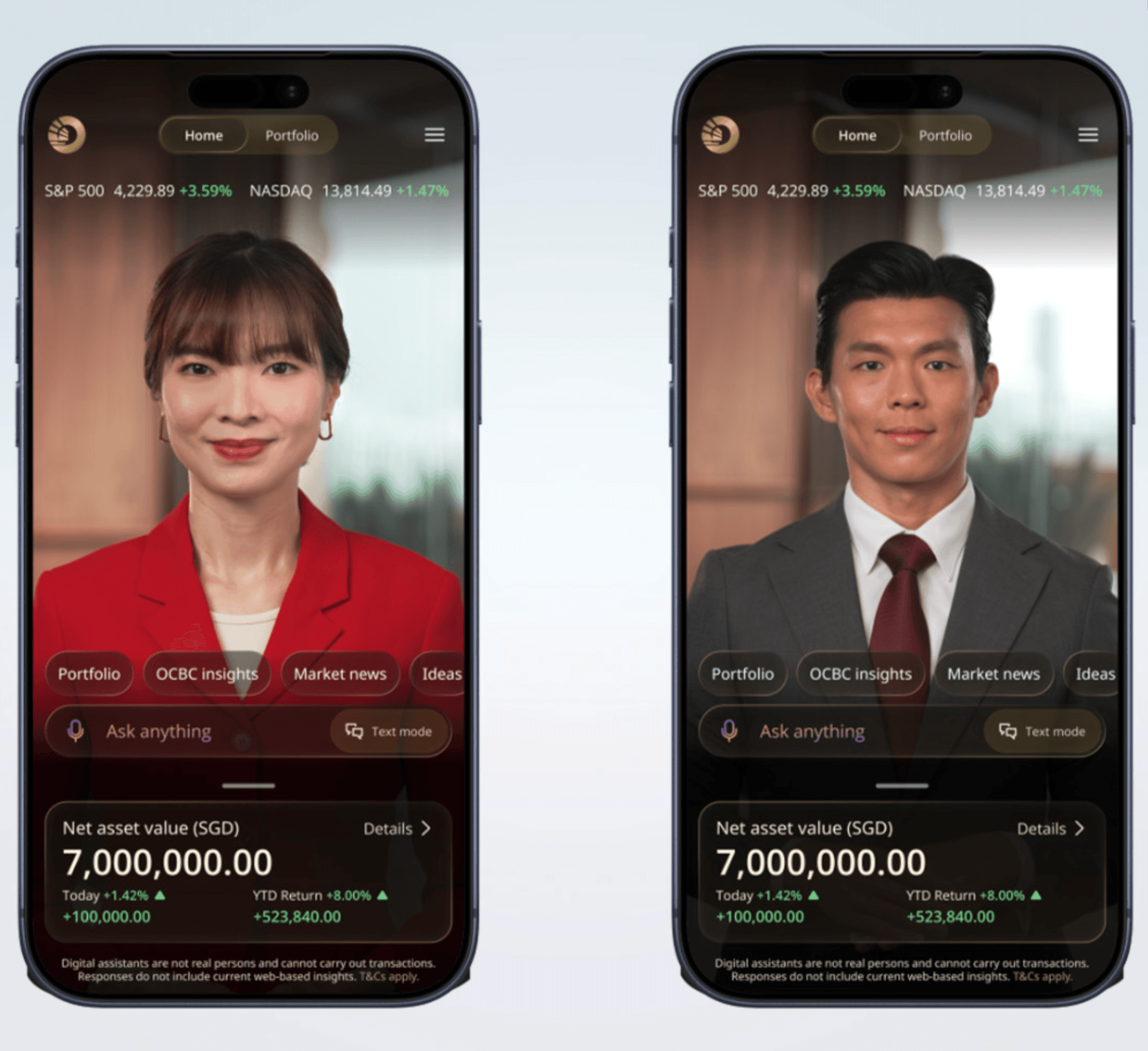
AI in wealth management is booming, but firms still haven’t agreed on how much clients ought to interact with AI tools directly (see: “Not your father’s advisor,” The Brief, May 21). This week, OCBC decided that the first touchpoint can be a bot, unveiling two AI avatars its wealthy clients will soon be able to treat as an extension of their advisor. In the “Corner,” we look at how the Singaporean bank plans to make it work.
Use Case: Wealth management avatars
Vendor: n/a
Bank: OCBC
Why it’s interesting: OCBC’s two avatars, named Wendy and Wayne, are being rolled out to wealth management clients with more than $1.5 million SGD ($1.2 million) in the bank. At the same time, the bank is hiring 600 more human relationship managers. It’s a bet that by letting AI handle the simpler client requests in wealth management – like buying an equity or getting insight on the news impacting a portfolio – the bank will be able to use humans more effectively to grow its book.
How it works: The tool pulls in real-time market data, OCBC research, customer portfolios, data on their transactions and other behavioral signals to answer questions customers have. The bank added deterministic guardrails – hard rules around what questions it can answer and what information it can access – to keep the tool from improvising responses. Customers can either write or speak to Wendy and Wayne, who will respond in English, though the bank says it will expand the languages they speak over time. If the avatars hit a wall with the type of action they’re allowed to take, they kick the conversation to a human manager.
How they did it: The avatars are powered by a “mixture of LLMs,” the bank’s release said. The bank built a four-layer architecture to ensure the avatars don’t go rogue: The first is all the data they’re allowed to access. Then comes guardrails so the models can’t go beyond certain types of questions. Agents that handle different types of questions sit on top of that. And an output model puts everything into a form that the customer can understand. Building it took less than three months, said Cheryl Soon, regional head of group wealth platform at OCBC.
By the numbers: Sunny Quek, the bank’s consumer banking chief, said OCBC will double its wealth business by 2029, with tools like the avatars part of its roadmap to hit that goal. Last year, the wealth arm had income of $5.6 billion SGD ($4.2 billion). For now, “all RMs will get efficiency, and therefore they should be able to support a higher business volume,” said CEO Tan Teck Long.
Bigger picture: Wendy and Wayne follow in the footsteps of Citi Sky, the AI tool Citi will be rolling out with Google this year. These types of client-facing tools are growing in popularity, but they’re not out in the wild just yet, and early data will show customer appetite. OCBC believes it will be high and will let the bank grow significantly: “Instead of AI reducing the workforce, AI like [avatars], which grows the business, will allow us to increase the workforce to support a much bigger business,” said CEO Tan Teck Long.

STAT OF THE WEEK
.png%3FupdatedAt%3D2026-07-02T13%3A21%3A33.816Z&w=3840&q=100)
That’s how much of the AI tab run through API marketplace OpenRouter went to open source models in June, according to a Citi analysis of the platform’s data. That’s up from 34% in January. The platform is primarily used by individuals, but the same trend is happening in the enterprise as bills add up (see: “Tokenflation,” The Brief, June 11). Open source models – especially those from China – cost a fraction of what pinging an OpenAI or Anthropic API does, though banks have been hesitant to let engineers use DeepSeek and its competitors over security fears. As costs add up though, conversations about getting approvals to use Chinese models are gaining more steam in the board room, bank executives tell us.
Yes, but: If more banks use the same underlying open source tech, any vulnerability could be dangerous to a big chunk of Wall St. As a result, Deutsche Bank, Goldman Sachs, Morgan Stanley, RBC and TD Bank joined together to help form the Open Source Enterprise Resiliency Alliance, a group that will share information on fixes so they’re not all duplicating the same remediation work. JPMorganChase and Citi joined a similar effort from The Linux Foundation called Akrites.

BEYOND THE INDEX
THE SPANISH ARE COMING (BACK)
Spanish banks are raiding Latin America for AI talent, new data from the Evident AI Index for Banks - LatAm, coming this month, shows
In the last five years, Santander and BBVA have brought aboard more than 2,000 people in the region to work on AI, our data shows. That’s more than 20% of the total AI workforce across the 20 banks ranked in the upcoming Index.
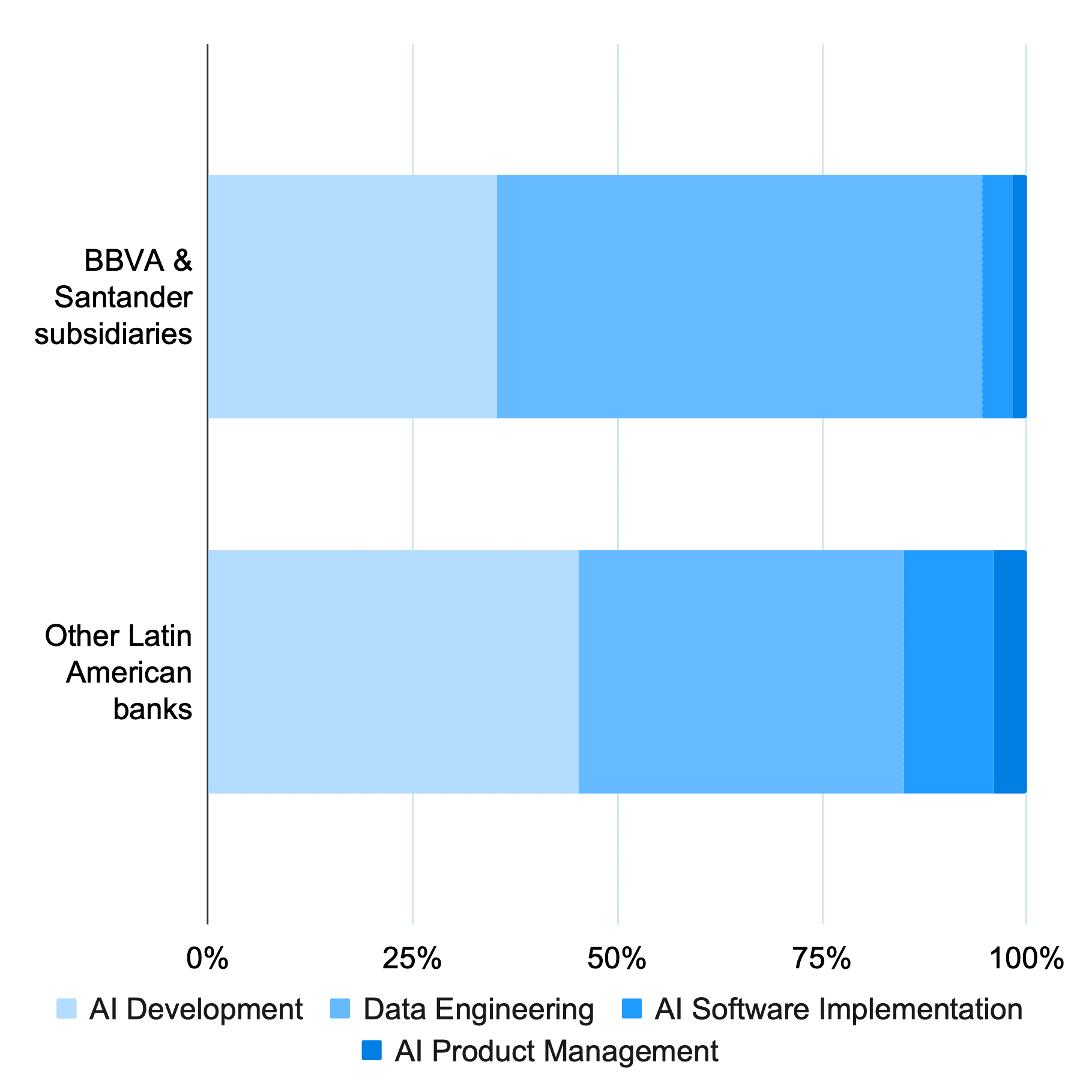
These global lenders have a great pitch: They can often offer top talent better pay, a bigger brand and a career path that extends beyond a single market. But their aggressive hiring – mainly of data engineers, people critical to setting up AI systems – has put Latin America’s regional players on the back foot. Now they need to find new ways to build talent pipelines before the biggest banks get there first.
BRAIN DRAIN
Global banks are hiring more data engineers than Latin America’s regional banks, which is slowing down some of the AI buildout.
Their focus has been on trying to get to AI talent early before the Spanish banks can woo them away. Brazil’s Banco Bradesco, for example, is offering a free AI and data analysis program for young people that ends with participants building a financial chatbot and presenting it directly to bank specialists. Banco de Chile is starting its recruiting process even younger: The bank backs a 150-hour AI program for high school students in the region that it uses to identify people it may recruit in the future. Bancolombia set up an early-career program called Talento B, and the most recent class brought 50 new young tech professionals into the ranks.
They’re also trying to raise their profile beyond their backyard to replace some of the AI talent that does defect to the global players. Itaú Unibanco runs a competition called the Quant AI Challenge, which invites university students to build investment strategies with Gen AI. Last year, more than 2,500 people registered, including students from North America and Europe alongside Brazil.
These programs are still small compared to the draw of the global players – which are launching their own new recruiting efforts as the homegrown banks get savvier. But the more talent regional banks can keep, the more time they buy themselves to build the foundation for bigger AI pushes.
COMING SOON: We’re launching our inaugural Evident AI Index for Banks - LatAm, covering 20 lenders across the region. Register your interest to find out more.
CATCH UP: JOIN OUR ROUNDTABLE
CAPTURING THE AI ADVANTAGE IN THE MIDDLE EAST AND AFRICA

This week we sat down with top AI banking execs from the leading Middle Eastern & African banks in the Evident AI Index. Watch the recording to catch up on:
- The enterprise-wide foundations setting banks up for successful AI adoption
- How leading banks are moving from AI activity to measurable AI impact
- Why talent remains the critical differentiator for scaling
- How national AI strategies in the UAE and South Africa are accelerating adoption
.svg&w=96&q=80)
TALENT MATTERS
JPMORGAN CDAO GOES
Teresa Heitsenrether, chief data and analytics officer at JPMorganChase, is retiring from her post at the end of the year after a nearly four-decade run with the bank. Heitsenrether served as CDAO and led the bank's AI efforts since 2023. She was instrumental in the development of the bank’s AI platform, LLM Suite, and, more recently, scaling AI into the firm’s lines of business (see: "Era of AI execution," The Brief, Feb. 19). She played a "pivotal role…in shaping the firmwide data and artificial intelligence strategy that is central to our future,” CEO Jamie Dimon and COO Jenn Piepszak wrote in a memo. Among the 50 lenders tracked in the Evident AI Index for Banks, she was the first AI head to be part of a bank’s executive committee and remains just one of six to hold a seat at a bank’s top table. Scot Baldry, the bank’s CTO, will take over Heitsenrether’s responsibilities, though he won’t be joining the executive committee, the bank said. He will report to CIO Lori Beer. Heitsenrether is the second high profile departure announced in a week: Consumer banking chief Marianne Lake said she would be leaving last Thursday as commercial and investment bank heads Doug Petno and Troy Rohrbaugh were promoted to be co-presidents. And earlier this year, Manuela Veloso, the bank’s AI research head, also left.
Olivier Crespin is now chief analytics officer at Singapore’s DBS. Crespin previously co-founded and ran Zand Bank, a neobank in the United Arab Emirates. Earlier in his career, he spent seven years with DBS, including as the head of its digital bank, where he launched India’s “first mobile-only, paperless, branchless bank,” he wrote on LinkedIn.
Westpac hired Richard Heeley to be its new CIO. He was previously CIO for banking and financial services at Macquarie. He’ll start at Westpac later this year and will oversee infrastructure, cybersecurity and engineering, the release said.
UBS named Jason Barron the AI transformation officer for its investment banking unit. The remit, according to a memo, is “setting clear direction, scaling what works, removing barriers, promoting the sharing of best practice and ensuring the right tools and data are in your hands.”
David Hardoon joined Accenture as head of advanced AI for Southeast Asia to focus on enterprise-scale deployment of Gen AI, agentic AI and responsible AI, he wrote on LinkedIn. He was previously global head of AI enablement at Standard Chartered.

NOTABLY QUOTABLE
“Who knew when the internet was born that the internet was going to create a million and a half jobs as Uber drivers? We are in the first or second inning of this [AI] revolution…I think the jobs will be greater, prosperity will be stronger.”
–Kevin Warsh, chairman at the Federal Reserve, on a panel, July 1

IN THE NEWS
CLAUDE GETS PAROLED
Anthropic is out of AI purgatory for now: The U.S. government lifted its export ban on Fable and Mythos, the lab’s two most-advanced AI models which were pulled off the shelf over national security fears on June 12. It means banks can once again build around the models or include them as an option in tools across the business. The lab celebrated by rolling out Claude Sonnet 5, a new version of its midsize (read: cheaper) model, which it says can handle agentic tasks that used to require its flagship. OpenAI hasn’t had the same luck. The ChatGPT-maker released its new GPT-5.6 models on Friday, but limited its access to a “small group of trusted partners” as the U.S. government reviews it.
AI “kill switches” are all the regulatory rage now: This week, Sarah Breeden, a Bank of England deputy governor, said the U.K.’s bank regulator is exploring whether guardrails, including a “kill switch,” are needed in autonomous trading. The comments follow a similar step up in U.S. regulatory scrutiny, which we spoke about with Mike Hsu, former acting comptroller of the currency (see: “What regulators really want,” The Brief, June 18). India’s central bank, meanwhile, proposed banks introduce “mandatory kill switches” in new draft rules out last week.
Santander inked a deal with CSIC, Spain’s national research council, on quantum computing and AI. The partnership will explore “trustworthy AI, privacy-preserving intelligence, advanced simulation, new computational paradigms and responsible AI governance at scale,” José Manuel de la Chica, the head of Santander’s AI lab, wrote. The bank has spent more than €84 million ($96 million) establishing university research programs in the last five years.
Goldman Sachs led a $110 million series C funding round into Taktile, a startup building agents that can take on tasks like approving loans, flagging money laundering, paying insurance claims or onboarding new banking clients. The firm serves more than 200 customers, including Allianz (#1 in the Evident AI Index for Insurance) and ABN AMRO.
WHAT'S ON
Tuesday 7 July
The Evident AI Index for Insurance Roundtable, Virtual
Tues 8 Sept. - Weds 9 Sept.
AI in Financial Services Europe, London
Thurs 23 - Fri 24
AI in Financial Services Workshop, Cambridge, MA
- Alexandra Mousavizadeh|Co-founder & CEO|[email protected]
- Annabel Ayles|Co-founder & co-CEO|[email protected]
- Colin Gilbert|VP, Intelligence|[email protected]
- Matthew Kaminski|Senior Advisor|[email protected]
- Kevin McAllister|Senior Editor|[email protected]
- Daniel Shackleford Capel|MD, Banking|[email protected]
- Maryam Akram|Senior Research Manager|[email protected]
- Alex Inch|Data Scientist|[email protected]
- Sam Meeson|AI Research Analyst|[email protected]
- Gabriel Perez Jaen|Research Manager|[email protected]
- Jay Prynne|Head of Design|[email protected]
- Marcus Gurtler|Junior Designer|[email protected]

