

DATA-DRIVEN INSIGHTS AND NEWS
ON HOW BANKS ARE ADOPTING AI
AI rent strike

Source: Adobe Firefly
5 November 2026
Welcome back to the Banking Brief. This week: Banks have to pay up to get access to cheap AI. The divide over who gets to build AI agents at banks is getting wider. Plus: A new challenger to Wall Street’s star fund managers.
People mentioned in this edition: David Abitbol, Bruce Ross, JinSung Kang, Anthony Green, Rinalds Krumins, Koren Maranca, Jenny Johnson, Gregory Bond, Gary Collier, Nir Bar Dea, Raffaele Savi, Carl Bachman Kharazmi, Ariana Salvatore, Steffen Nissen, Milton Maluhy Filho and others.
This edition is 1,899 words, a 6-minute read. Check it out online. If you were forwarded the Brief, you can subscribe here.
– Alexandra Mousavizadeh & Annabel Ayles

TOP OF THE NEWS
DIY AI
Banks have spent a fortune in recent years renting high-spec AI from frontier labs. Now, they're looking to get on the property ladder.
The AI equivalent of that means running open-weight models on your own GPUs rather than paying OpenAI or Anthropic every time someone sends a new request. The savings, as Revolut showed this week, can be huge: The neobank cut its AI coding bill by 90% by ditching Claude and running Chinese open-weight model GLM-5.3 in-house instead.
But as banks rush to get off the labs’ meter, they’re learning the same lesson every homeowner does: Owning the place comes with a lot of extra work (and bills) – in this case, expensive hardware and the engineers that can make it run. It’s leaving lenders racing to make sure savings on rented tokens don’t get swallowed up by the cost of producing their own.
“If you just get GPUs and upload weights on a GPU and you start doing some inference, you’re going to get terrible performance,” said David Abitbol, Revolut’s AI operations lead. Getting its 90% savings meant painstakingly tuning the bank’s setup to run as efficiently as possible, he said.
RBC this past week laid out why that’s no easy task. The bank built its own “AI farm” to run models in-house. “A huge amount of [the economic benefit from AI] comes from what’s…running on our own premises on our own GPU,” Bruce Ross, the bank’s group head of AI, told Evident during last month’s Symposium. But the path to those gains is anything but linear: Ask the bank’s researchers how many GPUs they need for work, and they’ll request four to six times more than they actually use, JinSung Kang, RBC Borealis’ infrastructure lead said. When the equipment is that expensive to buy and run, it makes figuring out the setup that will yield the best results “more of an art than a science,” he said.
Part of the reason for that is that bank demand for AI tends to be uneven given employees work set schedules. “If you only have interactive use cases, your GPUs are dark for 16 hours a day,” Anthony Green, distinguished architect at Red Hat, told Evident this week. That doesn’t mean the cost goes to zero; it just means the bank gets nothing for what it’s spending keeping the machines running. “One of the most expensive GPUs is the one that’s being underutilized,” said Rinalds Krumins, principal engineer at HSBC, at an event last month.
Banks are starting to find ways to fix that by “scheduling model evaluation, data processing, research experiments, and other deferrable work for off-peak hours,” Green said. China Merchants Bank, for example, found that its hardware was only being used some 35% of the time. By rejigging how workloads got scheduled this summer, the firm was able to boost that to 60%. In turn, it cut the amount it was paying for AI text processing by 60%, the bank said.
That work doesn’t come cheap, though. JPMorganChase has been hiring experts to come in and do something similar in its own data centers. Their starting salary is nearly $300,000. But as banks look to make AI cheaper in the long term, they may have no choice but to pay up, Red Hat’s Green said: “Executives are pushing this because once AI is business-critical, operational independence becomes non-negotiable.”
COMING SOON
THE FIRST EVIDENT AI INDEX FOR ASSET MANAGEMENT

Save the date. In two weeks, Evident launches the first AI Index for Asset Management, the global standard benchmark for AI maturity in the sector. Covering 30 of the world’s largest asset management companies, the Index will reveal who is leading the race and how the sector as a whole is evolving. Discover who will feature, and register your interest today to be the first to see the results.

STAT OF THE WEEK

That’s how many AI agents Morgan Stanley advisors have tried to build by prompting the bank’s AI platform, Koren Maranca, head of AI for the firm’s wealth management division, said this week. Most don’t make it past early testing, she said, but their ability to try to build something is the bigger point: “If you want to build your own agent, and if you have a level of knowledge and complexity, the world is your oyster," she said.
Zoom out: There’s a big difference between letting bank employees build their own agents and letting them build their own software. These AI agents at Morgan Stanley – or the 30,000 JPMorganChase talked about last year – handle pretty narrow tasks on someone’s desktop, like tracking portfolio returns. That keeps them from creating a mess for software engineers to clean up. "[Non-technical people] leave out the boring stuff like authentication, entitlements, end to end testing, build and deployment,” one JPMorganChase employee said this week. “You'll just get a load of slop.”
Case in point: This week, Goldman Sachs – which had previously extended developer tools like Claude Code and GitHub Copilot to bankers and traders – restricted access to just engineers and “strats,” employees who work between trading, quant research and software engineering. That may well help bolster the firm’s security (and lower its AI bills) in the long run. But it didn’t stop staff who had previously been told to make AI tools a part of their everyday work from being annoyed that the apps vanished, one employee told Evident.

EVIDENT AI INDEX FOR ASSET MANAGEMENT
MAN VS. MACHINE
In asset management, fund managers become stars by beating the market. To keep that status, they may need to start beating their own firm’s AI.
So far, the industry’s AI efforts have largely been aimed at giving those leading investors more hours in the day. The Evident AI Index for Asset Management – out Nov. 17 – will show that the vast majority of the 300-plus AI use cases launched by ranked firms are designed to save people time.
But firms are starting to change tack. Rather than just using AI to boost productivity, they’re feeding decades of investment expertise into tools capable of coming up with ideas of their own. It’s setting up a Kasparov or John Henry-esque competition inside firms over who can make a bigger splash on the bottom line: individual star managers using AI to make better calls or an AI drawing on collective wisdom.
BUYING TIME
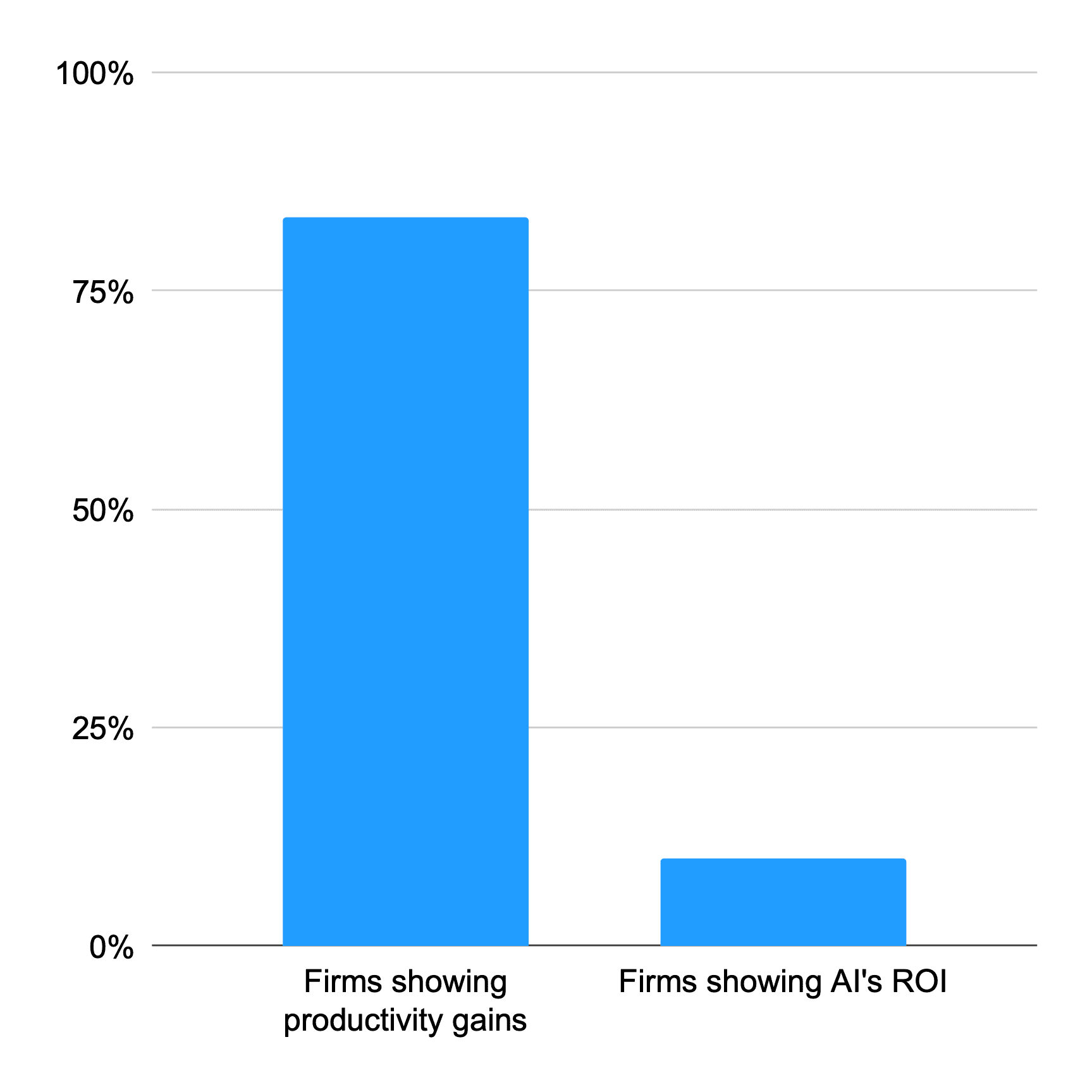
Of the 30 firms ranked in the upcoming Evident AI Index for Asset Management, 25 showed some productivity gains from AI while just 3 reported firmwide returns.
Firms are beginning to judge the differences side-by-side. At Blackstone, nearly every investment now comes with two memos, one written by the human deal team and another sourced from an “AI chief investment officer” trained on more than 14 years of memos and debates. Franklin Templeton, meanwhile, has more than 1,000 agents running across its investment operation, CEO Jenny Johnson said at an event in Hong Kong this week. The multi-asset team has a team member that’s a “full AI agent” which “will question some of the things they are doing.”
The hardest part of that kind of setup, Man Group found, wasn’t getting agents to generate ideas; it was building a way to figure out which were any good. At the London-based hedge fund, AI trained on historical investment data came up with 598 potential strategies for how the firm ought to place its bets, CIO Gregory Bond and CTO Gary Collier wrote in September. Just 42 were considered good enough, and only 20 are actually trading in production – not quite the hit-rate human managers tend to have.
But the groundwork is being laid for AI to be a bigger voice in the room. “The ideas that the AI is coming up with are different than the ideas that humans are coming up with,” Bridgewater Associates CEO Nir Bar Dea said last week. Back in 2023, Bridgewater found that AI could “generate the ideas that create alpha,” Bar Dea said. Rather than hand that capability to employees, it built what he called “a factory around AI intelligence.” That idea now underpins the AIA Macro fund, where AI generates investment ideas – albeit under human supervision. Through September, the $4.5 billion fund returned 16.4%, just shy of the 18.4% return from Bridgewater’s flagship Pure Alpha fund.
That may suggest humans still have the edge. But there’s no telling how long that’ll last. “There is no permanent source of alpha,” wrote Raffaele Savi, global head of BlackRock Systematic, in his hedge fund outlook last week. “There is only the discipline to keep searching for something different.”
COMING SOON: The Evident AI index for Asset Management will be released on Nov. 17. Want it in your inbox when it comes out? Sign up here.
THE 2026 EVIDENT AI SYMPOSIUM
WATCH EVERY SESSION

AI is already reshaping financial services. At this year’s Symposium, the question on stage was how firms become AI-first institutions, and what it takes to get there.
Throughout the day, speakers and attendees explored what it means to reimagine workflows end-to-end around AI, harmonize fractured technology stacks and harness knowledge from across the firm.

IN THE NEWS
CHECKS AND BALLOTS
The so-called “blue wave” in this week’s U.S. elections could usher in changes to tech and banking policy, lenders said. Just don’t expect it to happen overnight. “The agencies still drive merger approvals and financial sector deregulation,” said Ariana Salvatore, head of public policy research at Morgan Stanley. “Legislative implications are likely to be more limited than the political rhetoric might suggest.” But that doesn’t mean banks will get a free pass on AI either. A day after the election, the Office of the Comptroller of the Currency issued its first framework for supervising banks’ AI use. It doesn’t impose new disclosure requirements, but does direct examiners to pay specific attention to what capabilities banks have granted agents and what the consequences would be should they go rogue. Even nonbinding rules like this will be a wakeup call for some firms. “There’s a big difference between ‘guess’ and ‘empirical proof’ in terms of what agent(s) are doing,” Edward Achtner, head of applied AI at BMO, wrote of the implications.
HSBC will open a new AI and emerging tech institute in Hong Kong at the start of next year, the firm announced during Hong Kong FinTech Week. The move comes weeks after the Hong Kong Monetary Authority questioned the bank over its choice to make Singapore the home of a similar AI hub (see: “Stat of the week,” The Brief, July 30). While the Singaporean outpost will focus on building AI into wealth, treasury and digital payments operations, the new Hong Kong institute will focus on “AI enabled fraud detection and engineering optimization, post-quantum cryptography and blockchain,” the announcement said. In Singapore, the bank is hiring more than 100 AI specialists; the bank didn’t make a similar promise for Hong Kong, but said it will be working with the Hong Kong University of Science and Technology on access to the area’s talent.
Santander has nearly hit its 2026 AI value target, bank leadership told investors during its earnings call last week. Through the first nine months of the year, the Spanish lender has generated $216 million from AI through increased revenue, cost savings and lower loan-loss provisions. That’s 97% of the firm’s year-end goal and an increase from the $93 million it reported back in July (see: “Bare ROI,” The Brief, Aug. 13). By 2028, the bank expects to get $1.2 billion of benefits from usage of the tech.
Itaú Unibanco (#2 in the Evident AI Index for Banks - LATAM) is buying Brazilian model-maker NeoSpace for nearly $600 million in a move that looks strikingly similar to Nubank’s 2024 acquisition of Hyperplane. That purchase underscored the development of nuFormer, the credit lending model that helped the firm expand its market, and the improvement of other AI models in use across the bank (see: “Retro-chic AI,” The Brief, Aug. 20). Itaú had already been reaping the benefits of working with NeoSpace before the acquisition, CEO Milton Maluhy Filho told investors Wednesday: “The results that we have seen in our models, it is completely different,” he said. “We increased in 10 points the Gini of the models with high penetration, high accuracy.” In layman’s terms: Its AI models are now better at figuring out which borrowers might default, which, in turn, could help the bank grow its book.

NOTABLY QUOTABLE
“AI springs up in every different location, and sometimes the overexuberance of that, makes it very hard for central teams to then figure out signal through the noise.”
– Prashant Prahlad, SVP of product at Capital One Software, in an interview, Oct. 27

TALENT MATTERS
PAIR PROGRAMMING
Barclays hired Carl Bachman Kharazmi to be group head of engineering and architecture. He was previously global director and head of platform engineering at LeapXpert, a startup building a business communications platform. Earlier in his career, he was global head of cloud at Standard Chartered. It’s not the only engineering move the firm made: Steffen Nissen is now head of agentic engineering for the investment bank. In the role, he’s tasked with building “the pipeline that takes engineering work from a ticket to reviewed, tested, mergeable code with coding agents doing the engineering and people holding the approval points,” he wrote on LinkedIn. He was previously head of AI, UI and rapid application development for the bank’s credit unit and worked in software engineering at Credit Suisse before that.
Zsolt Szekeres is now executive director of AI evaluation and governance enablement at Morgan Stanley. He was previously global head of AI model risk management, where he led a team of 70 people in Morgan Stanley’s Budapest outpost.
Graham King was promoted to head of technology for risk strategy, data and AI at CommBank. He’s been with the bank for more than 15 years. In the new role, he’s “bringing together engineering, data and emerging AI capabilities to shape the future of risk,” he wrote.
Wells Fargo is hiring a principal engineer for agentic identity security to “deliver secure and scalable identity controls for AI agents and emerging autonomous technologies.” It comes as the bank asks customers to prove that they’ve turned off AI agents’ access to their bank accounts.
Leonard D’Amico joined JPMorganChase as executive director of AI/ML product strategy and delivery. He comes from PayPal, where he worked in enterprise resiliency and asset management governance.
Nirmal Mukhi joined Capital One as VP of AI engineering. He was previously chief architect at ASAPP, a firm that builds AI agents for contact centers.
Goldman Sachs hired Divyasri Chinthala as an AI software engineer. She was previously an AI engineer at Aviva, where she helped build an agentic claims support system and a real-time calls processing engine that reduced manual documentation time by 50%.
WHAT'S ON
OUT NOW
Full replay of the 2026 Evident AI Symposium
Sat 14 - Tues 17 Nov.
ICAIF ‘26, Milan
Weds. 18 Nov.
AI in Financial Services Summit, New York
- Alexandra Mousavizadeh|Co-founder & CEO|[email protected]
- Annabel Ayles|Co-founder & co-CEO|[email protected]
- Colin Gilbert|VP, Intelligence|[email protected]
- Matthew Kaminski|Senior Advisor|[email protected]
- Kevin McAllister|Senior Editor|[email protected]
- Daniel Shackleford Capel|MD, Banking|[email protected]
- Maryam Akram|Senior Research Manager|[email protected]
- Alex Inch|Data Scientist|[email protected]
- Sam Meeson|AI Research Analyst|[email protected]
- Gabriel Perez Jaen|Research Manager|[email protected]
- Jay Prynne|Head of Design|[email protected]
- Marcus Gurtler|Junior Designer|[email protected]

