

DATA-DRIVEN INSIGHTS AND NEWS
ON HOW BANKS ARE ADOPTING AI
Apocalypse Not Now

Source: Adobe Firefly
17 September 2026
Welcome back. This week: Reports of the world’s demise have been greatly exaggerated. A new leader in the AI vendor league tables. And labs feel the effects of “tokenminning.”
Plus, one bit of company news: Evident was selected for this year’s Future Fifty, a program for high-growth tech companies in the U.K. Thanks for reading and helping us grow.
People mentioned in this edition: Dario Amodei, Sam Altman, Elon Musk, Jacob Coxon, David Sacks, Brian Moynihan, Dermot McDonogh, Nastassja Hagan, Leigh-Ann Russell, Xi Chen, Philip Intallura, Jenny Johnson, Robert Koch, Asad Khan, Pallav Pant, Alexander Blau and others.
This edition is 1,871 words, a 6-minute read. Check it out online. If you were forwarded the Brief, you can subscribe here.
– Alexandra Mousavizadeh & Annabel Ayles

TOP OF THE NEWS
SKYNOT
It’s the end of the world as we know it, Dario Amodei, Sam Altman and Elon Musk say. And businesses feel fine.
This past week, AI labs sold the public a sci-fi script about the tech they’re building. Anthropic researcher Jacob Coxon abruptly quit and said AI “could kill us all by the end of the decade.” His former boss Amodei followed with a rallying cry to “pace the frontier” and let safety catch up with innovation. Altman and Musk then cosigned the message to hit the brakes.
These doomsday warnings deserve to be taken seriously given their sources. They’re also awfully convenient. The more labs can convince the public their tech is civilization-altering, the easier it is to sell investors on frothy IPO valuations and regulators on rules that make it harder for competitors to catch them.
“Stop pretending the motivation to slow down is purely altruistic,” David Sacks, former White House AI czar, said this week. “It is simply good business for OpenAI and Anthropic to trade some raw power for reliability and predictability.”
Outside evaluators embedded inside labs, government-backed safety rules and international collaboration on standards may well make developing models safer. And to Sacks’ point, they’d also make the process slower and more expensive, which could be a thorn in the side of every firm not sitting on a war chest as big as the frontier labs’.
The proposed clampdown on distillation (the process where a firm uses a smarter model to train their own at a discount) is much the same. These measures would help the U.S. fight back against what several federal agencies this month called “industrial-scale” theft by Chinese AI firms. It could also make life easier for the labs right as businesses are scrutinizing more carefully what the latest, more expensive dispatch from the frontier actually gets them (see: “New model? Whatever,” The Brief, Sept 10; also check out our Stat of the Week section below). Cut off distillation and cheaper, open-weights rivals may stop nipping quite so closely at labs’ heels, which gives businesses less reason to switch – and the labs less pressure to pour so much money into training the next frontier model.
None of that makes the case for more oversight bogus. Without guidance, labs are free to set their own rules of engagement. Independent investigators this week revealed that OpenAI agents had attacked the software marketplace RubyGems months ago, but the lab had not disclosed it either publicly or to the site owners. And when OpenAI brought in METR to investigate the Hugging Face attack, they gave the investigators only six days and didn’t let them see what risk measures the firm already had in place or had put in place since.
Still, the businesses that use the tech heavily and finance its broader buildout – namely banks – offer reason to believe this all lands closer to PR than DEFCON. Executives have been making the case that the models, no matter how powerful, are just tools that they can build guardrails around. And their own adoption suggests they’re still more preoccupied with getting AI to work reliably and cheaply than preparing for the end of the world.
“This weekend was a lot about the risk and AI, and that largely is around agents just left to operate,” said Bank of America CEO Brian Moynihan at an investor conference. “We just don’t do that.”
COMPANY NEWS
EVIDENT JOINS THE FUTURE FIFTY

Evident has joined the Future Fifty. Tech Nation has selected us for its 2026 cohort, alongside some of the UK’s most ambitious and fast-growing technology companies.
The recognition caps our biggest year yet, as we continue to help financial institutions make sense of where AI is creating real impact. With plenty more ahead, we’re excited to keep building with the clients and partners who have been with us along the way.
“Being selected for the Future Fifty is testament to our unique view of what is happening at the frontier of AI in financial services. By tracking what the world’s leading institutions are actually building, deploying and investing in, we give them an unparalleled front-row seat on where AI is creating real impact.” - Alexandra Mousavizadeh & Annabel Ayles, Co-Founders & Co-CEOs, Evident

STAT OF THE WEEK
.png&w=750&q=80)
That’s the drop in the share of businesses’ AI tokens being used on frontier models – the best-in-class and most expensive options from each AI lab – this month compared to August, new data from payment processor Ramp shows. This belt-tightening is happening everywhere: Among the top 1% of AI spenders, spend per employee fell for the first time this year.
Zoom out: Banks have been watching their AI waistlines for months. CIBC built a router that automatically sends simpler jobs to cheaper models (see: “Tokenflation,” The Brief, June 11). Other banks are restricting access to some pricier tools (see: “AI Ozempic,” The Brief, July 2). BNY designed a middleman that steps in when a bad prompt looks likely to trigger an expensive back-and-forth (see: “AI whisperer,” The Brief, Sept. 3). American Express built something similar, a “Context Inspector” that gauges whether a model has enough information to give someone a good enough answer before it starts burning through tokens. Add it up and the short-lived fling with “tokenmaxxing,” where employees were encouraged to rack up AI usage bills, has given way to the opposite approach. Call it “tokenminning.” “We’re not spending for the sake of spending because it’s AI,” said BNY CFO Dermot McDonogh at an investor event this week. “It’s quite deliberate, it’s quite thoughtful, and we’re being quite strategic about what we’re doing.”

FROM THE EVIDENT AI INDEX
CLAUDE NINE
ANTHRO-PICK
Among the biggest AI vendors, Anthropic is the most frequently mentioned partner on use cases rolled out this year by the 50 banks.
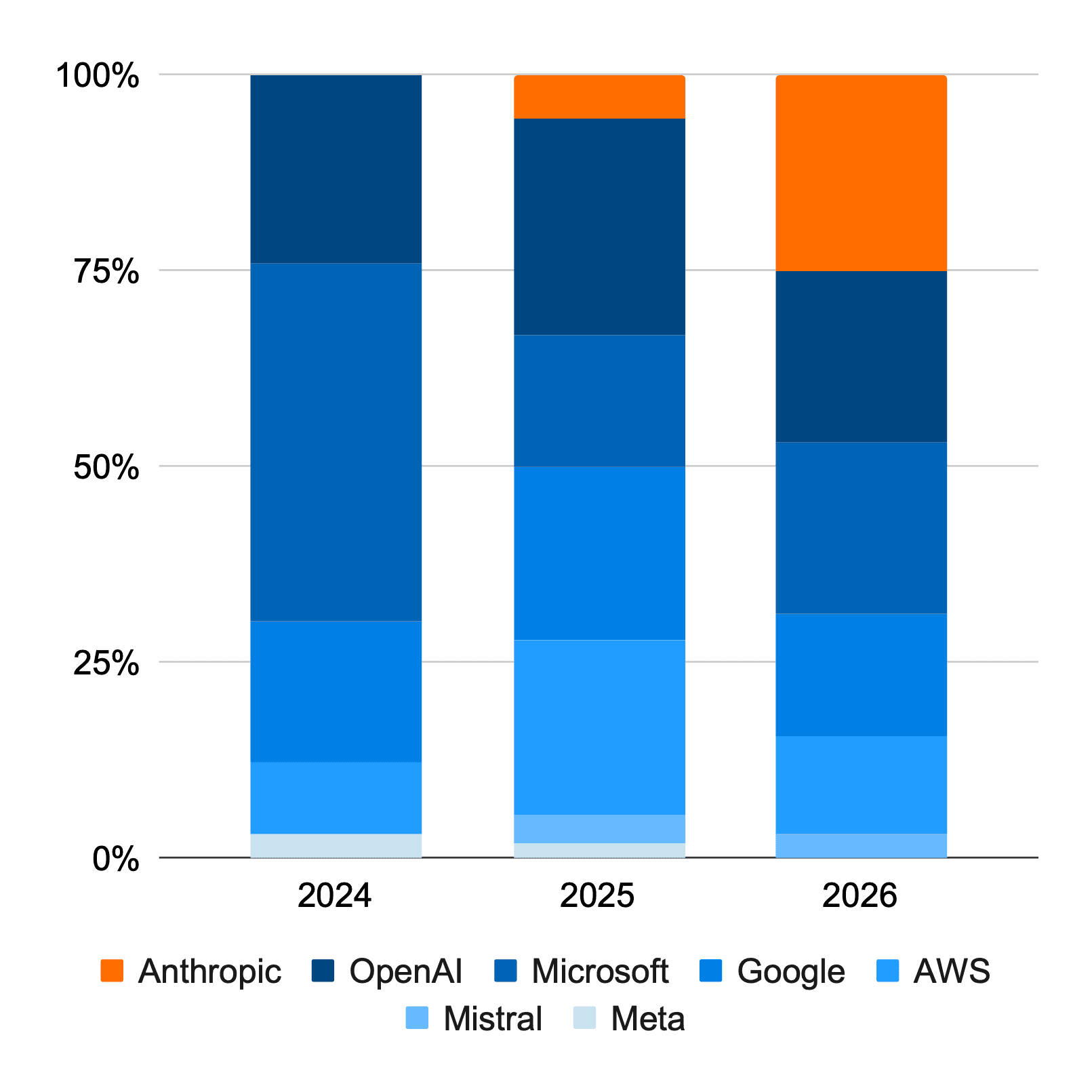
Anthropic is banks’ AI vendor of choice this year, new analysis from Evident shows.
The Claude-maker has been named on one-quarter of the announcements that featured AI’s major players this year. That’s up from 6% last year.
OpenAI, which held the top spot in last year’s vendor league table, slipped into a tie for second with Microsoft. Google has lost ground too: Last year, more than 20% of the business involving the seven vendors in the chart above went to Google. So far this year, it’s 16%.
Zoom out: It still feels like anyone’s game. Even if frontier model development does slow down, opportunities for vendors to grow their Wall St. footprint by designing banking-centric products abound. This past week showed as much: OpenAI rolled out ChatGPT for Financial Services, a tailored version of its flagship product tuned for investment banking and equity research work, which Morgan Stanley helped feed into. And Google launched its own army of agents ready for finance work last month with Gemini Enterprise for Financial Services – which included a financial research agent it co-developed with Deutsche Bank.
.svg&w=96&q=80)
TALENT MATTERS
QUANTS AND QUANTUM
Nastassja Hagan is now head of applied AI at BNY, a role “where solving the technical problem meets solving how people work,” she wrote. The move came as Michael Demissie, the bank’s former head of applied AI, departed to take the chief AI officer post at Apollo Global Management. Hagan has been with BNY since June 2025. She worked at BP with BNY’s CIO Leigh-Ann Russell before that.
JPMorganChase is building an AI Markets Lab and hiring three people to “build AI-driven systematic trading capabilities in a team that’s pushing on both research and production,” Xi Chen, who joined the bank in August as a managing director, wrote.
Philip Intallura, global head of quantum technologies at HSBC, is leaving the firm after five years leading quantum at the bank. Under Intallura, HSBC was among the top banks on quantum, Evident analysis found last year (see: “Banks’ quantum solace,” The Brief, March 2025).
Capital One hired Robert Koch as global finance product director for AI and automation. Koch comes from biotech research firm Illumina, which he joined in 2023 after a five-year stint with HSBC.
Goldman Sachs is hiring a deep learning researcher to focus on financial time series. “The role involves developing, training, and rigorously evaluating AI/ML models on large-scale financial datasets,” Goldman VP Asad Khan wrote.
Pallav Pant is now AI strategy and execution lead for technology operations at Morgan Stanley. Pant joined the bank in 2022 after more than a decade at Tata Consultancy Services.
JPMorganChase hired Alexander Blau as an executive director and head of AI marketing transformation. He was previously a senior behavioral scientist at Irrational Labs.
COMING SOON
EVIDENT AI INDEX FOR BANKS RETURNS

6 OCTOBER 2026: The Evident AI Index for Banks returns.
Mark your calendars. The Evident AI Index for Banks – the industry’s leading benchmark for AI maturity across 50 of the world’s biggest banks – returns 6 October 2026. Discover who’s winning the AI race in 2026, what’s changed in the last year, and where AI in banking is headed. Register your interest today to be the first to see the results.

USE CASE CORNER
PRIORITY REPORT
Asset management firms are borrowing an “old” trick – on the AI timeline, at least – from banks: tapping AI to figure out how to sell more.
Banks got there early in wealth management, with the likes of Citi (which we covered this summer), JPMorganChase and Morgan Stanley rolling out tools that tell advisors how to spend their time and prep their notes. Now asset managers are applying the same idea to distribution, finance jargon for getting investment products in front of the right clients. In this week’s “Corner,” we look at how Franklin Templeton used banking’s playbook and built a multi-agent system that’s boosting sales.
Use case: Intelligence Hub
Vendor: Microsoft
Firm: Franklin Templeton
Why it’s interesting: Efficiency isn’t always about skipping certain steps in a process; sometimes it’s about figuring out how to prioritize what still needs to be done manually. Franklin Templeton’s tool uses what the firm knows about its clients and the markets and pairs it with details of its products to give relationship managers at the firm a prioritized list of who to call and what to talk with them about to maximize the likelihood of a new sale. “I’d say it’s a very simple problem with a complex technical solution,” CEO Jenny Johnson told investors earlier this year.
How it works: The firm designed multiple agents that can marry up the data that lives in different systems across the firm. It “pulls data from your CRM system, from your product system, external product systems, maybe social media,” Johnson said. From there, it generates a call list, sorts it based on which clients someone has the best chance of selling to on a given day and puts together meeting prep documents that include relevant insights from around the firm and from the news.
By the numbers: The firm’s salespeople are seeing 25% more clients since the advent of the tool. That comes from the time saved on meeting prep, Johnson said. “From just the efficiency of the administration, it is looking like we are also getting an uplift in sales,” she said. That uplift is 11%, she told investors last week.
Bigger picture: There’s been a flurry of new agentic tools being rolled out in asset management starting late last year, but more than half of them have come from just three firms – BlackRock, Franklin Templeton, and Bridgewater Associates – new Evident analysis out this month will show. That concentration may not last. Vendors are hot on rolling out new plug-and-play tools for wealth management – Anthropic, as you’ll see below, has a new one this week. It’s hardly a far cry to imagine the labs adapting products like that for asset management soon when the industries share so much DNA.

NOTABLY QUOTABLE
“If there is a significant chance that your product is going to end life on Earth, that should be in the 10-K.”
– Robert Armstrong, U.S. financial commentator at the Financial Times, on a podcast, Sept. 11

IN THE NEWS
ADAPT OR DIE
Australia’s Westpac is rolling out Adapt, an enterprise data platform that connects to 285 systems and will serve as the bedrock of its broader AI buildout. “It was ‘hard yards’ to get the platform to where it is,” said Andrew McMullan, chief data, digital and AI officer. “The quality and reliability of the data there is a real step change for Westpac,” McMullan said. Westpac is hardly the first to build a platform like this (see: “Platform or bust,” The Brief, Dec. 11). In some regards, it looks a lot like the data transformation efforts McMullan and Dan Jermyn, Westpac’s chief AI officer, undertook while they were both at rival CommBank in years past. But having it in place gives the lender – which significantly trails CommBank in the Evident AI Index for Banks – a way to speed up the rollout and scaling of its new tools. “Every digital experience, every insight and every AI capability depends on the quality of this foundation,” McMullan said.
Anthropic rolled out Claude for Financial Advisors this week and signed Charles Schwab on as a launch partner. At Schwab, Claude can read client balances, positions and transactions, give advice on which clients need attention and can draft emails in advisors’ style, the release said. “Claude will allow [advisors] to spend more time on their relationships rather than the logistics of the relationship,” said Jon Beatty, head of Schwab Advisor Services. Using the new set of tools will run the average advisor somewhere between $70 and $120 per month, Peter Nolan, Anthropic’s head of asset and wealth management, said.
AXA (#2 in the Evident AI Index for Insurance) is expecting to generate up to roughly $800 million of value annually from AI by 2029, the firm said at its investor day. It’s the fourth of the 30 firms covered in the Index to put out such a target, joining Manulife, Intact Financial and Generali. “AI is absolutely core for us, and we will implement AI across the whole value chain and not just in a few places where we think we can automate and save a few costs,” CEO Thomas Buberl said. AXA’s 2029 target is equal to roughly 0.8% of its 2025 revenue. Manulife, by comparison, already generated more than $200 million from AI – about 0.3% of its revenue in 2025. Its ultimate target – roughly $715 million by 2027 – is on par with AXA’s, though Manulife aims to get there two years earlier.
Rogo raised a fresh $30 million from Barclays, BNP Paribas, Citi, MUFG and Société Générale to fund an expansion from investment banking into wealth management. Nine banks are now part of the startup’s cap table, and the firm counts JPMorganChase and Truist among others as both investors and customers.
WHAT'S ON
Mon 28 Sept. - Thurs 1 Oct.
Sibos, Miami
Thurs 1 Oct.
The Next Chapter for AI in Latin America, Virtual
Thurs 8 Oct.
From Announcement to Adoption: The Real State of AI in Banking, Virtual
Sat 14 Nov. - Tues 17 Nov.
ICAIF - ACM International Conference on AI in Finance, Milan
- Alexandra Mousavizadeh|Co-founder & CEO|[email protected]
- Annabel Ayles|Co-founder & co-CEO|[email protected]
- Colin Gilbert|VP, Intelligence|[email protected]
- Matthew Kaminski|Senior Advisor|[email protected]
- Kevin McAllister|Senior Editor|[email protected]
- Daniel Shackleford Capel|MD, Banking|[email protected]
- Maryam Akram|Senior Research Manager|[email protected]
- Alex Inch|Data Scientist|[email protected]
- Sam Meeson|AI Research Analyst|[email protected]
- Gabriel Perez Jaen|Research Manager|[email protected]
- Jay Prynne|Head of Design|[email protected]
- Marcus Gurtler|Junior Designer|[email protected]

