

DATA-DRIVEN INSIGHTS AND NEWS
ON HOW BANKS ARE ADOPTING AI
Back to AI future

Source: Adobe Firefly
20 August 2026
Welcome back to the Banking Brief. This week: Banks are using cutting-edge AI to make their old tech sing. Agentic payments are booming – unless you ask the people who might actually use them. Plus: Can cartoon characters boost AI adoption?
People mentioned in this edition: David Vélez, Shantanu Chandra, Brendan Rappazzo, Luke Gee, Claire Thompson, Kamaljit Singh, Bryan Lee, Nimrod Barak, Lalit Kumar, Tilak Joshi, Tan Su Shan and others.
This edition is 1,909 words, a 7-minute read. Check it out online. If you were forwarded the Brief, you can subscribe here.
– Alexandra Mousavizadeh & Annabel Ayles

TOP OF THE NEWS
RETRO-CHIC AI
Banks have found another use for all that shiny, new AI tech: making their old AI better.
Flashy AI avatars and autonomous agents may get all the fanfare (see: “Agentflation,” The Brief, July 16). But so far the returns from these advanced applications are largely absent (see: “MIA-gents,” The Brief Aug. 6).
Banks – as Nubank, JPMorganChase and Morgan Stanley showed in recent weeks – are now racing to find ways to make their big investments in frontier tech pay off in other ways. The bleeding edge tech, they’re finding, may be just as useful in sprucing up their old workhorse models from the past decade as it is at creating the sci-fi tools that capture the headlines.
Take Nubank: Last year, the bank replaced its old credit-risk model with NuFormer, one that uses the same building blocks – called transformer architecture – that LLMs like ChatGPT and Claude are built on (see: “Nu world order,” The Brief, June 25). Where the old model may have made a decision on lending based on set signals, like income or account balances, NuFormer takes a more holistic view and bases creditworthiness on a bigger slice of a borrower’s financial life.
That alone helped boost the bank’s business – which reported 40% revenue growth this past week. But the benefits of bringing elements of the frontier into tried-and-true models also means that when those models on the frontier use different techniques to get better, the bank can copy and paste them into its lending business. The latest NuFormer update took techniques pioneered by Chinese open-weight models including Qwen and Kimi K3 to process more information both faster and more cheaply, CEO David Vélez told investors. The result: The newest version of NuFormer quadrupled its context length (how much data it can process at once), its training speed (how quickly it learns) and inference speed (how quickly it produces a response). It’s done that while reducing the cost of running it in production. “Research is compounding gains in efficiency and model quality,” he said.
JPMorganChase is getting the same frontier lab hand-me-down effect in its efforts to fight fraud. Its Large Payments Model – which it detailed this week – brings that transformer architecture to a job previously done by older machine learning models. With the new model, it can take in more signals, interpret what they mean more efficiently and recognize the patterns of bad actors better than ever, the bank says. The results suggest that’s true: For one payment type, the new model caught 64% more fraud in terms of dollar value than the old model at the same operating cost, Shantanu Chandra, the bank’s head of applied science for payments, wrote.
Morgan Stanley is taking a slightly different approach, but still using the new tech to give old models a makeover. In a demo released to the public this month, the firm showed off AlphaLab, a tool which uses agents to automate the research that would go into creating predictive models for pricing or credit. Instead of getting human researchers to read papers and run tests, agents run the show."There's been a handful of models, all sorts of flavors, where we had a decent model already but we just turned it over to AlphaLab to keep kind of churning on it," said Brendan Rappazzo, an AI/ML researcher at the bank who left this month. “It's found meaningful improvements that are now working their way through risk and going into production.”
COMING SOON
2026 EVIDENT AI INDEX FOR BANKS

THIS OCTOBER: The Evident AI Index for Banks returns. Discover who’s winning the AI race in 2026, what’s changed in the last year, and where AI in banking is headed.
Register your interest today to be the first to see the results

STAT OF THE WEEK
.png&w=750&q=80)
That’s the share of AI use cases with vendors launched in the first half of 2026 by banks that named Visa or Mastercard as a partner, new data from the Evident Use Case Tracker shows. It puts these payments firms behind only the frontier AI labs as the biggest “vendors” for bank tools this year that weren’t built in-house.
What’s going on: Banks are jockeying to avoid being squeezed out of so-called “agentic commerce,” the futuristic process where AI agents search, compare and buy things for you. Their solution: Rack up a bunch of pilots and demos with Mastercard and Visa now. Payments companies are much more involved in building the plumbing for these agent-led transactions. But lenders are getting in now so their accounts play nice with agents should this kind of shopping actually take off. Banks, for their part, are mostly responsible for authenticating and approving these kinds of pilot transactions. Building up this capability is as much about defense as offense: Agents may not make the same decisions about which cards and accounts to use for a purchase as a human might. Banks want to understand how those choices are made so their cards don’t get passed over.
Yes, but: Consultants – who project that agents will facilitate up to $5 trillion in payments by 2030 – are a lot more bullish on agentic commerce than individual consumers and businesses. More than half of millennials, a generation with a soft spot for AI, wouldn’t let an agent buy something worth less than $250 for them even if they could return it within seven days, a new survey showed. At the same time, around half of merchants see agentic commerce as a threat to their business, in part because it can erode brand loyalty, a Visa survey out last month showed. That both sides of the agentic transaction are unenthused may not even be the biggest hurdle to getting the market off the ground: Regulators will want to figure out how liability for these agents works long before regular people get their hands on them.
.svg&w=96&q=80)
TALENT MATTERS
SCOTIA’S BIG SIGNING
Scotiabank hired Luke Gee to be chief data and AI officer, effective Oct. 19, a bank spokesperson told Evident. Gee joins from TD Bank, where he was chief analytics and AI officer. In the new role, he’ll report to Phil Thomas, the bank’s chief strategy and operating officer. Yannick Lallement had served as Scotiabank’s chief AI officer until February. He’s now VP of technology AI modernization at TD.
Claire Thompson is joining Barclays as chief data and analytics officer for the corporate banking unit. She was previously chief data officer at the wealth management firm Quilter and served as CDAO of Legal & General before that.
ANZ is hiring a head of architecture for data, analytics and AI in Bangalore who will lead “strategy, target states, roadmaps and architecture outcomes.” History says the bank may look to HSBC to fill the ranks: Kai Yang, chief data and AI officer, Donald Patra, the bank’s CIO, and CEO Nuno Matos are all HSBC alumni who have joined the Australian lender since last May.
Kamaljit Singh joined State Street as managing director of AI transformation, where he’ll be “leading the machine learning and AI-led transformation applied to asset management,” he wrote on LinkedIn.
Bryan Lee joined Singapore’s UOB as group head of data. He was previously a managing director at the Bank of Singapore, the private banking arm of OCBC. Earlier in his career, he was chief data and AI officer at AXA.
Nimrod Barak joined Synchrony as chief AI officer, where he’ll “be responsible for shaping Synchrony's AI agenda end to end.” Agentic commerce is “one of our key priorities,” he wrote on LinkedIn. He previously headed Citi’s AI center of excellence.
Lalit Kumar is now a forward deployed agentic AI engineer at RBC Borealis where he’ll be “combining deep technical work (MCP servers, RAG, multi-agent systems) with direct collaboration alongside business teams,” he wrote on LinkedIn. The move fits with a bigger trend of banks seconding their central AI teams into individual lines of business (and copying Palantir’s job title): Truist is hiring a senior director of forward deployed engineering, and Citi is hiring an SVP forward deployed engineer.
HSBC hired a “shadow AI consultant” to figure out how people are using AI beyond what’s provisioned. It’s a growing concern: Earlier this summer, Community Bank reported to the SEC that an employee had handled “certain non-public customer information using an unauthorized artificial intelligence-based software application.”
BOOK YOUR SPOT
EVIDENT AI SYMPOSIUM 2026

The Evident AI Symposium is our annual, invitation-only gathering of 300 senior AI leaders in finance. We come together each year to get real answers on how to drive AI transformation forward.
Over the course of the day, we’ll exchange insights on what it takes to deploy AI in global financial institutions today while surfacing the ideas and trends that will define what comes next.

USE CASE CORNER
HIGH FLYING AI
Giving employees access to loads of AI agents is hard. Getting them to remember what each agent should actually be used for is even harder. In this week’s “Corner,” we explore how a new tool from payments firm Block is using cartoons to make employees use AI better.
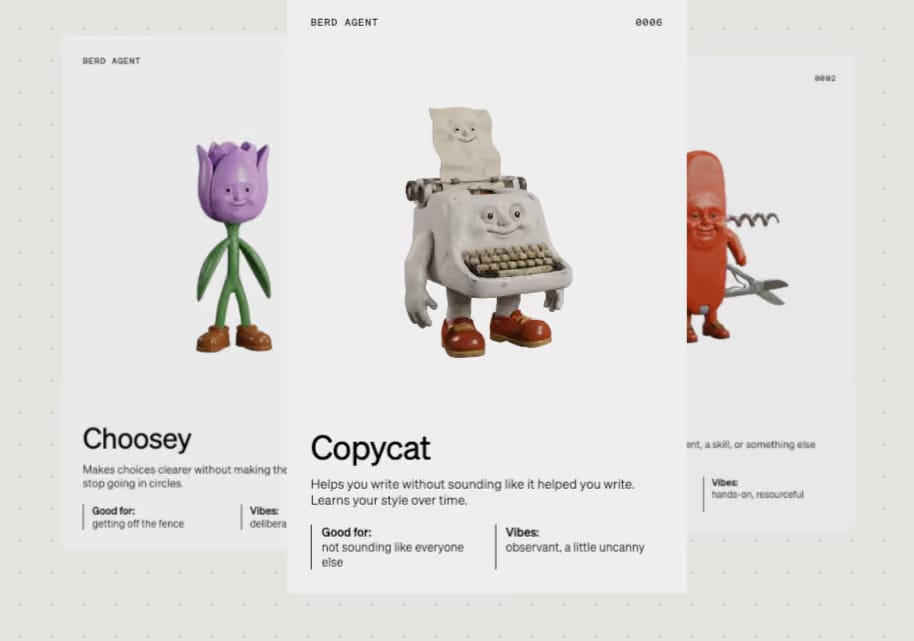
Use Case: Berd
Vendor: n/a
Firm: Block
Why it’s interesting: Block could see that its employees were juggling lots of AI tools at once: Claude to spin up some code, ChatGPT for some research, Goose – its own internal chatbot – to get company information (see: “Talk to me, Goose,” The Brief, Jan. 29). The company could also see that people weren’t always reaching for the right one for the task at hand. So it built Berd, a desktop app that puts all the tools in one place and gives each agent its own cartoon avatar. The firm sees it as a visual shortcut that lets its employees – especially non-technical ones – understand what’s actually happening behind the scenes when they prompt an AI tool.
How it works: Employees first write what they want to achieve, like you would in an LLM. The system decides which tools it needs to complete the job and then spins up what it calls “Gloopies” to show you which types of agents are going to help make it happen. One, for example, called Copycat will emulate how a user writes if the task involves generating text. Another, called Pushback, is designed to play devil’s advocate if the task involves making a decision.
How they did it: Block built the tool and open-sourced it, meaning other enterprises can download and use it. It sits on top of the tools already in use. It’s not just model agnostic, but harness agnostic – meaning it may choose a coding tool like Claude Code for one job and Codex for another, rather than just cycling through models.
By the numbers: Block says Berd isn't a revenue product, but something that makes its employees’ work more consistent. Because it’s centralizing where that work gets done, similar tasks get done to a similar standard. It also lowers the barrier to entry, the firm says.
Bigger picture: AI tools have long had names. One of BNY’s agents, for example, is named “Payment Pete,” and, as you can probably guess, it helps facilitate payments. Here a company goes a step further and giving its agents goofy faces and personalities to make it more memorable. Banks largely shy away from this kind of anthropomorphism over fears that making AI feel more human may lead some to trust its outputs implicitly. But if Block’s approach ends up yielding huge efficiency gains from non-technical staff, they may want to revisit that approach.

NOTABLY QUOTABLE
“At this point, saying that AI will cure cancer is more a cliche than it is inspiring, and most people think it is deceptive. The thing that will work is *actually curing cancer*. I think by far the most accurate criticism of AI companies including Anthropic is that we haven’t yet delivered on our big promises to benefit the world.”
– Dario Amodei, CEO at Anthropic, on X, Aug. 15

IN THE NEWS
AI CAVALRY ARRIVES
More than half of U.K. businesses say that AI has created new jobs, new survey data from Lloyds shows. Banks are no exception, especially in junior hiring: NatWest is doubling the number of engineers it's hiring out of school compared to last year, and Standard Chartered upped its entry level hiring in the corporate and investment bank by 46%, Bloomberg reported. In the Evident AI Index for Banks, the top five lenders all grew their headcounts in the last year, adding roughly 11,000 employees to the ranks in total, their latest earnings reports show.
A GitHub outage on Monday stopped developers — including those at some banks — from using AI coding tools for nearly eight hours. Tech services go down now and again, but with AI tools, it’s becoming a feature rather than a bug (see: “APIs go AWOL,” The Brief, Oct. 16). Cloud services tend to have “five nines of reliability,” engineering shorthand that means it works 99.999% of the time. In the last 90 days, GitHub’s “uptime” sits at 99.08%. That may sound small, but it’s the difference between a service being unavailable for five minutes a year and roughly 80 hours a year. “When the world became dependent on the internet, we built redundancy, failover, and an entire industry obsessed with five nines,” wrote Tilak Joshi, who works on Gen AI platform engineering at JPMorganChase. “Inference industry is heading there — but not there yet. If your inference provider goes down, you go down.” Said another way: “Today’s GitHub outage demonstrates the need for internally hosted coding focused models,” wrote Naveen Sankar S., an executive director at Wells Fargo.
Bank of China, the fourth-largest bank in China by assets, is using AI token consumption to determine credit worthiness for corporate lending. The bank now offers “Computing Power Token Loans” of up to $4.45 million, which companies can apply for by showing the bank their AI token usage bills. The bank sees it as a way to fund companies that don’t fit the normal lending criteria, namely startups with low headcounts, sparse balance sheets and irregular cash flows that are nonetheless growing fast by deploying AI. So far, it’s approved a total of $4 million in this type of loan spread across five companies.
Beijing’s AI blitz continues: Alibaba this past week released a smaller version of its flagship model, Qwen 3.8, that’s fit to run on a laptop rather than expensive data center hardware. DeepSeek, meanwhile, rolled out DeepSeek Harness, which is a bit like Anthropic’s Claude Code or OpenAI’s Codex. Banks haven’t yet adopted Chinese AI with open arms (see: “Red AI scare,” The Brief, July 23). But it’s not as taboo as it once was: “We use all tools,” said DBS CEO Tan Su Shan during the Singapore bank’s earnings this month. That includes Chinese models, she added.
WHAT'S ON
Tues 8 Sept. - Weds 9 Sept.
AI in Financial Services Europe, London
Tues 8 Sept.
The Next Chapter for AI in Latin America, Virtual
Mon 28 Sept. - Thurs 1 Oct.
Sibos, Miami
- Alexandra Mousavizadeh|Co-founder & CEO|[email protected]
- Annabel Ayles|Co-founder & co-CEO|[email protected]
- Colin Gilbert|VP, Intelligence|[email protected]
- Matthew Kaminski|Senior Advisor|[email protected]
- Kevin McAllister|Senior Editor|[email protected]
- Daniel Shackleford Capel|MD, Banking|[email protected]
- Maryam Akram|Senior Research Manager|[email protected]
- Alex Inch|Data Scientist|[email protected]
- Sam Meeson|AI Research Analyst|[email protected]
- Gabriel Perez Jaen|Research Manager|[email protected]
- Jay Prynne|Head of Design|[email protected]
- Marcus Gurtler|Junior Designer|[email protected]

