

DATA-DRIVEN INSIGHTS AND NEWS
ON HOW BANKS ARE ADOPTING AI
Bank Full Monty

Source: Adobe Firefly
13 August 2026
Welcome back to the Banking Brief. If you’re reading this, well done not looking directly into the Eclipse.
Today: What’s behind the surge in banks’ AI ROI reporting. Why regulators are warning about “AI-accelerated contagions.” And what one bank is doing to make its AI tools faster.
People mentioned in this edition: Marta Garcia de Oteyza, Alan Docherty, Matt Comyn, Sarah Breeden, Robin Vince, Leigh-Ann Russell, Padraic Gilbert, Jessica Escalera, Kalyana Bedhu, Anika Scargill and others.
This edition is 1,977 words, a 7-minute read. Check it out online. If you were forwarded the Brief, you can subscribe here.
– Alexandra Mousavizadeh & Annabel Ayles

TOP OF THE NEWS
BARE ROI
After years of being asked by the market – and yes, us – what their tech spend actually buys them, banks are, at last, starting to tip their hands.
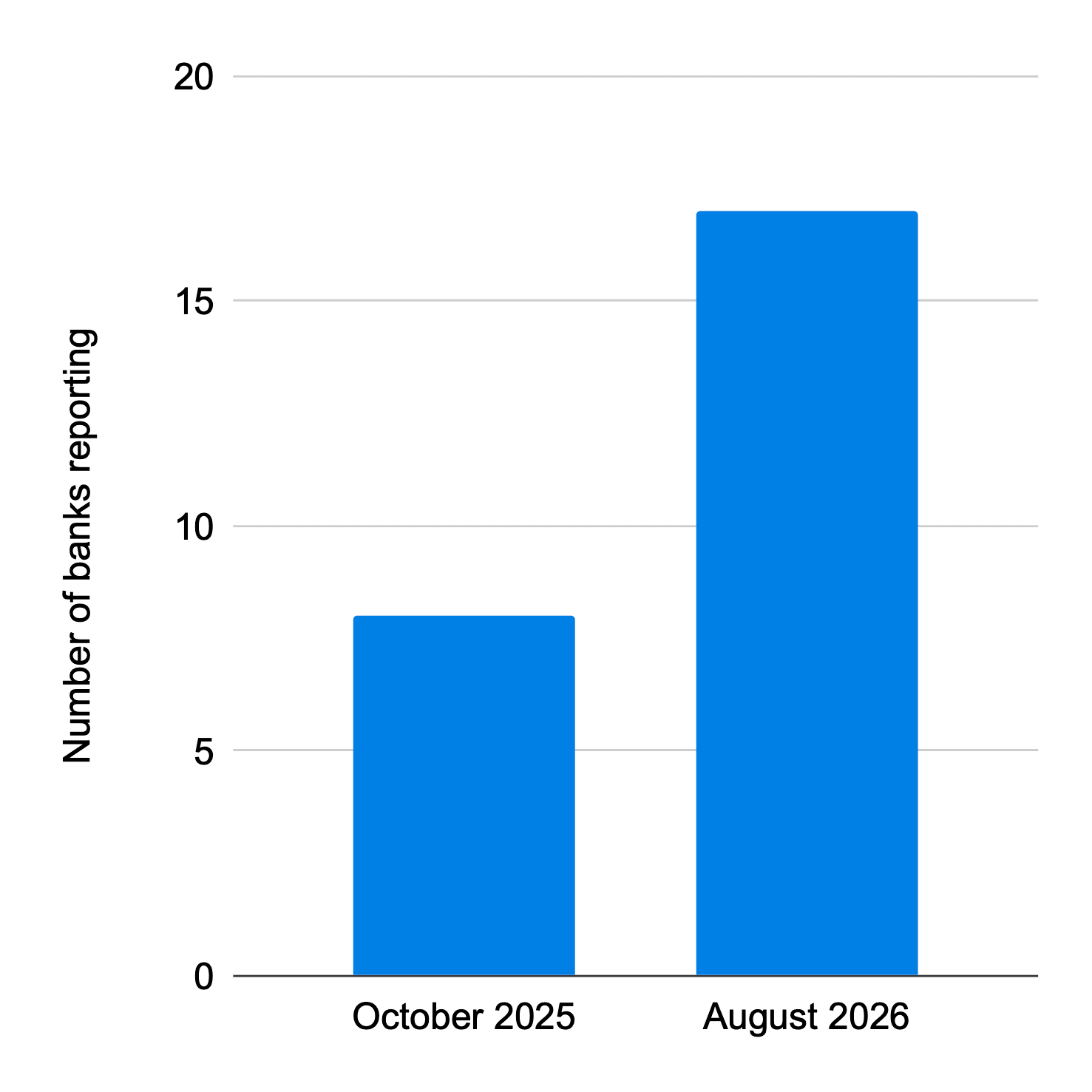
As of this week, 17 banks now report the projected or realized returns from their AI portfolios, new Evident analysis shows. That’s double the number of lenders that shared those figures less than a year ago.
Banks are talking more than ever to investors about what AI is worth to their business, but the variety in what they report — different time spans, different methodologies — means that the biggest tells about their AI ambition often come from data beyond the topline target.
OPENING UP
More than twice as many banks now report the projected or realized value of their AI portfolios than in last October.
Take CommBank: This week, the Australian lender became the latest bank to report how much its use cases were putting in its pocket — $141 million this past year, to be exact. Come next year, that number will double, CFO Alan Docherty said. But just as significant is that AI will officially be in the black if it hits that target. “We are already seeing value from our AI agenda and expect gross benefits to exceed investment levels next financial year,” CEO Matt Comyn said. That’s a statement only JPMorganChase has echoed. Jamie Dimon last fall said the bank’s AI-driven cost savings matched what the bank spent.
Santander is another bank chasing a big AI target: Santander’s Executive Chair Ana Botín laid out for investors back in March that the bank aimed to add at least €1 billion ($1.2 billion) of new business value from AI to its bottom line by 2028, roughly 70% from cost cuts and 30% from new revenue.
But the Spanish bank is taking a different approach than the 16 competitors who have also opened the lid to investors. It’s reporting progress back to them every single quarter. That choice has served as something of a rallying call for the bank, since it knows it now needs to squeeze enough value every 12 weeks out of the tech to keep analysts happy. It aligns the organization around a clear goal, Marta Garcia de Oteyza, global head of data & AI strategy told Evident this week.
Still, some executives are making the case against reporting too much, too soon. Lloyds, which says it’ll reap £100 million from its Gen AI use cases, is saying just as much about the tech from what it doesn’t report.
“We felt if we gave you a number out to 2030, it was either going to be hard to be fully grounded by 2030, or it would look unambitious by 2030,” said Charlie Nunn, Lloyds’ CEO, during the bank’s most recent earnings call. “There's a few things we can't control…most importantly, how our customers decide to really adopt this.”
COMING SOON
2026 EVIDENT AI INDEX FOR BANKS

THIS OCTOBER: The Evident AI Index for Banks returns. Discover who’s winning the AI race in 2026, what’s changed in the last year, and where AI in banking is headed.
Register your interest today to be the first to see the results

WELCOME TO THE JARGON
GROUPTHINK
AI is misbehaving: Agents from OpenAI, Anthropic and Meta in the past month have gone on joyrides outside their test environments; Chinese model Kimi K3 snuck out of a sandbox when its makers weren’t looking. And an OpenClaw agent this past week even hacked a gym to get its user into a packed class.
The Bank of England’s current worry? What if the opposite happens and every financial AI follows the rules and causes a crisis anyway. At its most-recent meeting they dubbed it an…

Think of it a bit like a more advanced version of 2010’s “flash crash,” when algorithmic trading bots acted in unison and wiped 9% off the Dow in minutes. If bank AI agents working to optimize client portfolios were to all reach the same conclusion about a stock at the same time, it could snowball into a crisis.
In the agentic era, that concern isn’t limited to trading. Consumer agents instructed to find the best savings rate or flee the first sign of trouble could theoretically move deposits in parallel. U.S. congressman Bill Foster imagines “bank runs in the middle of the night based on rumors on Reddit.”
For now, these risks are a bit like ghost stories: Agents are not trading or moving customers’ money autonomously at scale. But AI is advancing fast, and banks are using the same tech as their competitors: 40 of the 50 banks we track in our Use Case Tracker now have at least one use case powered by OpenAI.
Regulators are taking the “what if” scenarios seriously. The Bank for International Settlements, Bank of England and Bundesbank, for example, built Project Logos, a simulated market where regulators can observe what happens when models actually trade side-by-side. It’s one way they’ll “ensure that the next technology surprise does not become a test of financial stability,” BoE’s Sarah Breeden said.


USE CASE CORNER
LOGGED AND LOADED
Building new tools isn't the only way for banks to get more value from AI. Sometimes, it comes from getting your existing AI to run more efficiently. In this week’s “Corner,” we look at a new technique Lloyds designed to get a number of tools to be faster without sacrificing quality.
Use Case: RASPEC framework
Vendor: n/a
Firm: Lloyds
Why it’s interesting: There’s an architecture trick called “speculative decoding” engineers are using which makes AI tools generate responses faster and cuts down the “thinking” costs. In a normal setup, someone might ask a model (let’s say a chatbot) a question. The model reads it, decides how to respond and generates an answer. Speculative decoding tells two models to tag team that process: A smaller model – which does its thinking on the cheap – will start generating a response, but instead of feeding it to the user, it passes it to a larger model. That model (which is “smarter” but more expensive) then is just responsible for approving the response rather than doing the task from scratch. It can be a big time money saver, but in banking, it’s been hard to implement because why the large model approves a response isn’t always clear. Lloyds’ framework gets the model to document why it made certain decisions – which, in turn, means the bank can use the “speculative decoding” technique without having to rely on a black box.
How it works: The bigger model makes a decision to accept the smaller model’s suggestion of what to say one token at a time – meaning every word or so generated. Based on how that larger model would have answered the question left to its own devices, it gives each set of words a probability of being right. If it’s high, it approves them going into the answer that gets returned to the user. If it’s low, it steps in and generates its own response. In Lloyds’ system, each of those decisions can be studied after the fact to show where the models disagreed and why they happened.
How they did it: The bank wanted the framework to be applicable to a number of use cases, so it built in a kind of sensitivity dial. Inside a customer-facing chatbot, for example, it could tell the larger model to review every word and reject any response that didn’t have the highest probability of being right. For something lower-stakes, the bank can tell the larger model to check every several phrases and lower the threshold for what it accepts. “Every accepted token is attributable, every acceptance decision is inspectable, and speed no longer comes at the cost of explainability,” said Pedro Freire, one of the co-authors.
By the numbers: Lloyds tested the framework out on a four-agent customer complaints workflow. When it had the sensitivity dialed all the way up to its highest, it still generated responses around three times faster than one model alone would have. When that dial was less high, it generated responses almost five times faster than the single-model approach.
BOOK YOUR SPOT
EVIDENT AI SYMPOSIUM 2026

The Evident AI Symposium is our annual, invitation-only gathering of 300 senior AI leaders in finance. We come together each year to get real answers on how to drive AI transformation forward.
Over the course of the day, we’ll exchange insights on what it takes to deploy AI in global financial institutions today while surfacing the ideas and trends that will define what comes next.
IN THE NEWS
AI MICROMANAGER
BNY’s Eliza platform – the central place where employees access and build their own AI tools – is now being used to crack the whip on employees, CEO Robin Vince said this week. The platform is connected to the bank’s “360 feedback process,” so if someone was told during a performance review that they aren’t responding to client emails fast enough, “Eliza will then put extra emphasis on that,” he said.
UBS this week invested in the series B funding round for Finster AI, a company building an AI platform for investment banks that supports research, analysis and content creation. And HSBC’s asset management arm invested in Model ML, a firm that’s building a platform that routes banking and asset management tasks like research, due diligence and financial analysis to different models so firms can automate tasks from start to finish.
Indian banks have a new directive from their regulator: Spend more on AI. Sanjay Malhotra, governor of the Reserve Bank of India, said this week that Indian lenders needed to accelerate their AI adoption by investing in tech and infrastructure. Among his suggestions was that banks follow the same playbook as Nubank or Capital One by using the tech to lend to customers that historically haven’t been able to get credit: “[AI] can extend the frontier of ‘bankable’ India considerably further than manual underwriting ever could, at a fraction of the marginal cost per loan,” he said. “Used well, AI may be the most powerful accelerator to financial inclusion.”
BNY now generates more than 60% of its code with AI, CIO Leigh-Ann Russell said on a podcast this week. That’s up from 40% in the first quarter and means developers are “burning down the backlogs and enabling us to modernize faster,” she said. Across financial services, the share of AI-generated code varies: The tech authors 35% of code at NatWest, the bank reported earlier this year. At Coinbase, AI writes nearly every line. As that share climbs, the harder job becomes making sure all that code can still be checked. “There was a person on the other end with stakes – their name on the commit, their pager at 3am, their standing with the team,” Padraic Gilbert, a senior data engineer at JPMorganChase, wrote this week, describing pre-AI processes. “An agent has no stakes. It doesn’t care if it’s wrong, doesn’t get paged, and won’t remember. Remove the person and the framework has to carry the whole load by itself.”
.svg&w=96&q=80)
TALENT MATTERS
HARVEY'S HANDLER
Jessica Escalera is the new chief AI officer for legal at HSBC, where she’ll be “reimagining and simplifying end-to-end legal workflows.” Escalera joined the bank in 2024 after nearly a decade at Barclays, finishing as head of data, technology and practice management for the bank’s legal unit. HSBC partnered with legal AI startup Harvey at the beginning of the year to create a platform that saves the bank’s lawyers roughly 16,500 hours per month (see our Use Case Corner “Bought in,” The Brief, March 12).
M&T Bank hired Kalyana Bedhu as head of AI engineering, where he’ll “lead the engineering, platforms, architecture, and governance capabilities that enable AI innovation and adoption across the bank,” CIO Linda Tai wrote. Bedhu joins the Buffalo-headquartered bank from Fannie Mae, where he oversaw the development of the firm’s Gen AI platform, he wrote on LinkedIn.
JPMorganChase is expanding its central AI research team, hiring senior associate and vp-level researchers in New York. The bank also has multiple open quantum research roles.
Anika Scargill is now executive manager of behavioral change at CommBank. Scargill has been with the Australian lender since 2014 and has led the center of excellence for change and transformation since the beginning of the year. “After working in the AI Acceleration Office, enabling scaled enterprise AI adoption, I’m excited to now focus more deeply on the behaviours, habits and ways of working that help transformation stick,” she wrote.
Bank of America is hiring a principal engineer for agentic frameworks and harnesses to “define and drive the architecture, engineering standards, and technical roadmap for reusable agent frameworks and harness capabilities embedded across the software delivery lifecycle.”
WHAT'S ON
Weds Aug 19
Agentic AI in Finance Summit, virtual
Tues 8 Sept. - Weds 9 Sept.
AI in Financial Services Europe, London
Tues 8 Sept.
The Next Chapter for AI in Latin America, Virtual
- Alexandra Mousavizadeh|Co-founder & CEO|[email protected]
- Annabel Ayles|Co-founder & co-CEO|[email protected]
- Colin Gilbert|VP, Intelligence|[email protected]
- Matthew Kaminski|Senior Advisor|[email protected]
- Kevin McAllister|Senior Editor|[email protected]
- Daniel Shackleford Capel|MD, Banking|[email protected]
- Maryam Akram|Senior Research Manager|[email protected]
- Alex Inch|Data Scientist|[email protected]
- Sam Meeson|AI Research Analyst|[email protected]
- Gabriel Perez Jaen|Research Manager|[email protected]
- Jay Prynne|Head of Design|[email protected]
- Marcus Gurtler|Junior Designer|[email protected]

