

DATA-DRIVEN INSIGHTS AND NEWS
ON HOW BANKS ARE ADOPTING AI
Banks to AI labs: ‘It’s complicated’

Source: Adobe Firefly
25 June 2026
Welcome back to the Banking Brief. This week: Banks are reminding AI labs that while they sure like dancing with them, the night is young. Then, what Nubank needs to do with AI to avoid the neobank fizzle when it comes North. Finally, don’t miss your chance to register for our Middle East and Africa banking roundtable next week.
People mentioned in this edition: Mike Pizzi, Teresa Heitsenrether, Victoria Ledda, Rodrigo Castillo, Gavin Munroe, Kelly Taira, Augustin de Kerversau, Richard Taylor, Ann Barron-DiCamillo, Derek Neldner and others.
This edition is 1,808 words, a 7-minute read. Check it out online. If you were forwarded the Brief, you can subscribe here. Write us: [email protected].
– Alexandra Mousavizadeh & Annabel Ayles

TOP OF THE NEWS
ON THE ROCKS
Sam and Diane. Ross and Rachel. Now: banks and frontier labs.
Lenders and top AI firms like Anthropic and OpenAI have been all over one another for the last year. But recent months have seen the relationship on the rocks. First, rising token costs began to gouge banks (see: “Tokenflation,” The Brief, June 18). Then, last week, JPMorganChase joined Goldman Sachs in cutting Hong Kong-based employees off from using Anthropic models as the fallout from the White House’s order to take Fable 5 offline continues.
As with every on-again, off-again couple, there’s too much history for this to be a real goodbye: Our data on 50 banks shows the number of public use cases referencing OpenAI or Anthropic has grown more than 70% in the last year. But banks are using the rough patch to double down on model agnosticism – their ability to swap labs’ models in and out of their tools – and remind the labs that the relationship is still open.
“We just are too large an organization and we’re too embedded in the ecosystem of the financial services world to have any over-reliance on a single provider,” said Teresa Heitsenrether, JPMorganChase’s chief data and analytics officer at a conference last week. The bank has been ringing the bell for agnosticism for well over a year now (see: “Age of promiscuity,” The Brief, May 29, 2025).
Architecting a system that can deliver the same result using Claude today, GPT tomorrow and a cheaper open-source model next week takes a particular type of engineering though. “Keeping your architecture open and flexible is really the way you should be designing things,” said Mike Pizzi, global head of technology and operations at Morgan Stanley, at the same event. “Now sometimes if you take a little bit of lock-in risk – which no one really wants to do – you may be able to get to market faster; that's the choice that people in my position have to make.”
In Morgan Stanley’s case, the decision to avoid that lock-in has meant working backwards until it gets to the most efficient way to get the best outcome on a particular task. “Let's build to the best model and then let's bring the models down to the most efficient where there’s really no deterioration,” Pizzi said.
More banks are putting that switching of models on autopilot. CIBC, for example, is taking away some model choice in CAI 2.0, the next version of its flagship AI platform, and using a system it built to match tasks to the right model, Chris Patterson, head of enterprise AI platforms and solutions told us this month. Vendors are moving into that same gap: Japan’s Sakana this week released a new plug-and-play system to make sure tasks get sent to the right tools.
The real end goal is to make sure model agnosticism becomes so embedded that it doesn’t actually impact decisionmaking, even when models get pulled off the shelf like they have in Hong Kong. “I don't want [business lines] to have to worry about the tools or how things interoperate or work together,” JPMC’s Heitsenrether said. “What I want you to do is focus on what are the things in your business that matter.”
LAST CHANCE: JOIN OUR ROUNDTABLE
CAPTURING THE AI ADVANTAGE IN THE MIDDLE EAST AND AFRICA

Next week, we go live with banking execs from Emirates NBD, Standard Bank Group and First Abu Dhabi Bank to explore what's really driving AI adoption across the Middle East & Africa. Don't miss your chance to put your questions to our panel live.

STAT OF THE WEEK

That’s the number of people Lloyds will place in new agentic AI roles over the next year, part of a broader push to have 1,000 people working on the bank’s biggest agentic use cases by the end of 2026. Some of that agentic work is already in production. The bank rolled out a multi-agent fraud prevention system this month that verifies identities, assesses suspicious transactions and helps employees figure out what to ask customers next in real time. “This is one of the first use cases globally where agents are being used in fraud prevention and detection, and we very deliberately chose to pick a use case where humans are in the loop,” Tom Martin, the bank’s business platform lead for economic crime prevention, told us in an interview this week. In the Use Case Tracker, our database of all publicly-available use cases, only Capital One and Citizens Financial have agentic fraud tools. As the bank scales more agentic tools, it needs the right mix of people. “One of the key controls that any bank or business needs to have is the quality of its people,” Martin said. “That’s why we’re investing so heavily there.”
Zoom out: Leading banks are leaning into hiring: The top 10 lenders in the Evident AI Index for banks have grown their headcount by 4% in the past year, according to the latest publicly-available data. The bottom 10 banks’ workforces have shrunk 2.5%. “AI is not going to replace junior bankers,” said Derek Neldner, CEO of RBC Capital Markets last week. “We’re very much in growth mode. We’re looking to hire, we’re increasing our hiring.” Bank of America is showing it’s taking the same approach, with about 4,000 new faces starting this month via internships and post-graduate hiring (see: “Campus hero,” The Brief, June 4). Banks are also launching large-scale retraining programs to keep headcount on the books (see: “Stat of the week,” The Brief, May 21). The end result is the same: The more work AI does, the more people a firm needs to harness it fully.

BEYOND THE INDEX
NU WORLD ORDER
Nubank conquered Latin American finance by using AI to give people locked out by the banking system a way in. Its next act – a U.S. move – hinges on whether the AI strategy it laid out this month can give people locked into their banks a good enough reason to leave.
The Brazilian neobank, founded in 2013, has grown dramatically in South America. Since 2020, it doubled its share of total accounts in Brazil and now serves 135 million customers across markets. More than 60% of Brazilian adults now have an account. And in March, it reported that it had grown its assets by 43% compared to the previous year.
The U.S. market won’t hand Nubank the same opening, as neobanks have found in the past (see: “Who’s afraid of neobanks,” The Brief, Oct. 16). But Nubank is entering the market with preexisting scale other neos haven’t had. With it comes a chance to use data and AI to mount the first real threat to retail banks’ bottom line.
NU BLOOD
Nubank has more than doubled its share of Brazil’s total number of bank accounts in the last five years, surpassing all other non-state-owned banks in the country.
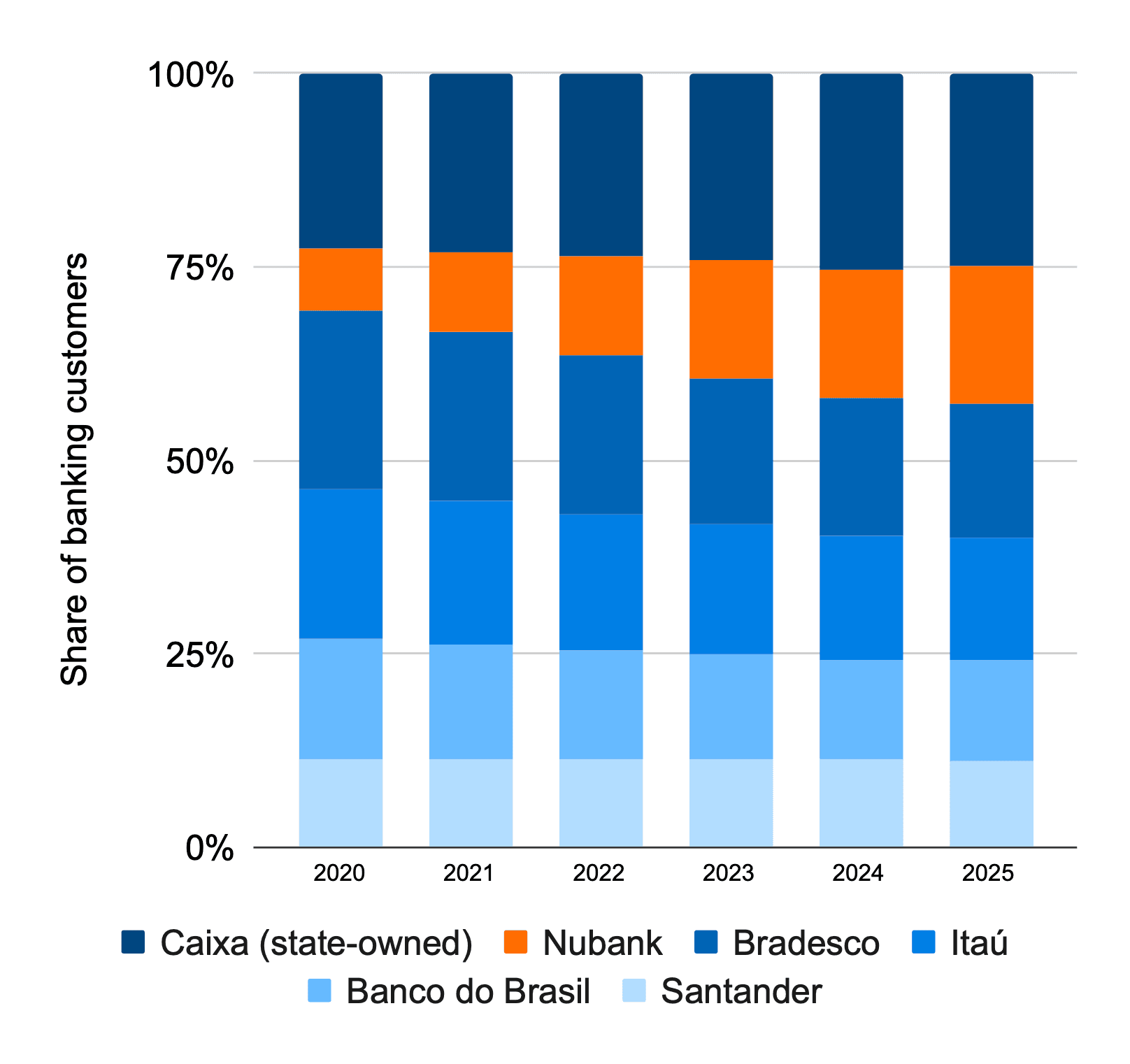
The first test is the most familiar: credit. Nubank’s rapid growth came in large part due to an AI model it developed called NuFormer, which it used to extend credit products to people in Brazil who hadn’t been able to go through the incumbent banks. The size of that market isn’t the same in the U.S., but the bank’s inroads with Hispanic consumers – who make up roughly one-third of the U.S.’ unbanked population – means it can run a similar playbook as it did in Colombia and Mexico when it expanded into those markets.
To grow beyond a niche player though, Nubank will need to expand how it uses its foundation model to other businesses. It’s doing some of that in Brazil already with what it calls the “AI private banker,” a suite of tools that help its users make financial decisions. Some of those capabilities already have more than 15 million monthly active users, the bank said. The crux in the U.S. expansion though will be whether it can roll out the same kind of product in a more expensive market without breaking the bank. Part of the bank’s success so far – and a reason some analysts are nervous about its U.S. move – is that it costs just $1 to serve each of its customers per month.
The bank may have more tricks up its sleeve yet though. “We have deliberately chosen not to fully disclose the go-to-market strategy that we wanna have in the U.S., mostly for competitive reasons,” said CFO Guilherme Lago during last month’s earnings, who is departing the company.
“There’s a lot of very competent competitors. But we think we have an insight,” said CEO David Vélez. “If we’re wrong, it’s a little loss. If we’re right, it’s going to be a huge opportunity for us.”
COMING SOON: We’re launching our inaugural Evident AI Index for Banks - LatAm, covering 20 lenders across the region. Register your interest to find out more.
COMING SOON
EVIDENT AI INDEX FOR BANKS - LATIN AMERICA

For the first time, we're ranking the 20 largest banks across Latin America. Who's leading the race? What's holding others back? And where does the real opportunity lie? Explore the banks featured in the inaugural Index, and register to be the first to know when the Index launches next month.
.svg&w=96&q=80)
TALENT MATTERS
DOWN UNDER DUO
CommBank appointed Victoria Ledda as CIO and Rodrigo Castillo as CTO effective July 1. Following former CIO Gavin Munroe’s departure at the end of last year, the pair had been splitting CIO duties on an interim basis – Castillo for central technology and Ledda for business technology.
JPMorganChase named Troy Rohrbaugh and Doug Petno co-presidents of the firm, and consumer banking chief Marianne Lake is leaving. Rohrbaugh will replace Lake at the top of that business, and Petno will oversee the commercial and investment bank. The pair had previously been running that unit together. It’s a new wrinkle in the race to be Jamie Dimon’s successor, whenever he eventually steps down.
BMO hired Kelly Taira as head of platform transformation within the bank’s U.S. banking unit. He’ll "lead the re-thinking of our Financial Center experience, at the service of our clients, employees, and the communities we serve,” Augustin de Kerversau, the unit’s COO, wrote on LinkedIn. Taira was previously managing director of consumer banking and investments at Bank of America Merrill Lynch.
U.S. Bank hired Ann Barron-DiCamillo as its global chief information security officer. She was previously global head of tech optimization at Citi and before that was vice president of cyber threat intelligence and incident response at American Express.
Hayden McDonald joined HSBC as a managing director and CTO, head of operational resilience and enablement. He was previously head of markets technology modernization at JPMorganChase.

NOTABLY QUOTABLE
“When people ask me about the AI strategy of J.P. Morgan, and I say there is no such thing. There are business strategies that AI enables.”
–Teresa Heitsenrether, CDAO at JPMorganChase, at a Databricks conference, June 17

IN THE NEWS
OPEN SOURCE-AME
Santander’s AI Lab has released 12 open-source AI projects on GitHub, covering an impressive range of research topics. The repos range from practical infrastructure – including software that lets teams easily switch between LLM providers such as OpenAI and AWS – to more experimental work, including an agentic ‘autoresearch’ system that makes models more resilient to jailbreaks (the reason Fable 5 got pulled off the shelf). The standout is a synthetic fraud-data generator, which ranks among the top 0.2% of GitHub repositories by stars (the site’s ranking system). It uses LLMs to create realistic fraud patterns for testing detection systems without exposing customer data. The move came in the same week that the bank revealed it was on pace to deliver more than €200 million ($228 million) in AI value by year’s end.
The Reserve Bank of India, the country’s central bank, is proposing banks introduce mandatory kill switches for AI models and implement risk management frameworks across the enterprise in proposed rules it released this week. It’s the latest move globally to amp up regulatory scrutiny on how lenders have scaled the tech, with the Office of the Comptroller of the Currency and the Federal Reserve putting increased pressure on Wall Street banks in recent weeks. Last week, we spoke with former OCC chief Mike Hsu about specific ways banks and supervisors ought to be working together (see: “What regulators really want,” The Brief, June 18).
HSBC inked a new deal with Google Cloud to expand AI capabilities, aiming to deliver $100 million over two years through productivity improvements and revenue growth. The partnership will focus on developing new AI tools that improve the personalization of wealth management, prevent financial crime and make employees more efficient, the announcement said. Google will send forward deployed engineers to the bank and HSBC will have the chance to work directly with Google DeepMind, the AI unit headed by Demis Hassabis.
Neobank Revolut is eyeing a 2028 launch in South Africa, its first foray into the continent. Nearly 100,000 people in the country have already signed up for the waitlist, said Jacques Meyer, the firm’s lead in South Africa. The move comes a week after Revolut secured a license to launch in the UAE, though it hasn’t released a timeline for when it’ll set up operations there, a company representative told The National News. Competition in each locale will be stiff: The top seven banks on AI in the Evident AI Index for Banks - MEA, which came out this month, all come from either the UAE or South Africa (see: “Tale of the tape,” The Brief, June 4).
WHAT'S ON
Tuesday 30 June
Capturing the AI advantage: What MEA banking leaders do differently, Virtual
Tues 8 Sept. - Weds 9 Sept.
AI in Financial Services Europe, London
Tuesday 7 July
The Evident AI Index for Insurance Roundtable, Virtual
- Alexandra Mousavizadeh|Co-founder & CEO|[email protected]
- Annabel Ayles|Co-founder & co-CEO|[email protected]
- Colin Gilbert|VP, Intelligence|[email protected]
- Matthew Kaminski|Senior Advisor|[email protected]
- Kevin McAllister|Senior Editor|[email protected]
- Daniel Shackleford Capel|MD, Banking|[email protected]
- Maryam Akram|Senior Research Manager|[email protected]
- Zachary Groz|Reporter|[email protected]
- Alex Inch|Data Scientist|[email protected]
- Sam Meeson|AI Research Analyst|[email protected]
- Gabriel Perez Jaen|Research Manager|[email protected]
- Jay Prynne|Head of Design|[email protected]
- Marcus Gurtler|Junior Designer|[email protected]

