

DATA-DRIVEN INSIGHTS AND NEWS
ON HOW BANKS ARE ADOPTING AI
Gospel according to Jamie

Source: Adobe Firefly
9 April 2026
Welcome back to the Banking Brief! This week: The hidden message in Jamie Dimon’s shareholder letter. A look at new ways banks measure AI. Plus how voice agents actually work inside a bank.
People mentioned in this edition: Jamie Dimon, Marianne Lake, Mary Callahan Erdoes, Chris Patterson, Kristin Milchanowski, Max Lemmens, Doug Petno, Troy Rohrbaugh, Joseph Manza, Gaurav Gupta, Jason Tong and others.
This edition is 1,741 words, a 5 minute read. Check it out online. If you were forwarded the Brief, you can subscribe here. We always want to hear from you at [email protected].
– Alexandra Mousavizadeh & Annabel Ayles

TOP OF THE NEWS
CHANGING OF THE GUARD
The most important AI message in Jamie Dimon’s letter to shareholders this year came in what he chose not to share himself.
It wasn’t because the JPMorganChase CEO was mum about the tech’s impact long-term, in fact he mentioned it far more than last year. It will “affect virtually every function,” at the bank in the future, Dimon wrote. It’ll eventually move money and budget for the bank’s customers on its own, he projected. But he left how AI was specifically impacting the firm today – what’s become a staple of these letters – to the heads of the bank’s businesses.
That may seem a subtle change, but how banks communicate AI’s value has big impacts on talent attraction and trust. And while investors wait for real ROI, the bank pushing that responsibility away from Dimon – arguably the sector’s biggest tech champion – and into the lines of business is a way for the bank to signal that its strategy is working.
TAKING THE LEAD ON AI
JPMorganChase’s business line heads dedicated more of their shareholder letters to AI than CEOs of many other U.S. banks.
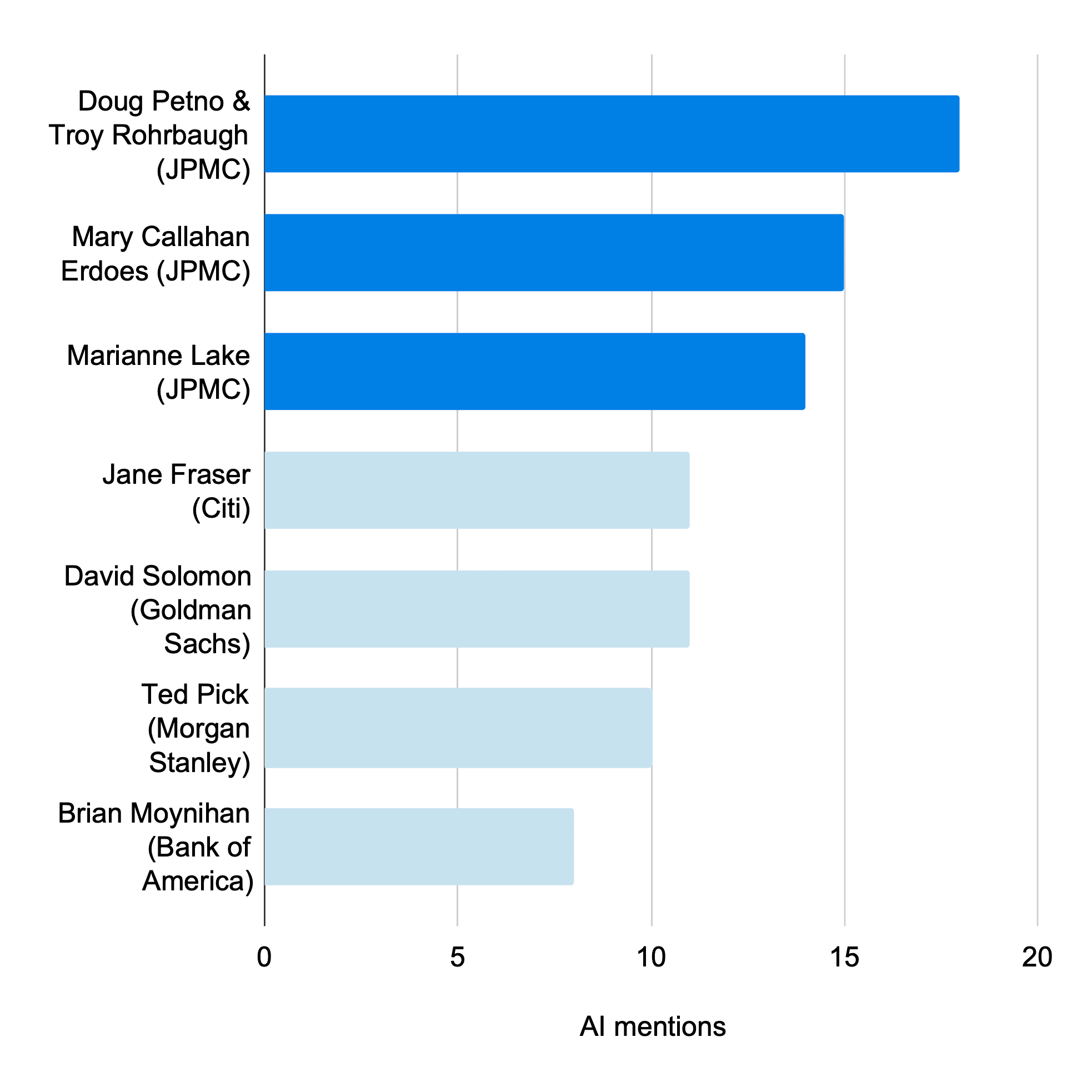
That strategy of having the business side lead on tech and AI has been in the works for more than two years. But in February, the bank began reworking its org chart inside each business line, rewiring processes to bring the tech closer to where the bank actually generates revenue (see: “Era of AI execution,” The Brief, Feb. 19). Those changes mean that business leaders aren’t just leading on AI strategy though; they’re on the hook for whether it works, too.
Their letters show that ownership in practice: Marianne Lake, who runs the consumer bank, said her unit had “delivered a nearly 60% increase in value from AI” in 2025 compared to the year prior. CIB tag team Doug Petno and Troy Rohrbaugh said the unit doubled the number of transactions it screened while halving the manual work thanks to AI. And wealth and asset management chief Mary Callahan Erdoes said AI was being used to automate almost 85% of foreign exchange trading.
Most banks still aren’t at a place to communicate those business-specific improvements, at least not with that level of detail. As you can see above, the three letters by JPMC lieutenants had greater AI focus than most bank CEOs.
Of course, talk is cheap compared to the returns. Banks are still very much figuring out the best ways to calculate it (see: “CFO-phie’s choice,” The Brief, April 2). When they crack it, it won’t take reading between the lines to see just how much impact it’s actually making.
WHAT'S ON AT EVIDENT
JOIN US LIVE
.png%3FupdatedAt%3D2026-03-27T12%3A36%3A54.002Z&w=3840&q=100)
The one-week countdown to our next virtual roundtable starts now. Join us and senior leaders from BMO, Wells Fargo, and EY to discuss where and how banking leaders should be focusing their AI efforts in 2026. On the agenda:
- Where banking leaders are prioritizing AI deployment
- How strategic investment and partnership decisions are shifting over time
- Where enterprise-wide ROI is really materializing – and where you can get the most bang for your buck

TREND LINES
FLYING (LESS) BLIND
AI may be creating the bank of the future, but lenders are still measuring it with the metrics of the past.
Banks can tell how many people are using AI. What they’ve struggled with is figuring out how close they are to turning usage into value. (See: “CFO-phie’s choice,” The Brief, April 2).
CIBC believes it’s found a way to bridge that gap, Chris Patterson, the bank’s head of enterprise AI platforms and solutions, told us in an exclusive interview. The Canadian bank has developed an “AI fluency” score, which Patterson says goes beyond whether AI is being used by employees to determine whether they’re using it well.
“It’s not simply how much they use it,” he said, describing how it differed from adoption. “You’ll notice some people don’t use it to the extent as others, but they’re clearly ahead.” The score tracks five signals based on how employees use its enterprise AI platform, CAI: their login frequency, the regularity of use, how deep their interactions with the tool go, the breadth of things they do with the platform and whether or not they build their own agents and use agents from the bank’s marketplace.
Patterson then separates people into five categories based on their proficiency, ranging from novices to “professors.” That helps him understand which parts of the bank need more hand-holding along with what parts of the bank might need more specific tools in order to be useful. The goal, he said, is getting everyone at the bank into the second-highest level of fluency – “expert.”
Other banks are taking different approaches to the same ends: BMO is testing an “AI net promoter score” to measure whether employees feel confident, frustrated or productive using the tools, the bank’s AI head Kristin Milchanowski said last year. The bank is also doing what it calls “touchpoint analysis” to reverse engineer whether productivity gains are coming from humans, AI or both JPMorganChase, meanwhile, is segmenting workers into “light,” “heavy,” and “non” AI users to see where it needs to put more work into development.
Bottom line: No bank we track shares true ROI (simply financial benefit minus the cost). In the meantime they’re trying to find other ways to show the investment is paying off.

STAT OF THE WEEK
.png%3FupdatedAt%3D2026-04-09T14%3A57%3A09.067Z&w=3840&q=100)
The amount publicly committed to academic partnerships by the 50 banks we track in 2025, up from $13 million the year before, new Evident analysis shows. It comes from 20 partnerships inked over the year, an increase from 14 the year before.
Zoom out: University partnerships are in vogue as banks look to compete for top talent and chase new research breakthroughs. That’s continuing in 2026: Four banks have announced new partnerships since January. They’re not one-size-fits-all approaches. Some focus on defined projects, like Lloyds’ tie-up with the University of Glasgow aimed at agentic software development (see: “AI in a day’s work,” The Brief, April 2). Others are broader and built around the development of new AI centers on campus. UBS – which spent the most on academic partnerships in 2025 – is setting one up at the University of Oxford (see: “Stat of the week,” The Brief, Feb. 5). Capital One has set up at least three dedicated research centers on campuses, adding two academic research hubs last year, the most of any of the banks we track.
.svg&w=96&q=80)
TALENT MATTERS
QUANTUM LEAP
BMO’s Kristin Milchanowski is expanding her role at the bank to include quantum and will serve as the founding director of the newly-announced BMO Institute for Applied Artificial Intelligence and Quantum. Milchanowski has overseen AI and data at the Canadian bank since 2024.
CIBC hired Joseph Manza to be director of AI enablement. Manza was most recently a digital product manager for AI in RBC’s wealth management division and worked in automation roles at Scotiabank earlier in his career.
Gaurav Gupta, a senior director and distinguished AI engineer at BNY, is leaving the firm to start a new venture, he wrote on LinkedIn. Gupta had been with the firm for nine years, and worked in software roles at TD Bank and BMO before joining.
Jason Tong is now director of security AI/ML products at RBC. Tong has been with the bank since 2022.
Bank of America hired Thomas Cook to be VP, AI quantitative analyst. He was most recently an AI research scientist at JPMorganChase.
JPMorganChase is hiring an agentic AI governance director to “invent and publish agentic governance frameworks.” Part of the remit will be to create risk tiering and agent oversight levels as the bank pushes more autonomous systems forward. Agentic use cases in production are still rare: There are only 16 actually in production at the 50 banks we track, our Use Case Tracker – the database of publicly-launched tools – shows. Much of the slow pace can be chalked up to governance issues, meaning the new hire has their work cut out for them. The bank is also hiring a Gen AI executive director within the chief analytics office, to “deliver production LLM based systems (text, image, speech, video)” that underpin LLM Suite products.
WHAT'S ON AT EVIDENT
NEW INDEX COMING SOON
The Evident AI Index sets the global standard for measuring AI adoption in banking. Now, for the first time, it's coming to the Middle East and Africa. Launching later this year, the MEA edition will benchmark more than 20 major banks across the region.

USE CASE CORNER
AI PHONE HOME
This year, Revolut began working with voice AI startup ElevenLabs to put voice agents into call centers. In this week’s “Corner,” we spoke to ElevenLabs’ Max Lemmens to explore whether voice agents are ready for prime time across the sector.
Use case: Voice agents for customer service
Vendor: ElevenLabs
Bank: Revolut
Why it’s interesting: Banks have tried, and largely failed, to make voice banking stick for a decade: Capital One launched an Alexa skill in 2016. Santander rolled out voice banking to the UK in the same year. But by 2022, Forrester reported that users “remained wary” of voice assistants. Revolut – and others – are now betting that the tech has evolved enough that voice agents can handle the bank’s complaints. As Max Lemmens of ElevenLabs told us, the goal for the project was to make an existing support flow work better, instead of forming new habits overnight.
How it works: ElevenLabs’ technology is handling the first step of support calls from Revolut customers. The system follows a three-step loop: speech-to-text transcribes the caller, an LLM generates the response, and a text-to-speech model delivers it back in audio. It’s a more modular approach than ChatGPT or Gemini’s end-to-end voice models – which don’t have the intermediate step – but it helps the lab (and the bank) audit, control and plug it into bank systems, Lemmens said.
By the numbers: The agents handle customer service calls for four million of the bank’s customers across the U.K. and Europe. The scope is narrow: The tools largely handle repetitive, high-friction issues like account-specific FAQs, pulling customer data, disputes and chargebacks. It’s cut time-to-resolution by more than 8x, the bank said.
Bigger picture: Voice agents aren’t becoming the front door to banking yet. Scale AI recently tested voice models and found that multilingual capability varies across languages. The technology can still struggle with accents, latency and natural conversational flow, Lemmens said. And the costs don’t always justify replacing humans. But banks have long built voice capabilities into their banking apps and processes. The question is no longer just whether a model can sound natural on the phone, but whether banks can connect it to legacy systems, govern it, and prove a business case. As Lemmens put it, “the AI vendor wars will be won and lost on implementation.”
Want to know more about the specific ways banks are rolling out AI? Check out our Use Case Tracker – the inventory of all the AI use cases announced by the world’s largest banks available to members.

NOTABLY QUOTABLE
“For people to use these tools right, you need to realize that human agency, human accountability — that’s a core part of the system. How the human uses the AI — that’s something that is deeply fundamental. And so the important thing is that as a user of these agents, you cannot abdicate responsibility. You cannot just say: the AI is just going to do stuff.”
– Greg Brockman, President at OpenAI, in an interview, April 7

IN THE NEWS
AI IN A DAY'S WORK
Grok may finally make banking inroads: Elon Musk is compelling banks working on SpaceX’s upcoming IPO to buy subscriptions to his AI chatbot Grok. Over the last few months, five banks have been helping to draft the filing: Bank of America, Citi, Goldman Sachs, JPMC, and Morgan Stanley.
Japan’s MUFG is rolling out a new AI use case that helps the bank determine when to refill cash at ATMs across the country. It’s active at 700 locations so far. In Italy, Intesa Sanpaolo was already doing this with a “quantum-inspired” algorithm, a way of using quantum tech on a less-specialized computer. It’s paying off: The bank is saving 10% of the ATM recharging costs by using the tech, quantum head Davide Corbelletto told us last year (see: “Don’t trust the process,” The Brief, May 29).
The UK is considering testing AI models in production at all of the country’s banks. The possible policy change, per Starling Bank CIO Harriet Rees, is motivated by the government’s concerns over the industry’s “reliance on U.S. models.” With the screenings, they’d hope to find a degree of “comfort…that they all are at a certain standard,” Rees said.
UBS invested in Artificialy, a Swiss-based AI company that co-develops enterprise tools. Before the investment, the bank had already been working with the startup, founded by Marco Zaffalon and Luca Maria Gambardella, and will now expand its relationship.
Anthropic’s new cybersecurity model, Claude Mythos, has identified hundreds of vulnerabilities in widely used software that was long considered secure, including a decades-old bug in Linux – the operating system that underpins the cloud. For now, the lab is only releasing Mythos to trusted partners, but hackers are already putting LLMs to work: The number of AI-assisted attacks rose 89% last year (see: “Clear and present danger,” The Brief, April 2).
WHAT'S ON
Tues 14 April
Scaling What Works: Where Banks Are Unlocking Real Value From AI, Virtual
Weds 15 - Thurs 16 April
AI in Finance Summit, New York
Mon 27 - Tues 28 April
Momentum AI New York 2026, New York, NY
- Alexandra Mousavizadeh|Co-founder & CEO|[email protected]
- Annabel Ayles|Co-founder & co-CEO|[email protected]
- Colin Gilbert|VP, Intelligence|[email protected]
- Matthew Kaminski|Senior Advisor|[email protected]
- Kevin McAllister|Senior Editor|[email protected]
- Daniel Shackleford Capel|MD, Banking|[email protected]
- Maryam Akram|Senior Research Manager|[email protected]
- Zachary Groz|Reporter|[email protected]
- Alex Inch|Data Scientist|[email protected]
- Sam Meeson|AI Research Analyst|[email protected]
- Gabriel Perez Jaen|Research Manager|[email protected]
- Jay Prynne|Head of Design|[email protected]
- Marcus Gurtler|Junior Designer|[email protected]

