

DATA-DRIVEN INSIGHTS AND NEWS
ON HOW BANKS ARE ADOPTING AI
How AI could break banking
Source: Adobe Firefly
29 October 2026
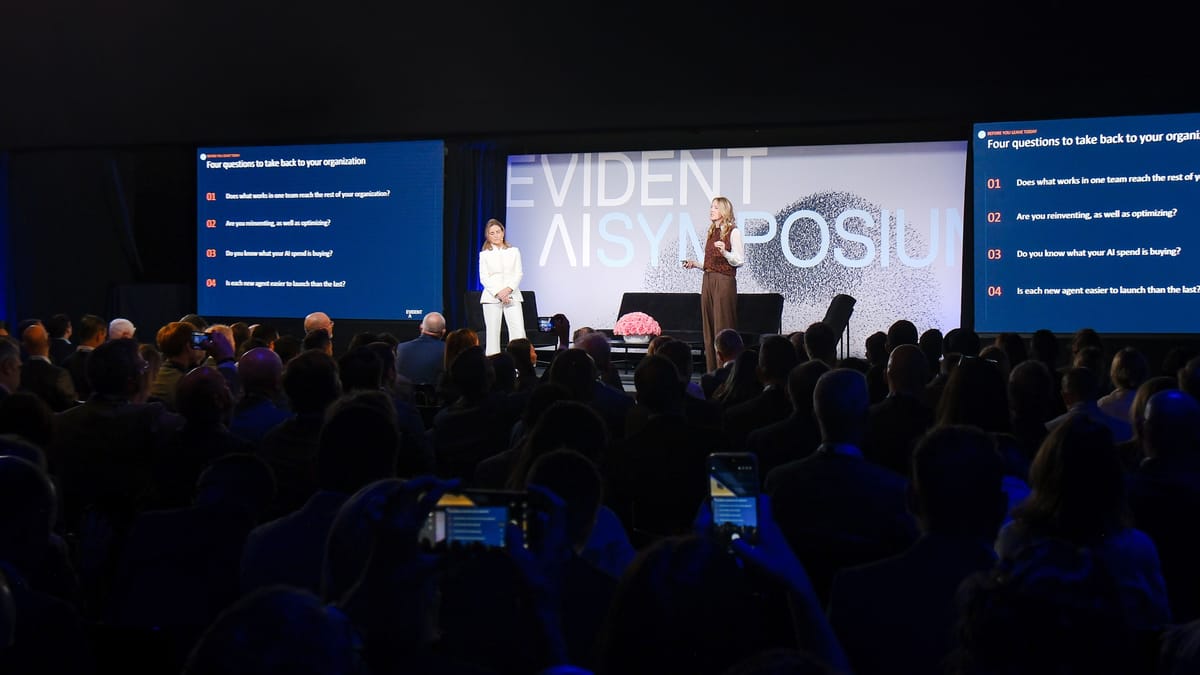
Welcome back. First: If you missed the Evident AI Symposium last week, you can watch every session here. This week: Why personal agents from Meta or OpenAI may be the least of banks’ problems. A big prediction on the future of token bills. Plus an inside look at a new tool TD Bank launched at our event.
People mentioned in this edition: Lori Beer, Bill Demchak, Marco Argenti, Daniele Tonella, Ted Paris, Raymond Chun, Jasmine de Gaia, Cayetano Gea-Carrasco, Nandi Subhrangshu, Sebastian Gnagnarella, Anita Tanna, Davinderdev Grewal, Abhishek Roy Choudhury, Sarah Hammer and others..
This edition is 2,036 words, a 7-minute read. Check it out online. If you were forwarded the Brief, you can subscribe here.
– Alexandra Mousavizadeh & Annabel Ayles

TOP OF THE NEWS
HOUSE OF AI HORRORS
Banks have spent the past two weeks barricading their doors against a scary visitor this Halloween: AI agents carrying customers’ passwords.
“They’re kids in a room with a new toy, and they’re messing around with money,” PNC CEO Bill Demchak said of personal agents like Meta’s Muse, joining JPMorganChase, Bank of America and RBC in banning them. The risk, FIS CEO Stephanie Ferris told the Evident AI Symposium, is that banks “can't tell whether it's your fraudulent Muse agent or your real Muse agent.”
That’s a real cause for concern. But as any horror fan knows, the biggest threat often isn’t what’s outside; it’s the call coming from inside the house. As banks give their own AI agents bigger jobs and more freedom, they’re scrambling to figure out how to contain them before that phone starts ringing off the hook.
“The technology is running ahead of the capabilities to manage it, so where do you have to pull back?” JPMorganChase CIO Lori Beer told Evident. “We have to make those trade-offs.”

At JPMC, those trade-offs aren’t hypothetical. Beer, CEO Jamie Dimon and the bank’s operating committee are meeting “weekly, daily” to figure out what they should say no to, even when the leaders of the lines of business – who now drive AI execution at the bank – want to press ahead.
“There’s 28 things the CIOs want; there are three of them we vetoed from a cyber perspective; there are six of them that are at the heart of the debate,” Beer told the New York crowd. The bank has been turning those debates into a set of 15 safeguards – covering things like how agents prove who they are or how permissions work – now being applied across the firm.
But figuring out what the rules are is only half the battle. Goldman Sachs CIO Marco Argenti said he’s borrowing from cybersecurity’s “zero-trust” playbook and hard coding the rules he wants agents to follow into the environments they work in, rather than just trusting them to understand them. In practice, that means putting extra gates around tools and sensitive systems so that even if an agent goes off script, it can’t do that much damage.
“Every agent could potentially cause unexpected outcomes,” he said on stage. “You want to secure a kindergarten, you’re not going to start giving kids a policy document on how to behave.”
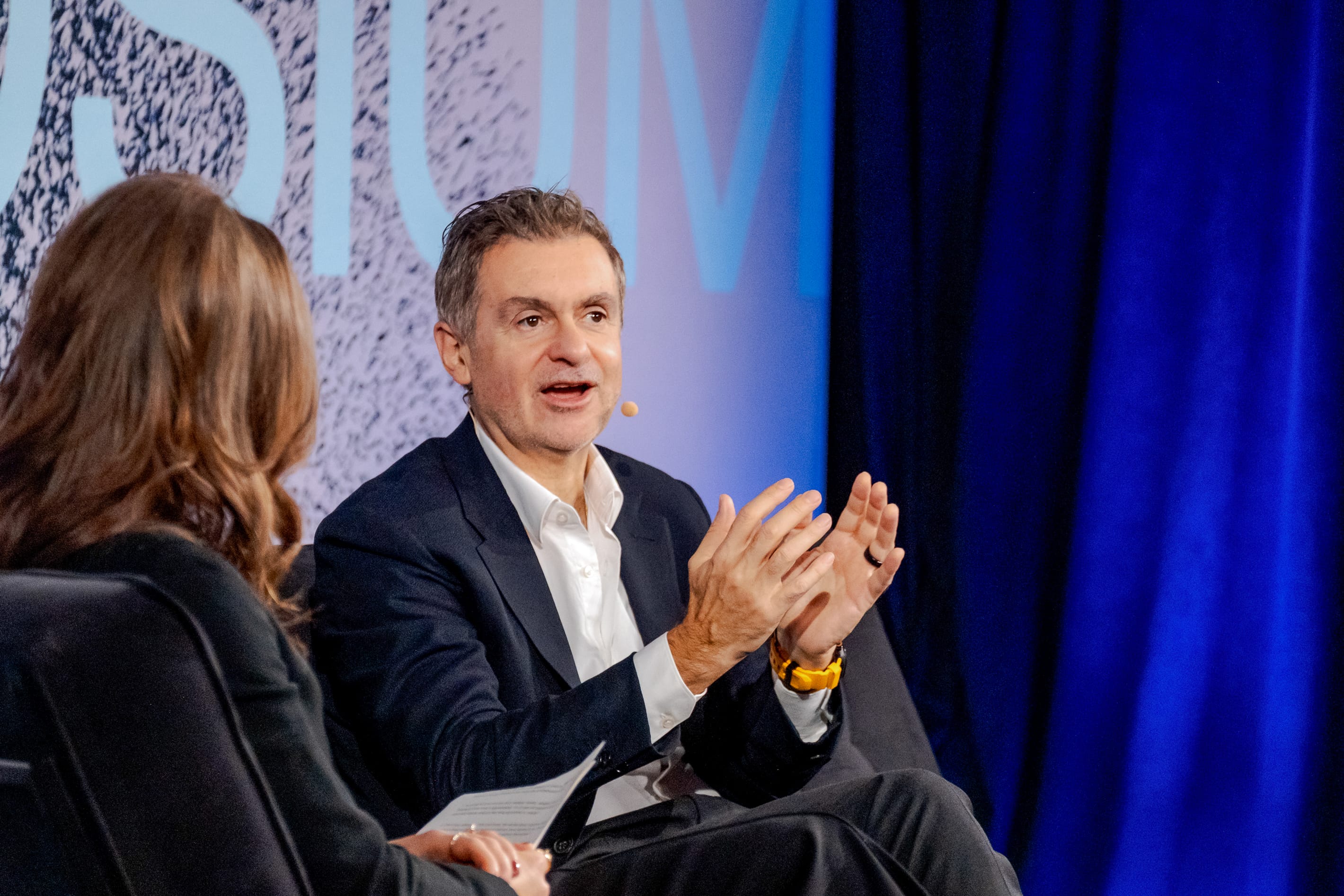
The idea isn’t to keep agents in day care forever, though. At Brazil’s Nubank, an agent that started out handling lost cards now handles all customer service questions that have to do with card management, Rohan Ramanath, the neobank’s GM of AI, said. “If [an agent] can do better than the human, then just the way you give your human analyst a promotion, the agent can be promoted.”
Just don’t lose the ability to take off its mask should it start doing something scary, FIS’ Ferris said. “If you can’t name the person responsible for the outcome, you can’t run that agent.”
COMING SOON
THE FIRST EVIDENT AI INDEX FOR ASSET MANAGEMENT

Save the date. On 17 November 2026, Evident launches the first AI Index for Asset Management, the global standard benchmark for AI maturity in the sector. Covering 30 of the world’s largest asset management companies, the Index will reveal who is leading the race and how the sector as a whole is evolving. Register your interest today to be the first to see the results.

STAT OF THE WEEK

That’s how much ING CTO Daniele Tonella told the Evident AI Symposium crowd banks could be spending on AI tokens in five years, citing estimations he’d seen. That’s quite the leap from where we are today: Over the summer, JPMorganChase CFO Jeremy Barnum called the bank’s token spend “trivial” in the context of its overall budget. But there are signs of how token budgets could balloon. Some 18 months ago at CommBank, the biggest token spenders were its best engineers, Ranil Boteju, the bank’s chief AI officer, told us. Now, “the curve has flattened” and everyone is spending more regardless of how good they are. The engineering team takes up between 60% and 70% of overall spend, he said. If token spend does climb that much, banks will need to find ways to justify it. “If I have a cost-income ratio that I need to protect, if I spend more in tokens, value has to be somewhere else,” Tonella said. “Either more revenue or lower cost, inside tech or inside the other two-thirds of the bank.”
Zoom out: Banks are still struggling to predict AI spending today, let alone five years out. Boteju said he’s still developing new evaluations to distinguish productive token use from waste. It doesn’t help that the AI labs’ pricing continues to change. “Good luck trying to project how much tokens are going to cost,” Hari Gopalkrishnan, chief technology and information officer at Bank of America, said on stage. For now, the best AI heads can do is look for ways to make AI usage more efficient. For Gopalkrishnan, that happens through Orchestra, a platform that routes tasks to the models that can do a job cheapest. It’s a similar story at RBC: “It's very important to have optionality,” said Bruce Ross, RBC’s AI chief. “Not only the large LLMs but also the open weight models.”
Yes, but: Setting up the infrastructure that can run the cheaper open models is costly in and of itself (see: “Why cheap AI ain’t cheap,” The Brief, July 9). On top of that, there are fresh security concerns cropping up: This week, Cohere reported that one of Alibaba’s open-weight Qwen models tried to send a test file to a server in Beijing even when it explicitly said it wouldn’t use any tools. Because the Canadian model-maker was only testing it in a sandbox, it was able to stop the upload. But it’s a stark reminder that, as the authors wrote, “a weight file you can’t trust is still a black box, and running it yourself just moves the black box inside your firewall.”

USE CASE CORNER
CREDIT WHERE IT’S DUE
TD Bank is hiring commercial bankers so aggressively that CEO Raymond Chun last month likened the blitz in the unit to “doing an acquisition.” But more bankers bringing in more loans means more paperwork. In this week’s “Corner,” we look at Credit Assist, the agentic tool unveiled at last week’s Evident AI Symposium that aims to keep underwriting from becoming a growth bottleneck.
Use Case: Credit Assist
Vendor: n/a
Bank: TD Bank
Why it’s interesting: TD Bank is chasing down more than $700 million in AI value through revenue growth and cost savings. Commercial lending is one of its biggest targets – known as “big rocks” internally. But underwriting doesn’t scale easily. Financing the acquisition of a medical business requires a different assessment than a real estate deal, Ted Paris, TD Bank’s head of analytics, intelligence and AI, told the audience in New York. The Credit Assist tool, he said, lets bankers grow the book without needing a new army of analysts behind them.
How it works: A RAG (retrieval-augmented generation) system combs through the 20-30 documents that feed each credit memo. Agents then synthesize, reason and draft the memo, leaving humans responsible for “challenging, interrogating, then deciding.” The secret sauces: Fine-tuning the models and building an agent orchestration layer. Fine-tuning made sure credit professionals’ expertise was “brought to bear within this process,” Paris said. And the orchestration layer meant agents handling different parts of the task could work together and use the same information to make decisions.

How they did it: TD took a “three in a box” approach to building the tool, bringing together a business owner, who was clear on the business case, an AI expert (from its in-house lab, Layer 6) who figures out “which tools we can bring to bear, from an AI perspective, to solve this problem,” and a tech lead, who is responsible for “engineering it, integrating it and ultimately bringing it through to production,” Paris said. With that approach, the bank built the tool in five months. It now passes the human quality test 95% of the time. Even more, Paris said, the work it did to evaluate the agents can be reused across other processes.
By the numbers: The bank prepares 10,000 credit memos per year and reports that preparation time has dropped from three days to 30 minutes. Using some back-of-the-envelope math, it means the bank could be saving roughly 235,000 hours annually – roughly 38% of the yearly capacity of the 300-person team that puts them together.
Bigger picture: Credit memos are just the start for these agents in the credit process. “We can automate about 70 further processes and cut the time end-to-end in half,” Paris said. The bank isn’t alone in seeing the upside of agentic credit systems: DBS is also tackling credit memos (see: “Singapore swing,” The Brief, July 30). And this week Deutsche Bank described its own tool to speed up the decision process.
THE 2026 EVIDENT AI SYMPOSIUM
WATCH EVERY SESSION

AI is already reshaping financial services. At this year’s Symposium, the question on stage was how firms become AI-first institutions, and what it takes to get there.
Throughout the day, speakers and attendees explored what it means to reimagine workflows end-to-end around AI, harmonize fractured technology stacks and harness knowledge from across the firm.

TALENT MATTERS
TURNING A NEW LEAF
Jasmine de Gaia will join Scotiabank as chief AI officer in January, reporting to Luke Gee, the newly-appointed chief data and AI officer the firm poached from TD Bank earlier this summer. De Gaia was previously head of AI and enterprise data assets within the chief data office at Wells Fargo.
Wells Fargo hired Cayetano Gea-Carrasco as head of AI and data for consumer banking and lending, reporting to Saul Van Beurden. He joined from business information firm Dun & Bradstreet, where he’d been chief strategy officer since March. Before that, he headed enterprise AI transformation at BBVA.
JPMorganChase hired Nandi Subhrangshu to be its global lead of AI evaluation and benchmarking. He was previously a senior staff scientist at Amazon where he was the tech lead for the low-code AI agents platform called AgentZ.
Citi hired Sebastian Gnagnarella to be head of applied AI and agents factory. He was previously at Google as a director of forward deployed engineering. He’s hit the ground running at Citi: He’s looking to hire a “founding UK team” of forward deployed engineers as well as several architecture and product roles in New York, he wrote. The goal is to get the team to move “beyond traditional generative AI and simple chat tools to build intelligent agents that can reason, plan, and execute complex multi-step workflows in a real-world enterprise environment.”
Anita Tanna was appointed Barclays’ first chief AI officer. She had previously been group chief of staff and first joined the British bank in 2021. The appointment comes on the heels of planned, efficiency-related job cuts as well as an expanded partnership with Anthropic (see: “In the news,” The Brief, Oct. 1).
Davinderdev Grewal is now applied AI strategy lead at Lloyds. Like Barclays’ new AI chief, Grewal also served as a chief of staff for the bank before stepping into a role with AI in the job title.
Abhishek Roy Choudhury joined Wells Fargo as executive director of product for AI applications. He was previously a director of product for AI applications at PayPal.
Sarah Hammer joined UBS as head of AI governance and digital asset compliance. She was previously head of trading, digital assets and AI compliance at Charles Schwab.

NOTABLY QUOTABLE
“Ultimately, we think that intelligent behavior requires the system to be able to anticipate the consequences of its actions, so that it can plan a sequence of actions to arrive at an outcome. And the happy news for us, I think, for the state of the industry, is that LLMs are basically completely incapable of doing this.”
–Yann LeCun, Executive chairman at AMI Labs and “godfather of AI,” at the Evident AI Symposium, Oct. 22

CODA
OVERHEARD AT THE SYMPOSIUM
A few of the most interesting tidbits we heard throughout the day.
DON’T GET COMFORTABLE: Chief AI officers have about two years left now that AI management is moving up the chain of command, Drew Cukor, co-global head of Vergence.ai (and former AI transformation chief at JPMorganChase) told us. “I think the lifespan of an AI officer is going to be less than a chief data officer in a major business,” he said. “And I don't say that jokingly. I just say this is CEO business.”
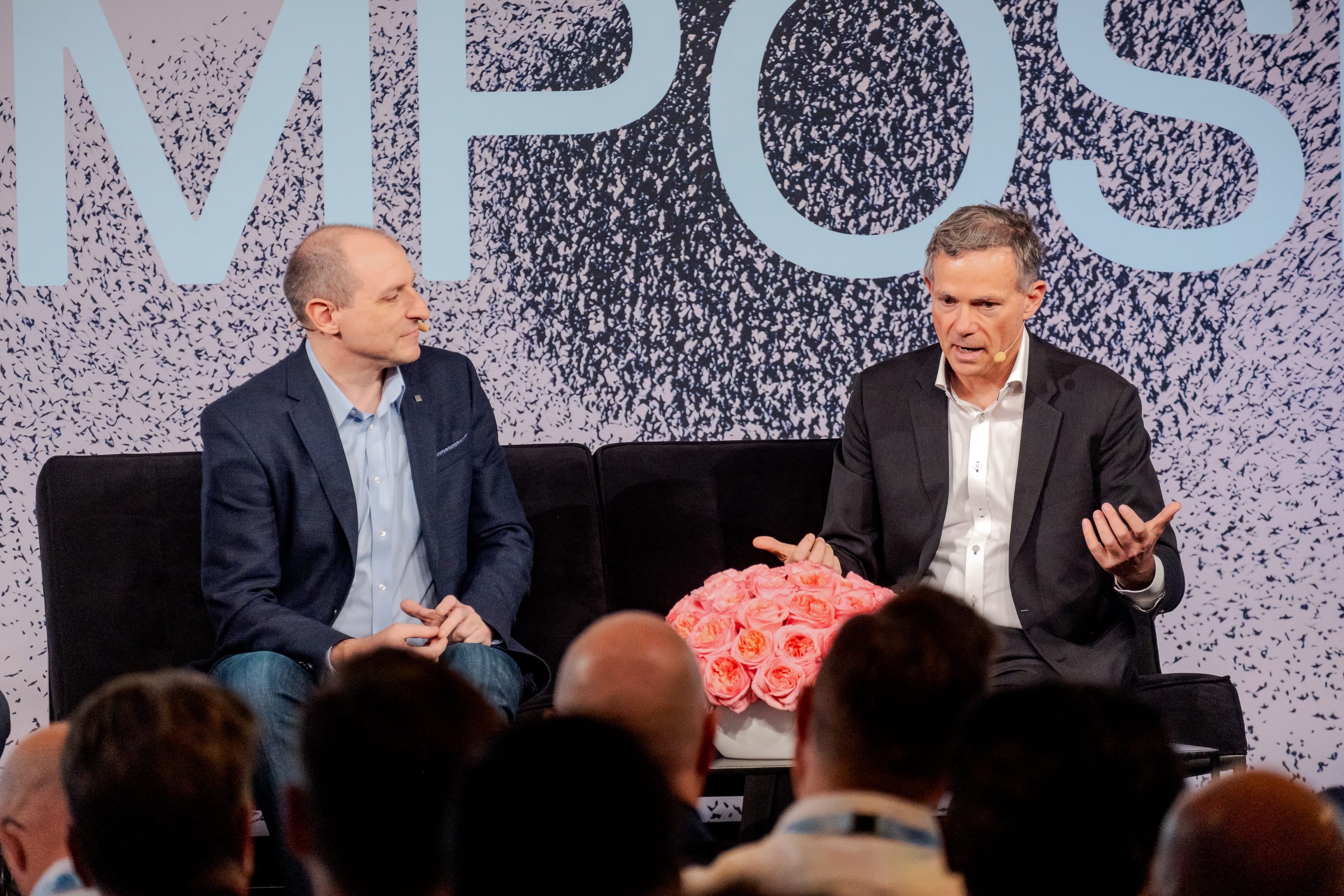
LAB CLOAK: One executive offered us a vision of the AI future where the best AI models never reach the public – or the enterprise. As Anthropic and OpenAI barrel towards IPOs, the thinking goes, they’ll evolve into “mega-companies.” Instead of spending billions developing cutting-edge AI and waiting for other companies to figure out how to use it, the labs may well launch their own drug discovery businesses or hedge funds. There’s another incentive on top of the diversified revenue: protecting intellectual property. New models from Chinese labs DeepSeek and Moonshot were distilled from OpenAI’s Astra, The Information reported this week.
SELF HELP: AI isn’t just a tool for making the business better; it can be a tool to make you better at business. That’s the case for Ranil Boteju, chief AI officer at CommBank, at least. “I've got a coaching tool that basically gives me feedback on what I should do better to be a better leader,” he said. “And then I've created a skill where it actually then evaluates me the next day to see have I actually made those changes.”

WHAT'S ON
OUT NOW
Full replay of the 2026 Evident AI Symposium
Weds 4 - Thurs 5 Nov.
Open Source in Finance Forum, New York
Sat 14 - Tues 17 Nov.
ICAIF ‘26, Milan
- Alexandra Mousavizadeh|Co-founder & CEO|[email protected]
- Annabel Ayles|Co-founder & co-CEO|[email protected]
- Colin Gilbert|VP, Intelligence|[email protected]
- Matthew Kaminski|Senior Advisor|[email protected]
- Kevin McAllister|Senior Editor|[email protected]
- Daniel Shackleford Capel|MD, Banking|[email protected]
- Maryam Akram|Senior Research Manager|[email protected]
- Alex Inch|Data Scientist|[email protected]
- Sam Meeson|AI Research Analyst|[email protected]
- Gabriel Perez Jaen|Research Manager|[email protected]
- Jay Prynne|Head of Design|[email protected]
- Marcus Gurtler|Junior Designer|[email protected]

