

DATA-DRIVEN INSIGHTS AND NEWS
ON HOW BANKS ARE ADOPTING AI
Insider training

Source: Adobe Firefly
12 November 2026
Welcome back. We hope you’ve had a better week than Nvidia’s comms team. In this week’s Banking Brief: Banks’ next AI breakthrough might come from your DMs. How one lender gets AI to help pick its next branch locations. Plus: Why off-the-shelf AI isn’t good enough for asset managers.
Also: Mark Tuesday on your calendars. We’ll be releasing our first Evident AI Index for Asset Management. Want it straight to your inbox on the day? Sign up here.
People mentioned in this edition: Abhijit Bose, Joao Wenzel, Antonio Bravo, Ranil Boteju, David Jordan, Aaron Linsky, Andrew Chin, Tijana Nikolić, Michael Palmer, Brijesh Solanki, Ravi Nair, George Anev, Fabien Cardineau, Pierluigi Di Dona, Michael Granovsky and others.
This edition is 1,899 words, a 6-minute read. Check it out online. If you were forwarded the Brief, you can subscribe here.
– Alexandra Mousavizadeh & Annabel Ayles

TOP OF THE NEWS
MODEL EMPLOYEES
Financial firms hunting for an AI edge have started giving models some new required reading: the passive-aggressive thread in your company Slack.
“More recently, we are seeing that Slack actually becomes a source for good context,” Abhijit Bose, head of enterprise AI and ML platforms at Capital One, said this week. “It's constant, it’s noisy, it’s very close to the truth,” said Joao Wenzel, COO of AI at Citadel Securities.
Reaction GIFs and Slackmojis may seem unlikely ingredients for smarter AI. But as powerful models become readily available, firms are looking everywhere for institutional knowledge that can set their tools apart. Building out so-called “context layers” promises to give every AI tool around the business the wisdom of the office veteran. It’s just as easy, firms are finding, for them to pick up the habits of the office dunce.
“Don’t assume that just indexing everything and cataloging everything is enough,” Wenzel said. “These things are extremely nuanced, and this intrinsic information that lives almost between the lines is hard for even the best state-of-the-art models to capture.”
His team has been learning that firsthand. Using Slack messages, meeting notes and code changes, Citadel Securities built a model that uncovers what Wenzel calls “watermelon projects,” initiatives that look green on the outside but are really red underneath. By catching discrepancies between official status reports and what employees actually said and did, the firm got better at sniffing out projects headed for trouble. Projects flagged by the AI were nearly twice as likely to get stalled as those it didn’t. Getting there meant teaching AI what information to trust when different sources told different stories, Wenzel said.
Capital One is tackling that challenge with a new “context retrieval engine,” Bose said. As the bank gives AI access to more internal knowledge, it found it needed a way to filter what a model should have access to based on the task at hand. “We have this multi-stage ranking system that takes all of this information, does a reranking over all of the chunks,” he said. It means the bank can give models access to as much potentially useful information as possible without as much of a risk that answers could be pulled from an outdated source or a misinformed chat. It’s now being scaled across the business, Bose said.
As more data becomes relevant to AI, though, there’s added work for banks. BBVA, for example, has been rounding up subject matter experts to help the bank establish ground truth so information doesn’t go stale, Antonio Bravo, global head of AI transformation, told Evident last month. CommBank, meanwhile, is “in the process of almost mandating that a certain amount of hours per week are totally dedicated to the process of data labeling” so it has more to feed its models, Ranil Boteju, the bank’s chief AI officer, said.
Tedious as that work may be, PayPal this week showed why there’s good reason for the effort: The firm’s AI assistant was only answering questions correctly a little over 40% of the time out of the box. But after engineers gave it the company’s rules for interpreting data, accuracy jumped to 95% even though the underlying model hadn’t changed.
But there’s a long way to go before that can be replicated across every tool at a bank. “How good and how capable are we of encapsulating all that corporate knowledge…is going to be a huge effort and requires a structured approach in tackling it,” Bravo said.
COMING TUESDAY
AI INDEX FOR ASSET MANAGEMENT

Who’s winning the AI race in asset management?
On 17 November, the Evident AI Index turns to asset management for the first time, ranking 30 of the world’s leading independent asset managers on how they adopt, scale and embed AI.
Be the first to see the results.

USE CASE CORNER
A WHOLE NEW WORLD
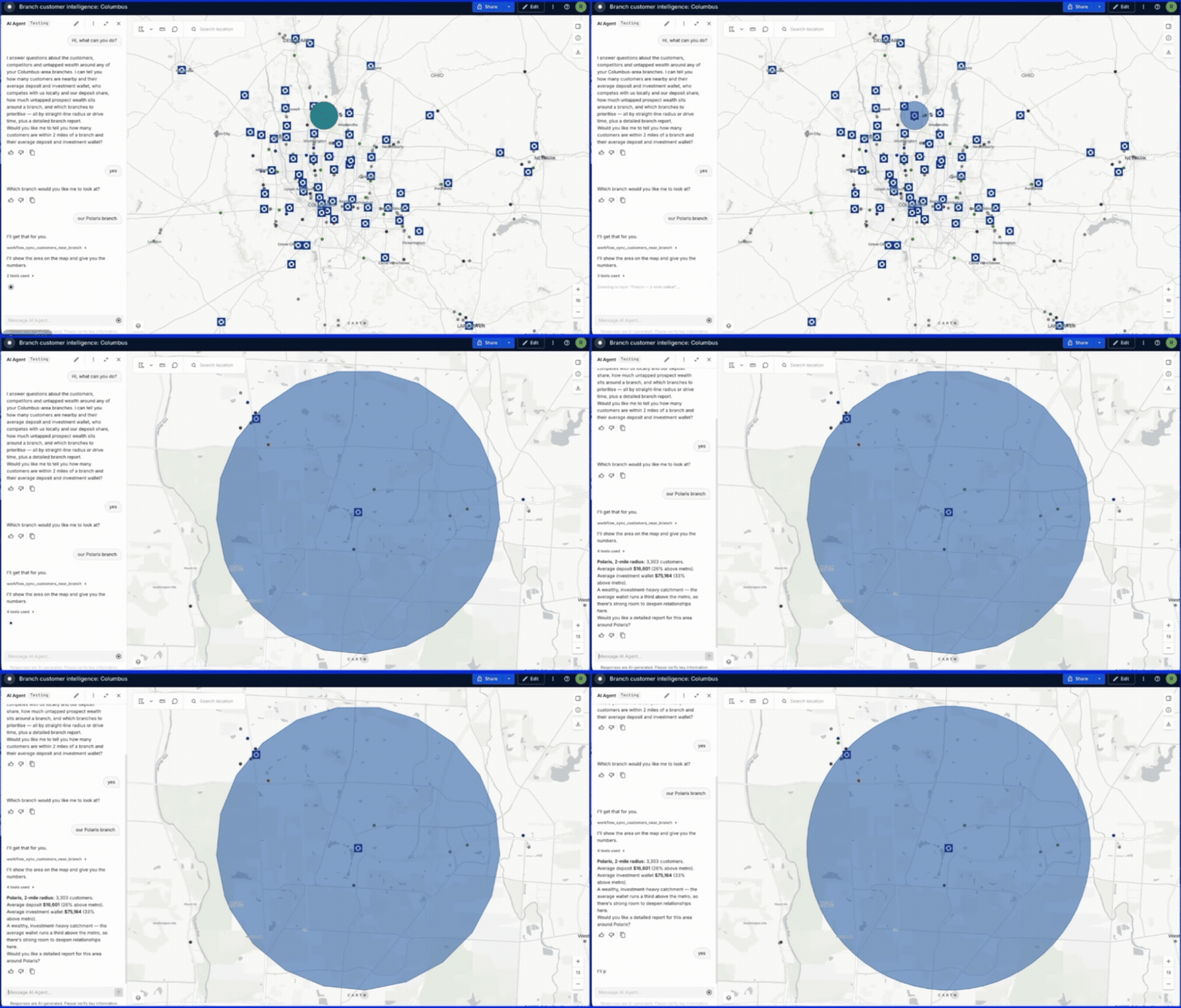
AI has been on the wanted poster for the killing of the bank branch for years now. A new tool shows the tech could actually be what ends up keeping them alive. In this week’s “Corner,” we look at how JPMorganChase is using a new AI tool to plot out its brick-and-mortar strategy and rewiring its old data team in the process.
Use Case: Geospatial copilot
Vendor: CARTO
Bank: JPMorganChase
Why it’s interesting: JPMorganChase pledged to open 160 branches and refurbish another 600 in 2026, part of a multibillion-dollar effort to increase the number of Americans within driving distance of a branch from 69% to 75%. Just opening new branches doesn’t guarantee more customers, though. “Building branches is one thing,” Marianne Lake, JPMC’s former consumer banking chief, said this summer, describing the firm’s strategy. “Building them in the right places, building them well…is part of it.” To maximize what new branches could bring in, the firm developed a new AI tool – built on geospatial data – which can be used to help determine where new brick-and-mortar outposts ought to go.
How it works: The geospatial copilot lets employees get answers to questions about the physical footprint of the bank that previously would’ve required help from a specialist mapping team, David Jordan, product director for the bank’s Geospatial, Real Estate Intelligence and Data team, said at a conference last month. In a demo, Jordan asked the tool to show how many customers were within a two-mile radius of a particular bank branch, what their average deposit was and how much was in their investment wallet. With that data, the tool then put together a report about how best to capture a larger part of that market. “The agents are pulling the data. They're prepping it. They're doing the analysis. They're rendering the map,” Jordan said.
How they did it: In 2025, the bank stood up a Geospatial, Real Estate Intelligence and Data (GRID) team, Jordan said. Since then, the team has been moving geographic data out of separate mapping systems and into the bank’s central data lakes and warehouses so it can be more easily integrated into other tools. “You have to put the data before the AI,” Jordan said. “It's the late 90s reliable Toyota Corolla that we learned to drive on, and you have to put that before you drive a Ferrari.” The transformation has changed the shape of the team. “Geospatial was a service desk where stakeholders filed a request, waited for days and got a map back,” he said. “The GIS team’s role is evolving from producing analysis to owning the platform.”
By the numbers: Geographic analysis at the bank has gone from taking weeks to taking seconds, Jordan said. The bank has opened 123 new branches through the first 10 months of the year, it said this week. And it’s paying off: New locations have contributed some 40% of its market share gain in consumer banking, Lake said this summer.
Bigger picture: So far, geospatial data has played a bigger role in parts of financial services beyond banking, namely insurance. This year, Allianz (#1 in the Evident AI Index for Insurance) rolled out a system that uses satellite data to detect wildfires earlier and alert policyholders, while AXA (#2) brought a similar kind of imagery into its risk platform. Across industries, there’s a bigger trend: Firms are democratizing access to specialist tools. That won’t kill the teams themselves, though, Jordan contends. “Your spatial experts are more valuable in an AI-native world,” Jordan said. “They're the ones who know when the model is confidently wrong.”

STAT OF THE WEEK

That’s how much more likely asset managers with AI research teams are to have deployed AI into their investment processes than those that only buy AI off the shelf, the Evident AI Index for Asset Management – out next Tuesday – will show. Simply bringing AI into investment decisionmaking doesn’t guarantee better returns. But research from the National Bureau of Economic Research this summer showed that hedge funds using AI-driven investment strategies outperformed those that didn’t.
Case in point: The internal research unit at Bridgewater Associates built out what it calls “The Vault,” a trove of 100 million documents covering 135 external sources and years of the firm’s memos and meetings. It’s using that data to make AI labs’ models more useful in-house. “We also have built investment signals from The Vault, turning unstructured data into structured, tradeable strategies,” Aaron Linsky, head of engineering for the firm’s Alpha Engine unit, said at an event last month. The firm showed how much of an impact that can have when it teamed up with Thinking Machines, Mira Murati’s AI lab. With data in The Vault, the firms fine-tuned an open-weight model and outperformed the strongest frontier offerings with a bill that was one-fourteenth the cost (see: "Cheap AI's catch," The Brief, July 9).
Yes, but: Any performance advantage from AI may end up being short lived. The same NBER study found that AI-led hedge funds’ performance faded over time. That puts a bigger premium on firms’ ability to combine their own research with the new models frontier labs release (see: “Man vs. machine,” The Brief, Nov. 5). “Organizational infrastructure is far harder to copy than the AI model itself,” Andrew Chin, chief AI officer at AllianceBernstein, wrote last month.
NEW FROM EVIDENT
A RECORD QUARTER FOR AI IN BANKING

The 50 banks in the Evident AI Index announced 111 new AI use cases in Q3. Banks are taking AI into new parts of the business, and agents are moving deeper into core workflows. But proof of value for each use case is getting harder to find.
We break down Q3’s top trends from our Use Case Tracker, with a short tour of each business line and function. Plus, a first look at how banks in Latin America and the Middle East & Africa are putting AI to work.

IN THE NEWS
UNUSUAL SUSPECTS
A flurry of cyberattacks in finance is showing why the résumé of the bank security chief has started to change. The latest blow came when hackers made off with $133 million from Crédit Mutuel in what the bank is calling a “sophisticated attack.” It came just a month after South Korea’s Shinhan Bank was the victim of an AI-assisted cyberattack. Banks are already beefing up their partnerships to keep safe: OpenAI and JPMorganChase signed a new deal last week focused on cybersecurity use cases, adding another layer on top of its participation in Anthropic’s Project Glasswing, which gives it access to upcoming models early so it can patch vulnerabilities (see: “Much ado about Mythos,” The Brief, April 16). But they’re also starting to look for different types of talent to fill security roles as AI becomes a bigger part of the day-to-day. Eight of the 50 banks we track have appointed new security chiefs so far in 2026. Of those, three had previous remits broader than just cyber. RBC’s Michael Palmer, who took one of the bank’s top security jobs this week, had been serving as the bank’s U.S. CIO. PNC’s CISO, Christian Winward, focused on integration as CIO of FirstBank. And Ann Barron-DiCamillo, now U.S. Bank’s CISO, was previously focused on operational efficiency at Citi.
Google launched its Gemini Decisions API, joining the market kickstarted by TypeSafe with its Jev model (see: “Jev your engines,” The Brief, Sept. 24). These “decision” models pick from predefined answers, skipping the expense of writing out a full answer like a large language model. Unlike Jev, Google’s new offering can directly handle audio, video and PDFs, though it costs more tan twice as much per-token. Still, decision models are proving to be a cheap alternative to costly LLMs. For a “what-kind-of-ticket-is-this” use case, Amazon cut costs from $22,000 to $500 per million tickets by switching Claude Sonnet for a decision model.
A bank suffered a service outage after human coders missed errors in AI-generated code, the Financial Conduct Authority revealed in a new report. The regulator is raising concerns that software engineers who can now code faster than ever might lose touch with the systems they’re building and miss critical errors because of it. There’s good reason for them to fear that: Earlier this year, Google found that its AI-keen engineers delivered software faster, but that software was more likely to need last-minute fixes.
AI agents are getting better at figuring out what to buy, Visa showed this past week. They’re not great at figuring out what not to buy. The payments firm built an agentic commerce benchmark and put 22 leading frontier models to the test, asking them to figure out a customer’s intent from a conversation and make simulated purchases when appropriate. The models were able to identify what users wanted to buy and stick to their preferences 57% of the time, Visa showed. The alarming bit was that in those failed attempts, agents still chose to make (incorrect) purchases 54% of the time.

NOTABLY QUOTABLE
“We will be available to all personal agents.We'd like to think we can have stronger relationships with some of them other than MCP connections and linkage. But we think the answer is we can help them do a better job for their customers.”
– Tom Wilson, CEO of Allstate, taking the opposite stance to many banks on the firm’s earnings call, Nov. 5

TALENT MATTERS
DOUBLE DUTCH
Tijana Nikolić is now head of advanced analytics and AI at ABN AMRO. She’s been with the bank since the start of the year and had previously been product owner of AI technologies. The bank also promoted Larissa de Wit to be lead portfolio office data & AI.
Michael Palmer is stepping into the role of chief security officer at RBC after serving as the bank’s U.S. CIO for the past few years. Brijesh Solanki will step into Palmer’s old post. He’s been VP of operations for the CIO office at the bank since the beginning of 2025.
Ravi Nair is now COO of technology and operations at RBC, reporting to Naim Kazmi. Nair joined the bank in August of this year after 11 years at Accenture.
George Anev joined JPMorganChase as executive director of AI product for the commercial and investment bank. He was most recently with Deloitte.
Fabien Cardineau joined JPMorganChase as a principal product manager, leading “the AI platform behind our agentic online banking experiences and our internal productivity tools,” he wrote. He was previously group product manager for health AI and platforms at Google.
Erin Li was promoted to senior director of applied AI and quantum research at CIBC, where she will “translate research into tangible business outcome,” she wrote. She was previously head of AI research and has been with the Canadian bank since 2014.
Michael Granovsky joined BNY as VP of applied AI engineering where he’ll be “building AI applications and workflows across the Markets business,” he wrote. He was previously a software engineer at Capital One.
Citi hired Pierluigi Di Dona to be AI product lead for capital markets. He was previously global data product owner at Bloomberg, where he “owned product strategy and roadmap for Bloomberg’s global Fixed Income Corporate Actions data platform.”
Bill Cotter is now head of responsible AI operations at BMO, where he’ll work to “scale our AI testing, evaluation, and monitoring efforts across the bank,” he wrote. He joined the bank in July of last year after being a part of the U.S. government’s AI Corps.
WHAT'S ON
OUT NOW
Full replay of the 2026 Evident AI Symposium
Sat 14 - Tues 17 Nov.
ICAIF ‘26, Milan
Weds. 18 Nov.
AI in Financial Services Summit, New York
- Alexandra Mousavizadeh|Co-founder & CEO|[email protected]
- Annabel Ayles|Co-founder & co-CEO|[email protected]
- Colin Gilbert|VP, Intelligence|[email protected]
- Matthew Kaminski|Senior Advisor|[email protected]
- Kevin McAllister|Senior Editor|[email protected]
- Daniel Shackleford Capel|MD, Banking|[email protected]
- Maryam Akram|Senior Research Manager|[email protected]
- Alex Inch|Data Scientist|[email protected]
- Sam Meeson|AI Research Analyst|[email protected]
- Gabriel Perez Jaen|Research Manager|[email protected]
- Jay Prynne|Head of Design|[email protected]
- Marcus Gurtler|Junior Designer|[email protected]

