

DATA-DRIVEN INSIGHTS AND NEWS
ON HOW BANKS ARE ADOPTING AI
New AI talent war

Source: Adobe Firefly
3 September 2026
This week: Banks are looking within for their next great AI hires. The best way for a banker to get hired at a frontier lab? Go work at Stripe. Plus, one lender shows how playing telephone with AI tools can lead to better answers.
People mentioned in this edition: Yibo Sun, Robin Vince, Marco Argenti, Adam Meshel, Mark Mason, Gabriele Butti, Peter Zaffino, Sammy Assefa, Amit Thawani, Raluca Iordache, Karan Nanda, Matt Zaba, Colin Teo, Katherine Hogbin and others.
This edition is 1,822 words, a 6-minute read. Check it out online. If you were forwarded the Brief, you can subscribe here. We always want to hear from you: [email protected].
– Alexandra Mousavizadeh & Annabel Ayles

TOP OF THE NEWS
INSIDE JOB
The only job in banking as hot as building AI is showing people how to use it, new Evident data shows.
In the past year, banks put nearly 2,000 people into so-called AI enablement roles – jobs where people use their knowledge of the bank to boost AI uptake and help decide what gets built next. Those teams are now growing nearly as fast as the ones building the tech itself.
It’s creating a different kind of Wall Street talent war. Sure, banks are still fighting to bring in engineers and developers who can build the next frontier tool. But they’re now competing just as hard to turn existing employees into full-time AI staff who can make sure those tools actually get used.
(EN)ABLE BODIES
Since last year, AI enablement teams have grown more than 20% at the 50 banks we track, even as overall headcount stayed roughly flat.
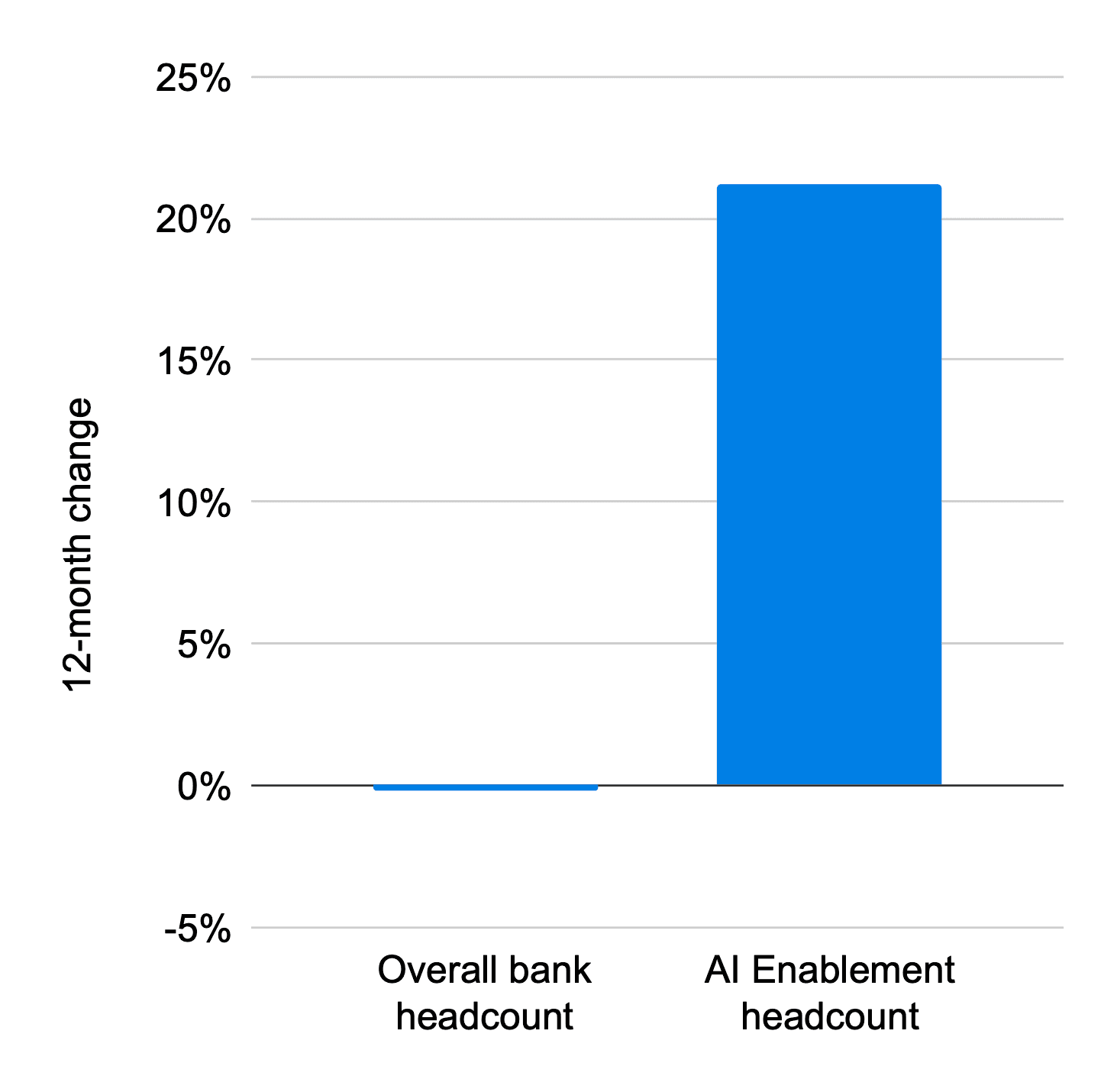
That push has banks acting a bit like Oprah with their org charts: “You get an AI job! You get an AI job!” All 50 banks we track made at least one AI enablement hire in the past year. And these roles – which depend on knowing a bank’s processes well enough to rethink them around tech – were among the most likely AI jobs to be filled by existing employees, our data shows.
“Business teams are becoming active participants in designing AI-enabled workflows, rather than simply writing requirements for engineering teams,” wrote Yibo Sun, director of AI and tech strategy for transformation and enterprise operations at RBC. His firm has one of the largest AI enablement teams in the Evident AI Index for Banks.
The shift Sun describes changes who banks need in the room to make AI work. Lenders have long relied on consultants – or, more recently, in-vogue forward deployed engineers – to set up camp and help them figure out how to get the most from new tech. That banks are now looking within for this kind of skillset is a bet that knowing the business will matter at least as much as, if not more, than knowing the tech when it comes to squeezing out returns.
“You can implement cutting-edge AI, but without organizational readiness, adoption stalls,” said Kevin Pollard, senior vice president of AI enablement at PNC. “The real competitive advantage lies in culture and enablement.”
The banks investing most heavily in that competitive advantage are the ones under the most pressure to prove AI pays off consistently to investors. Seven firms have now published realized gains that come directly from their AI portfolios. Those banks alone made nearly one-quarter of the AI enablement hires of the 50 banks we track.
“The technology is already at a level where it can do just incredible things,” said BNY CEO Robin Vince, who grew his enablement team at a faster clip than nearly any other bank this year. “Ultimately, adoption and embedding in a company is going to be the differentiator for many firms on whether or not they’re successful with AI.”
BOOK YOUR SPOT
EVIDENT AI SYMPOSIUM 2026

The Evident AI Symposium is our annual, invitation-only gathering of 300 senior AI leaders in finance. We come together each year to get real answers on how to drive AI transformation forward.
Over the course of the day, we’ll exchange insights on what it takes to deploy AI in global financial institutions today while surfacing the ideas and trends that will define what comes next.

STAT OF THE WEEK

That’s how many more people OpenAI and Anthropic hired from Stripe this year than from the 10 highest-ranked banks in the Evident AI Index for Banks combined.
The payments firm is punching above its weight, new Evident analysis shows: Stripe’s workforce is roughly 8,000 people. Those 10 banks – JPMorganChase, Capital One, RBC, CommBank, Morgan Stanley, Wells Fargo, UBS, HSBC, Goldman Sachs and Bank of America – together employ some 1.5 million.
Zoom out: Stripe is turning into a clearinghouse for Wall Street talent looking to get a foot into the frontier AI labs. Lenders increasingly want AI that can learn the language – and unwritten rules – of banking faster. At Goldman, for example, “the transfer of the institutional knowledge into the AI is the biggest question” the bank’s engineers are grappling with, CIO Marco Argenti said. Labs are trying to answer that call. To do it though, they’re prioritizing people who have one foot in banking and one foot in tech already. Stripe, which has roughly 1,000 alumni of those 10 banks on staff, according to LinkedIn data, is set up to be a perfect poaching ground.
MORE ON PAYMENTS: This week, Evident expanded the Use Case Tracker to include Payments firms. Evident members have exclusive access to a comprehensive database of more than 200 AI use cases from the 12 firms ranked in the Evident AI Index for Payments. Explore the full data set.

IN THE NEWS
SHARING IS CARING
AI savings from suppliers ought to be shared with everyone, Comrade Banks say. Citi and Morgan Stanley told law firms that their use of the tech – and the productivity benefits it produces – should mean lower bills for Wall Street. “If the number of hours they’re working on a matter has come down because of AI… our expectation is for costs to come down significantly per transaction,” said Adam Meshel, Citi’s head of legal. Banks haven’t been able to crack legal AI in-house, so it tracks that they’d be looking to trim billable hours another way: Just 2% of tools rolled out by the 50 banks we track deal with legal work, our Use Case Tracker shows. But they’d better hope IPO clients have short memories when banks send their own invoices.
TD Bank is ahead of schedule on its AI returns, the bank reported this past week. Through the first three quarters of its fiscal year, the Canadian lender has delivered $141 million worth of value, more than 95% of the way to its full-year target of $145 million. Santander is the only other bank reporting AI’s business value quarterly, the way TD now seems to be (see: “Bare ROI,” The Brief, Aug. 13). TD is smashing its goal; Santander, meanwhile, is plugging away at a $232 million target this year that’s nearly $100 million more ambitious. The two banks have also laid out longer-term goals. But how investors treat these different approaches to near-term milestones may end up being a useful test case as more banks share their results.
Lloyds is training a transaction foundation model it’s dubbed Atum (not to be confused with RBC’s ATOM, which does the same thing). The bank says Atum will give data science teams a shared model that understands customers’ financial history, rather than forcing each new tool to learn it from scratch. That more comprehensive view will help the bank spot fraud more easily, personalize more services and better predict when customers may leave, Lloyds said. As banks try to squeeze more from their proprietary data – and grow warier of handing it to third party AI firms – these models are catching on with the lenders that have the resources to build them: TD Bank has TD AI Prism, Revolut has PRAGMA and JPMorganChase has its Large Payments Model (see: “Retro-Chic AI”, The Brief, August 20).
RBC wants agents to deal with banking regulators. The Canadian lender is working on ReconAI, a reconciliation system which checks that the figures reported to regulators agree with internal records, a new job posting showed. The system will use AI agents to read regulatory instructions and propose adjustments if disparities emerge. This may seem niche, but these reports are hefty: Back in 2024, former Citi CFO Mark Mason said the bank produces 11,000 regulatory reports globally. One of them required 750,000 lines of data. Preparing them adds up: One estimate suggested UK businesses spend up to $5.4 billion a year preparing documents for bank cops.
WHAT'S NEW AT EVIDENT
Q2 2026 AI USE CASE TRENDS IN BANKING

AI use case announcements hit a new record, a growing group of banks are reporting group-wide AI value, and the vendor landscape continues to fragment. Here's how the AI use case landscape for banks developed in Q2 2026.

PAT SIGNAL
AI WHISPERER
In this segment, we explore how a bank’s patent advances its AI strategy. This week: A BNY patent (published Sept. 1) shows that the bank thinks playing “telephone” with its AI tools can get them to answer employee and customer questions better.
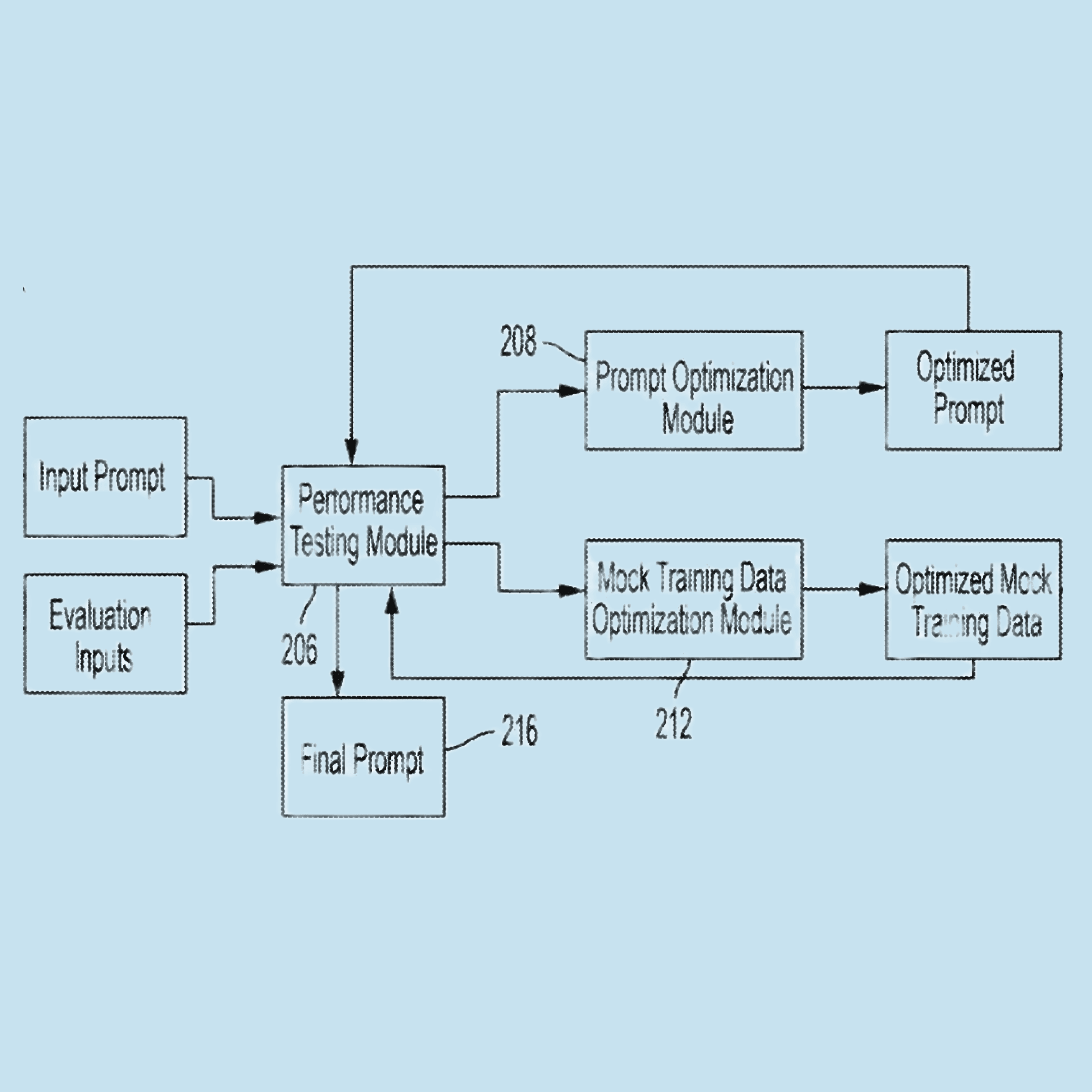
The patent, explained: AI tools don’t always like the way people talk to them. Models tend to respond best to direct and specific instructions, but people don’t always spell out what they need so clearly. BNY’s system plays translator – turning what people write into the type of prompt more likely to get them the response they want. The bank first teaches the system what “good” looks like, using sample answers and whatever in-house rules it wants to bake in – say, requiring certain sources for certain types of questions. When someone types in a question, the system intervenes before the response gets back to them and determines whether it hits the threshold. If the answer has missed the mark, the system rewrites the prompt and tries again on a loop until it gets a satisfactory one back.
What the bank can do with it: BNY could plug the system into its chatbot, Eliza, to cut down the back-and-forth time employees take to reword their prompts when the first answer misses the mark. But the bigger prize may be behind-the-scenes: Developers building AI tools have to write instructions telling the models what job they need to do and how to do it. BNY’s engineers could use the system to test whether those instructions are clear enough, rewrite them until they are and save themselves time patching issues down the line.

NOTABLY QUOTABLE
“My concern is not even a short-term one. Let’s say these models can be wrong right now. But fast forward any number of years – who’s going to have the expertise to recognize a wrong output? When today we speak about the human in the loop, we implicitly assume that the human has the expertise to spot wrong outputs. But the human has that expertise because they created that in a world before the existence of this model. Who’s going to have the expertise 15 years from now?”
– Gabriele Butti, global head of credit quantitative research at JPMorganChase, in an interview, Sept. 1
.svg&w=96&q=80)
TALENT MATTERS
PALANTIR'S PULL
Peter Zaffino, former CEO and current executive chair of AIG, is joining Palantir as head of financial services. Zaffino’s last day on the insurer’s board will be Sept. 15, and he’ll join Alex Karp’s firm on Jan. 15. “The organizations that will lead in the future are those that are building durable AI infrastructure today,” Zaffino said. “I am incredibly excited to work with financial services organizations to transform their AI strategy into strategic advantage.”
Amit Thawani is now CIO of the consumer bank at Lloyds. He was previously CIO of the insurance, pensions & investments unit – which this week was renamed Wealth & Investments. Under Thawani, the unit launched a pilot of an AI tool that delivers financial guidance to customers – a first for U.K. lenders. Lloyds has been pushing regulators for more room to use AI this way – and helping shape the policy around how banks could do it safely (see: “Rules, Britannia!” The Brief, Aug. 27).
Sammy Assefa joined the asset management firm Wellington Management as head of enterprise AI. He was previously head of AI and machine learning at U.S. Bank.
Raluca Iordache is now the head of the AI center of excellence and CIO of Deutsche Bank’s private banking arm. She’s been with the bank for nearly six years and was previously co-head of AI applied innovation.
Karan Nanda was promoted to senior director of strategy, planning and value for the AI group at RBC. It’s a role “dedicated to turning high potential AI use cases into solutions that deliver meaningful value for our clients,” he wrote.
ANZ hired Matt Zaba as general manager of audit analytics and AI. He joins the bank after a seven-year stint at Australian rival NAB, where he finished his tenure as an executive of AI strategy, governance and assurance.
Colin Teo joined Mastercard as a director and data scientist focusing on “financial crime in the account-to-account (A2A) payments space,” he wrote on LinkedIn. He joins from Standard Chartered, where he was director of machine learning.
HSBC wants its hiring to be more high-tech: The bank promoted bank veteran Katherine Hogbin to be head of AI, products and enablement for enterprise talent. In the role, she’s tasked with “accelerating our AI and operational excellence agenda to keep improving how we attract, hire and develop talent,” she wrote.
WHAT'S ON
Tues 8 Sept. - Weds 9 Sept.
AI in Financial Services Europe, London
Mon 28 Sept. - Thurs 1 Oct.
Sibos, Miami
Thurs 1 Oct.
The Next Chapter for AI in Latin America, Virtual
Sat 14 Nov. - Tues 17 Nov.
ICAIF - ACM International Conference on AI in Finance, Milan
- Alexandra Mousavizadeh|Co-founder & CEO|[email protected]
- Annabel Ayles|Co-founder & co-CEO|[email protected]
- Colin Gilbert|VP, Intelligence|[email protected]
- Matthew Kaminski|Senior Advisor|[email protected]
- Kevin McAllister|Senior Editor|[email protected]
- Daniel Shackleford Capel|MD, Banking|[email protected]
- Maryam Akram|Senior Research Manager|[email protected]
- Alex Inch|Data Scientist|[email protected]
- Sam Meeson|AI Research Analyst|[email protected]
- Gabriel Perez Jaen|Research Manager|[email protected]
- Jay Prynne|Head of Design|[email protected]
- Marcus Gurtler|Junior Designer|[email protected]

