

DATA-DRIVEN INSIGHTS AND NEWS
ON HOW BANKS ARE ADOPTING AI
New Evident AI Index for Insurance

Source: Adobe Firefly
18 June 2026
Just out: the 2026 Evident AI Index for Insurance. We’ll tell you who came out top and why. There are plenty of lessons in there for other parts of the financial industry.
Then: One of banking’s former top regulators tells us how the world’s bank cops ought to handle agentic AI.
People mentioned in this edition: Claire-Marie Coste-Lepoutre, Thomas Buberl, Michael Hsu, Mike Lyons, Takis Georgakopoulos, Petri Tuomola, Sameer Gupta, Matt Partridge, Arthur Mensch, Ranil Boteju and others.
This edition is 2,051 words, a 7-minute read. Check it out online. If you were forwarded the Brief, you can subscribe here. Write us: [email protected].
– Alexandra Mousavizadeh & Annabel Ayles

EVIDENT AI INDEX FOR INSURANCE
TRADING PLACES
.png&w=3840&q=80)
Allianz leads all insurance companies on AI maturity, according to the Evident AI Index for Insurance, released this week.
To claim the top spot, the German insurer leapfrogged AXA, last year’s top finisher. Manulife climbed to third and is again the Index’s top life insurer. Zurich rose eight places – more than any other ranked firm – and placed fourth. And Liberty Mutual Insurance jumped two places to take the crown as the top property & casualty insurer on AI.
The Index assesses 30 of the largest insurance companies across North America and Europe on the quality of their AI talent stack, the impacts of their innovation efforts, the tech leadership of their C-suites and the measures they’ve put in place to govern and scale AI effectively.
This sector has fewer easy AI wins than banking. While lenders have constant, low-stakes client interactions to automate, insurers tend to only hear from customers after events like a flood, a fire or a crash. Carriers, as a result, have focused less on bolting AI onto parts of those interactions and more on how to change them from start to finish. A year ago, that looked like they had less to show for their AI investments. But as every financial services firm now races to rebuild messy processes around this tech, insurers’ slower start may turn out to be what prepares them to capture the biggest upside in the new agentic era.
THE WHOLE NINE
More than 40% of the AI tools released in 2026 by the 30 insurers we track now automate several steps of a workflow, rather than just focusing on one task.
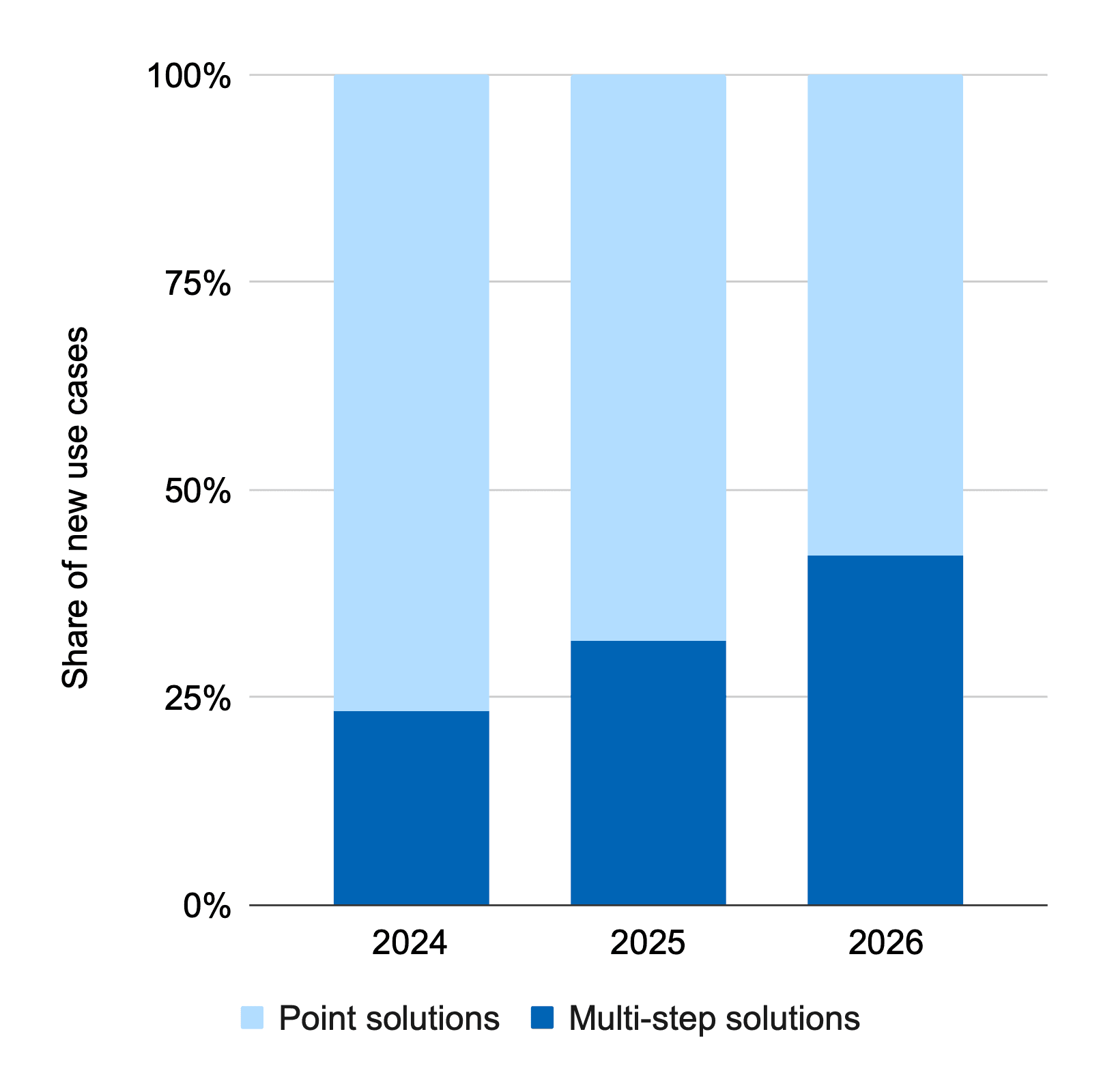
Allianz is at the front of that shift. Most AI use cases in insurance are still narrow point solutions focused on improving productivity. Leading insurers are now starting to chain tools together to tackle more than one part of a process and compound the efficiency gains. Allianz’s Project Nemo, for example, is a multi-agent system that handles different steps of the claims process – from validating coverage to checking for fraud. In its first application, it cut processing time on some food spoilage claims from days to hours by tackling the process as a whole.
At the same time, insurers are starting to introduce new tools that improve not just how people work, but how effectively decisions get made on underwriting or portfolio performance – the types of outcomes that actually impact the bottom line. “There will be benefits [from AI] as we are working in terms of customer experience, optimizing the processes,” said Allianz CFO Claire-Marie Coste-Lepoutre in the firm’s earnings call last month. “Productivity becomes a sort of a by-product of the optimized processes that then we can reinject into making our product in terms of pricing points also more attractive to fuel the growth.”
Tools that push beyond productivity are still the exception, but that’s starting to change. AXA’s extreme weather risk platform now turns real-time data into predictive insights that help the firm avoid costs through proactive disaster prevention. Manulife is using a sales support agent in Singapore that recommends actions and drafts personal notes to customers which, in pilot, resulted in a 5% higher repurchase rate.
Come next year, more insurers will need to prove they can move from building tools that automate a single task to ones that tackle a bigger workflow, and from touting productivity gains to delivering a boost to the bottom-line.
“For us, AI is an efficiency play, but not only,” said Thomas Buberl, AXA’s CEO on an earnings call in February. “AI will change how customers access insurance, it will change the personalizations in products, and it will also change the customer experience.”
Explore the full ranking and download the Key Findings Report for more details and analysis about insurance and AI.
JOIN OUR ROUNDTABLE
EVIDENT AI INSURANCE ROUNDTABLE

AI maturity is rising across the insurance industry, and the competitive landscape is shifting fast. As once-differentiating capabilities become more widespread, insurers face growing pressure to move beyond efficiency gains and scale AI in ways that improve core outcomes across underwriting, pricing, and claims.
To mark the launch of the 2026 Evident AI Index for Insurance, join us as we unpack the results and explore what the sector's frontrunners are doing differently.
.svg&w=96&q=80)
Q&A
WHAT REGULATORS REALLY WANT
Regulators are ramping up their scrutiny of the way banks use AI, Reuters reported on Friday. The Office of the Comptroller of the Currency and the Federal Reserve have started asking banks to map how they’re using AI across areas like KYC and lending and are probing whether banks have “kill switches” that they can hit should AI spiral out of control.
Michael Hsu served as acting comptroller of the currency from 2021 to 2025. He was one of the top banking regulators when ChatGPT was first rolled out. He now advises Anthropic and is co-chair of the financial services workstream at MLCommons, a non-profit developing AI standards and benchmarks. We sat down with him this week to see what comes next as the regulators turn up the heat.

EVIDENT: Why is this scrutiny coming now?
HSU: Until recently there have been three frameworks – model risk management, third-party risk management, software development lifecycle. If you ask banks where their AI risk function sits, it usually was some combination of these three. I don't think retrofitting [to those frameworks] is the right approach. That’s like saying a horse and buggy is like a car. It’s not. You’ve got to treat it differently, and especially for agentic, you just have to start with a clean sheet of paper.
One of the powers and the risks with these models is they’re not entirely predictable. There are cases like PocketOS, a small vertical SaaS company, that gets its code base wiped out. When I talked to bankers, I said, ‘what if it had been a small bank somewhere that had done what PocketOS had done, which is use Cursor to do various things, and it just wiped out its code base?’ Everybody agrees the regulators would have said, ‘shut it all down.’ It wouldn't have been a measured, deliberate reaction. They were just going to shut the whole thing down until we figure out what safe is.
What needs to happen to figure out what safe is?
There’s two-sided risk here: Traditionally, with derivatives or crypto, if I don’t adopt anything, it’s perfectly fine. With AI, that’s not the case. If you don’t do anything, you are going to be in trouble and in six or 12 months, you’re going to be so far behind, and you’re going to be vulnerable. We’re going to see a lot more sandboxes in the future. You need an environment where I can see it, I can touch it, something can go wrong, it’s not catastrophic.
Say a bank is thinking about adopting a coding agent. You can test it out with the following programming languages and see what it can do in a way where it’s not connected to your production systems. But we can see what that looks like, the bank can see it, the regulator can see it. A lot of banks are already doing this, they’re just not doing it with a kind of regulator view, because I think there’s a lot of uncertainty about what to do with that. And it does presume that regulators have some competence, some expertise, which they’re trying to get up the curve on. I think there is a gap, and these gaps take time to fill.
So then what role does the regulator fill?
The best example of this from before is probably cloud. The technology comes out, the world starts to use it, regulators are like, ‘Whoa, whoa, whoa.’ But a part of the cloud that’s interesting is who’s responsible for what. At the end of the day a bank can’t run the cloud by itself, it has to depend on one of the three big cloud providers. This came to a head when I was acting comptroller. How do we split our responsibility? So they came up with a shared responsibility model.
Eventually, the same thing’s going to happen, where there will be a shared responsibility model to say the foundation model providers are responsible for XYZ, the wrappers, the harnesses, everyone in between. The bankers responsible for certain things. If you don’t have that, you just wait for lawsuits and enforcement actions. For cloud, the treasury played a bit of a convening role, like let’s get everyone in the room together. But really the major players did have to come to the table and say, okay, I’m willing to negotiate. Now that we have that model, we can all build off of that, so I’m a little bit more optimistic that the challenge is less the structure and the willingness and the pattern. It’s just the speed of all this.
.svg&w=96&q=80)
TALENT MATTERS
CEO SHUFFLE
Mike Lyons will take over as CEO and president of Truist in September after a year and a half as CEO of payments firm Fiserv. At the helm, Fiserv launched the One Fiserv Action Plan, a broad strategy that included “fully embracing AI,” he said at a conference last month. That included overseeing last month’s launch of AgentOS, a platform for banks to build their own agentic tools (see: “In the news,” The Brief, May 21).
In turn, Fiserv appointed Takis Georgakopoulos as its next CEO. Georgakopoulos has served as the firm’s COO since last April and was one of Lyons’ top lieutenants on the AI strategy. At the firm’s investor day last month, Georgakopoulos said that 40% of its engineers were using AI every day and that 25% of its code was AI-written. “We are gonna take both of those numbers close to 100% by year-end,” he said. “Even at this modest level of adoption, the results have been nothing short of amazing.”
Petri Tuomola, group head of enterprise architecture and data/AI platform at DBS, is leaving the bank. Tuomola had been with the Singaporean lender since 2020 and built the bank’s AI platform which “now runs hundreds of AI/ML use cases in production,” he wrote on LinkedIn. His departure is the latest tech shakeup at DBS: Sameer Gupta, the bank’s former chief analytics officer, announced he was leaving in April and started as chief data and AI officer at Lloyds this week.
Matt Partridge is now Gen AI adoption lead within UBS’ chief AI office, where he’s “responsible for identifying and prioritizing high-value Gen AI use cases,” he wrote on LinkedIn. Partridge was previously an AI platform initiative management lead, where he helped develop UBS’ investment banking platform.
State Street hired Vijoy Basu as managing director of AI within the bank’s Global Delivery unit in India. He was previously director of data science and AI at supply chain company Ferguson.
JPMorganChase is recruiting AI talent in London, with an invite-only event focused on how the bank is scaling AI.
JOIN OUR ROUNDTABLE
CAPTURING THE AI ADVANTAGE: WHAT MEA BANKING LEADERS DO DIFFERENTLY

To mark the launch of the Evident AI Index for Banks - MEA, join top AI executives from the region’s leading banks on June 30 to unpack the 2026 results and explore what the frontrunners are doing differently.

STAT OF THE WEEK
.png%3FupdatedAt%3D2026-06-18T10%3A30%3A51.762Z&w=3840&q=100)
That’s how much the U.K. has committed to its sovereign AI fund, an effort that’s come into focus after the White House forced Anthropic to take down Fable, the “Mythos level” model it considers a threat to national security. That the government can simply shut off model access in the matter of an afternoon is concerning for non-U.S. firms, which have been deepening their relationships with AI labs based in their own countries. Last week, British AI lab Cosine got the backing of both NatWest and Lloyds. Canada’s Cohere is working closely with RBC. And French lab Mistral deepened its partnership with BNP Paribas last month and is co-developing new tools (see: “French connection,” The Brief, June 11).
Yes, but: The sums being raised outside the U.S. wouldn’t make Scrooge McDuck blush. Anthropic and OpenAI have combined raised more than $260 billion, according to PitchBook. Mistral, meanwhile, is on the hunt for $3.5 billion, which would bring its total funding to roughly $6.5 billion. Geopolitical tensions and rising AI bills are putting a premium on banks’ model agnosticism strategies, but the funding gap means defections aren’t happening. “Today, we do not yet own the best language models,” wrote Mistral CEO Arthur Mensch on LinkedIn. “But we’ve constantly reduced that gap.”

NOTABLY QUOTABLE
“Any chief AI officer should operate on the premise that they should not have a role in the future.”
–David Hardoon, former global head of AI enablement at Standard Chartered, in an interview, June 15

IN THE NEWS
ANOTHER LAB TURNS THE SCREW
Microsoft is the latest firm to switch its pricing model to be based on usage of AI tokens rather than a per-seat cost. It follows Anthropic and GitHub’s moves to do the same and puts banks’ strategies on how to be more efficient with tokens – as we explored last week – into greater focus (see: “Tokenflation,” The Brief, June 11). Ranil Boteju, chief AI officer at CommBank, gave us a look at how that calculus gets done at Australia’s top AI bank after our story ran last week: “We can apply usage caps and for use cases, we optimize model usage for certain tasks to reduce costs,” he emailed in response to a question about how the bank would answer if usage spiked. “Organizations with high token consumption may need to consider prioritizing token allocation to specific individuals and use cases.”
Microsoft’s announcement came with a carrot, too: Axios reported that, along with the pricing switch, the firm is considering hosting a version of DeepSeek’s models that would give users a more economical way to use certain features. The Chinese model-maker is flush with cash after closing a $7.4 billion round this week and recently cut its token prices by 75%. Using Chinese models has been a thorny prospect at banks – especially U.S. lenders. But as AI costs add up, some executives tell us they’re pushing their firms harder for access to these Chinese models so bills don’t end up erasing the hard-won gains of their AI deployments to date.
AI continues its slide from the cool table to outcast in the public’s eyes, new data shows. Only about one-third of Americans are excited about having AI in products and services, according to polling firm Ipsos. That’s down five points on the year. The tech’s rising unpopularity is forcing banks to think harder about how they market new AI-driven products: TD Bank’s AI Insights Report out this week showed that while more than half of Canadians are comfortable with AI being used in back-end processes like fraud protection or credit scoring, only one in three would trust AI financial advice over something their parents told them. It’s not the only bank working public attitudes deeper into product considerations: CommBank launched the AI Attitudes Barometer earlier this year to gut check how Australians are feeling about the tech as it rolls out new AI tools.
WHAT'S ON
Tuesday 30 June
Capturing the AI advantage: What MEA banking leaders do differently, Virtual
Thursday 25 June
Open Source in Finance Forum, London
- Alexandra Mousavizadeh|Co-founder & CEO|[email protected]
- Annabel Ayles|Co-founder & co-CEO|[email protected]
- Colin Gilbert|VP, Intelligence|[email protected]
- Matthew Kaminski|Senior Advisor|[email protected]
- Kevin McAllister|Senior Editor|[email protected]
- Daniel Shackleford Capel|MD, Banking|[email protected]
- Maryam Akram|Senior Research Manager|[email protected]
- Zachary Groz|Reporter|[email protected]
- Alex Inch|Data Scientist|[email protected]
- Sam Meeson|AI Research Analyst|[email protected]
- Gabriel Perez Jaen|Research Manager|[email protected]
- Jay Prynne|Head of Design|[email protected]
- Marcus Gurtler|Junior Designer|[email protected]

