

DATA-DRIVEN INSIGHTS AND NEWS
ON HOW BANKS ARE ADOPTING AI
Sticker shock

Source: Adobe Firefly
2 April 2026
Welcome back to the Banking Brief and happy Q2 to all who celebrate. This week: AI is going to cost a lot more before it starts making things cheaper. Why bank chatbots are back in vogue. Plus, how CommBank uses agents to handle emerging threats.
People mentioned in this edition: Jensen Huang, Marguerite Bérard, Marco Argenti, Hari Gopalkrishnan, Brendan Coughlin, Anton Frolov, Rohit Dhawan, Lambert Mathias, Aarti Gupta, Karanbir Singh Mann and others.
This edition is 1,763 words, a 5 minute read. If you were forwarded the Brief, you can subscribe here. We always want to hear from you at [email protected].
– Alexandra Mousavizadeh & Annabel Ayles

TOP OF THE NEWS
CFO-PHIE'S CHOICE
Banks are getting more candid about how much value AI can create inside their business. Just don’t ask them how much they’re spending to get it.
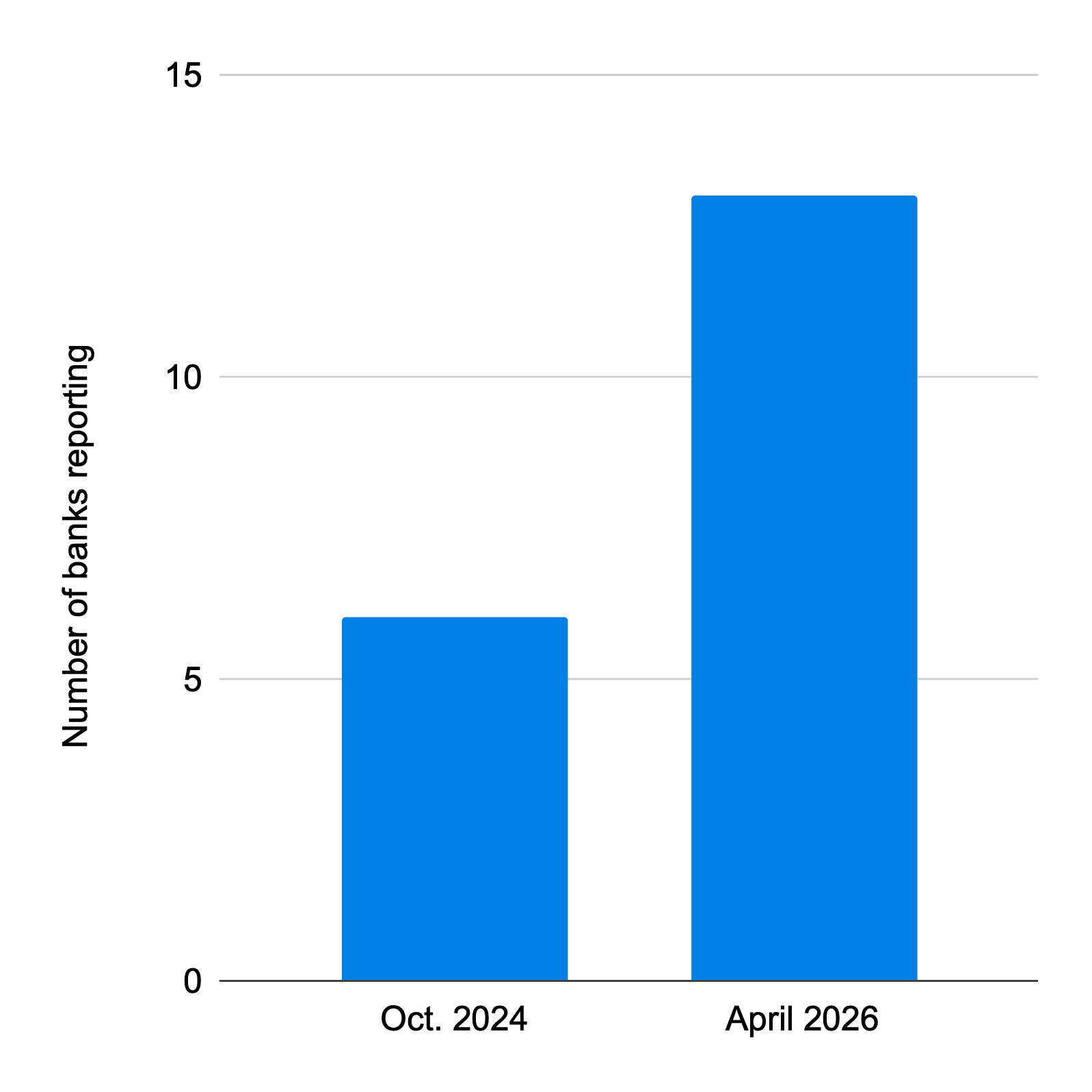
More than one quarter of the 50 banks we track now share a real or projected figure for AI’s benefit, new Evident analysis shows. BMO said $720 million ($1 billion CAD) will come from the tech by 2030 at last week’s investor day. Santander put it at $1.2 billion (€1 billion) by 2028 at its February event.
What those numbers leave out is the other half of the ROI equation: costs. AI is working, but it’s making bankers faster, not fewer (see: “It’s not the AI, stupid,” The Brief, March 26). Until banks can fully transform their processes around the tech, they end up footing the bill for both the old workflows and the AI they’ve layered on top of them.
That overlap forces them to make a choice: Let AI usage – and costs – run so the bank can transform faster, or hold the line on spending and risk missing out on the actual payoff.
DOUBLING DOWN
The number of banks reporting the actual or projected financial value generated from AI has more than doubled in 18 months.
How much, and fast, costs can shoot up shows why it’s not straightforward. One bank told us its token costs this past month – the meter that runs based on how much AI employees are using – has grown 250% since the beginning of the year. In Silicon Valley, it’s even more pronounced: Nvidia CEO Jensen Huang last month said he now expects his top engineers to be billing $250,000 worth of AI use to the company, which comes on top of the $500,000 salary the firm’s already paying.
Not every bank can stomach that cost or unpredictability. ABN AMRO limits Microsoft Copilot licenses to employees that ask – and pay – for them with their own learning and development budgets, CEO Marguerite Bérard said this week. That prudence is easier to sell to investors in the short term, but it also caps how quickly the bank can rewire itself.
Goldman Sachs is taking the opposite tack. Most of the bank’s employees now use its platform, GS AI, multiple times a day, CIO Marco Argenti said on a podcast this week. That usage is informing how the bank is approaching transformation (see: “Goldman’s gold mine,” The Brief, March 26). But it hasn’t come cheap: “There’s going to be a token sticker shock for CFOs.” Argenti said, describing how transformation changes AI’s economics. “All of a sudden, they’re going to start seeing bills that they absolutely did not expect.”
It’s up to every bank, then, to convince the CFO that those bills still pale in comparison to the cost of watching from the sidelines.
WHAT'S ON AT EVIDENT
JOIN US LIVE
.png%3FupdatedAt%3D2026-03-27T12%3A36%3A54.002Z&w=3840&q=100)
The two-week countdown to our next virtual roundtable starts now. Join us and senior leaders from BMO, Wells Fargo, and EY to discuss where and how banking leaders should be focusing their AI efforts in 2026. On the agenda:
- Where banking leaders are prioritizing AI deployment
- How strategic investment and partnership decisions are shifting over time
- Where enterprise-wide ROI is really materializing – and where you can get the most bang for your buck

TREND LINES
COMEBACK KIDS
More than half of Americans now use AI to help manage their money, up from just 10% a year ago, new data from TD Bank shows. The surge is giving the lowly consumer banking chatbot a second wind.
These tools haven’t always been the crown jewel in a bank’s AI portfolio. In many cases, far from. A survey from Swedish bank Handelsbanken last year found that one-in-five people had actually shouted at their computer while using them.
For years, the tech just wasn’t good enough for what people wanted. Customers expected a tool like Iron Man’s Jarvis and were given something closer to a Magic 8 Ball. As lenders have gotten a handle on Gen AI – and now Agentic AI – that gap is closing. And banks are now betting that they can transform these once-frustrating tools into a point of differentiation.
“We’ve learned, in a way the hard way, and over time, that by investing in a foundation and these capabilities, the third and fourth and fifth build is much faster,” said Bank of America chief technology and information officer Hari Gopalkrishnan.
Those later builds are starting to show how banks will break free from bots that just direct users to FAQs. NatWest put Gen AI into Cora so it could answer spending questions and create data visualizations rather than send customers down scripted paths. Satisfaction jumped 150%. BBVA put an “AI coach” into Blue, a Gen AI tool which suggests steps to improve finances, tailored to each customer’s particular situation. And Wells Fargo rejigged the architecture behind Fargo so questions were routed to the model equipped to answer a particular question best. Usage has shot up to more than 1 billion interactions, up from 250 million just a year ago, the bank said last week.
The next step is turning personalized insights into action. Bank of America’s Erica, which has 58 million customer interactions per month, gets halfway there through proactivity: More than half of its exchanges are nudges the tool sends on its own – tips about deals they're eligible for based on their spending or warnings of upcoming balance issues. The challenger banks are showing how to go further: Starling Bank rolled out an assistant late last month that can transfer money straight from chat and take independent actions to help customers hit savings goals. Brazil’s Nubank is developing capabilities to let agents handle debt renegotiations and card servicing end-to-end, the bank shared last week.
Bottom line: Consumers are willing to give chatbots a second chance. Banks need to make sure that when they shake up their offerings, they don’t just say “ask again later.”

STAT OF THE WEEK

That sums up the ambitions of Citizens Financial’s AI overhaul, the bank’s president Brendan Coughlin said in an interview this week. The bank is investing $300 million to “reimagine” nearly 50 banking processes – from call center operations to anti-money laundering – with a target of $450 million in returns by 2028.
Zoom out: It’s a test of whether a bank can skip the line. Most lenders have spent years layering AI, and then Gen AI, into the areas Citizens identified. Coughlin is pointing at skipping straight to agentic workflows: “We’ve actually started deploying — it’s in pilot — agentic AI into our call center with the goal of 50%-plus of our phone calls will ultimately be answered by a nonhuman in a very effective way,” he said. If it works, the bank will have compressed years of incremental build into a single push. If it doesn’t, it’s a reminder that while AI may provide shortcuts for tasks, rewiring processes, controls and teams still has to happen step-by-step.

IN THE NEWS
AI IN A DAY'S WORK
JPMorganChase is getting ever-closer to tying AI to employee performance, a leaked memo last week showed. Developers now must “demonstrate measurable improvement in code quality, speed and productivity through regular use of approved AI coding assist tools,” it read. The alternative, one developer said, is being seen by management as underperforming. The bank’s message on AI is starting to mirror CEO Jamie Dimon’s stance against remote work: If you don’t like it, go work somewhere else.
Lloyds inked a new four-year research partnership with the University of Glasgow, focused on “how agentic AI can support software and data engineering at scale,” the bank’s AI head Rohit Dhawan wrote on LinkedIn. The bank didn’t disclose how much funding it would put into the program, but these academic tie-ups are taking up a larger part of budgets. UBS put roughly $21 million into a partnership with the University of Oxford earlier this year (see: “Stat of the week,” The Brief, Feb. 5). And BNY’s work with Carnegie Mellon University clocked in at $10 million.
Want to know what it would look like if OpenAI owned a bank? Look to Russia. Sber, the country’s largest lender, built a foundation model to rival ChatGPT back in 2023. This week, it released an update that improved the model’s long-term memory and integrated it into its banking chatbot, GigaChat. “We are moving from being just an answer-giving tool to becoming a multi-agent AI assistant,” said Anton Frolov, the bank’s head of Gen AI development. Its true ambitions though are bigger and more in line with China’s approach to superapps, where one app can connect to every part of someone’s digital life: “The era of dozens of apps for different tasks is ending,” he said. “In their place will be a single assistant that knows the user, adapts to their life, and is even capable of changing its own interface.”
Ping An, China’s largest non-state owned insurance company, says it’s aiming to double its price-to-book ratio through the use of AI, which could add up to $174 billion to its market cap. The firm already has AI embedded in operations: The tech handled 70% of its loan recoveries in 2025 and handled nearly 60% of its accident and health insurance claims.
WHAT'S ON AT EVIDENT
NEW INDEX COMING SOON
The Evident AI Index sets the global standard for measuring AI adoption in banking. Now, for the first time, it's coming to the Middle East and Africa. Launching later this year, the MEA edition will benchmark more than 20 major banks across the region.

USE CASE CORNER
CLEAR AND PRESENT DANGER
Through the 2010s, there was a running joke that a company’s head of cybersecurity existed to be fired. In 2026, they may just get replaced by agents. In this week’s “Corner” we look at a new agentic tool from Australia’s CommBank that it uses to keep up with a surge of machine-generated threats.
Use case: Agentic threat hunter
Vendor: n/a
Bank: CommBank
Why it’s interesting: The cybersecurity tools vendors are putting out aren’t equipped to handle how fast those new threats are popping up, Andrew Pade, GM of cyber defense operations at CommBank, said at a conference last month. A report from security firm CrowdStrike this year found that AI-enabled attacks grew 89% in 2025 compared to the previous year. The scale of potential threats banks need to defend against is growing even faster. Since Pade joined CommBank six years ago, the number of threat signals that the bank needs to track has jumped 5,000 times over – from 80 million per week to 400 billion. “You cannot manage that with traditional cyber defenses,” Pade said. In response, the bank built its own agentic tool to take in threat information and identify spots across the business’s tech footprint where it could be vulnerable.
How it works: The bank uses two AI agents in tandem to wrangle the increased threats. The first agent assesses how serious a threat is. That work used to take humans two days. It takes the agent about 30 minutes. A second agent then scans the bank’s systems to see how those threats could be exploited inside the bank’s systems.
By the numbers: The agents reduce the amount of time it takes the bank to respond to threats, but they also gives the security team a better handle on what the emerging risks to the bank actually are, Pade said.
Bigger picture: Banks still play cybersecurity use cases close to their chest to avoid revealing information to bad actors. In the Use Case Tracker – our database of the use cases publicly rolled out by the 50 banks we track – CommBank’s build is the first new tool since JPMorganChase launched its threat modeling co-pilot late last year (see: “Playing defense” The Brief, Nov. 13). But with regulators now warning banks of increased cyber risk due to geopolitical turmoil, behind the scenes there’s an uptick in new tools in the space.
Want to know more about the specific ways banks are rolling out AI? Check out our Use Case Tracker – the inventory of all the AI use cases announced by the world’s largest banks available to members.

NOTABLY QUOTABLE
“One of the advantages of having forward deployment engineers [from Anthropic] is also that there is a little bit of clash of culture that is happening around the table. And so people think really, really differently. And that pushes people outside their comfort zone.”
– Marco Argenti, CIO at Goldman Sachs, on a podcast, March 30
.svg&w=96&q=80)
TALENT MATTERS
NEW REALITY
JPMorganChase hired Lambert Mathias as a managing director, where he’ll be “designing architectures where perception, memory, reasoning, and tools come together to operate reliably at scale,” he wrote on LinkedIn. Mathias was previously an AI research scientist for Meta’s Reality Labs unit, the division working on virtual reality and AI glasses.
Aarti Gupta is now head of planning and enablement for data, digital and AI at Westpac. She’s been with the Australian bank since 2019.
Karanbir Singh Mann was promoted to director of software engineering at RBC. He’ll focus on “bringing together strong backend engineering with emerging agentic AI capabilities,” he wrote on LinkedIn.
Morgan Stanley is hiring a Gen AI strategy and transformation change management officer. Among the responsibilities is tracking “metrics to assess the impact of education and engagement efforts on employee literacy and adoption.”
WHAT'S ON
Tues 14 April
Scaling What Works: Where Banks Are Unlocking Real Value From AI, Virtual
Weds 15 - Thurs 16 April
AI in Finance Summit, New York
Mon 27 - Tues 28 April
Momentum AI New York 2026, New York, NY
- Alexandra Mousavizadeh|Co-founder & CEO|[email protected]
- Annabel Ayles|Co-founder & co-CEO|[email protected]
- Colin Gilbert|VP, Intelligence|[email protected]
- Matthew Kaminski|Senior Advisor|[email protected]
- Kevin McAllister|Senior Editor|[email protected]
- Daniel Shackleford Capel|MD, Banking|[email protected]
- Maryam Akram|Senior Research Manager|[email protected]
- Zachary Groz|Reporter|[email protected]
- Alex Inch|Data Scientist|[email protected]
- Sam Meeson|AI Research Analyst|[email protected]
- Gabriel Perez Jaen|Research Manager|[email protected]
- Jay Prynne|Head of Design|[email protected]
- Marcus Gurtler|Junior Designer|[email protected]

