

DATA-DRIVEN INSIGHTS AND NEWS
ON HOW BANKS ARE ADOPTING AI
🚨Top AI asset managers🚨
Source: Adobe Firefly
19 November 2026
Welcome back. We’re off next week for Thanksgiving, so we’re bringing you a double issue to read in between refreshing ANT today. First up: the new Evident AI Index for Asset Management – who’s winning, what cutting-edge tools look like in this sector and the people shaping what’s next. There are plenty of lessons for bankers.
Then: Evident’s Maryam Akram reports from the top financial AI conference, where the buzz on the ground should have OpenAI and Anthropic sweating. Plus: Capital One’s big move.
People mentioned in this edition: Rick Rieder, Rob Goldstein, Erik Roth, Mani Iyer, Jenny Johnson, Gary Collier, Deep Ratna Srivastav, Greg Jensen, Max Gokhman, Tony Kim, Francesco Bonchi, Stefano Pasquali, Daniele Magazzeni, Kevin Cassar, Janet Peterson, Guy Gubi, Mark Howden, Dorota Polak-Gilewska, Kieran White, Ibrar Ulhaq and others.
This edition is 2,031 words, a 6-minute read. Check it out online. If you were forwarded the Brief, you can subscribe here.
– Alexandra Mousavizadeh & Annabel Ayles

EVIDENT AI INDEX FOR ASSET MANAGEMENT
TALE OF THE TAPE
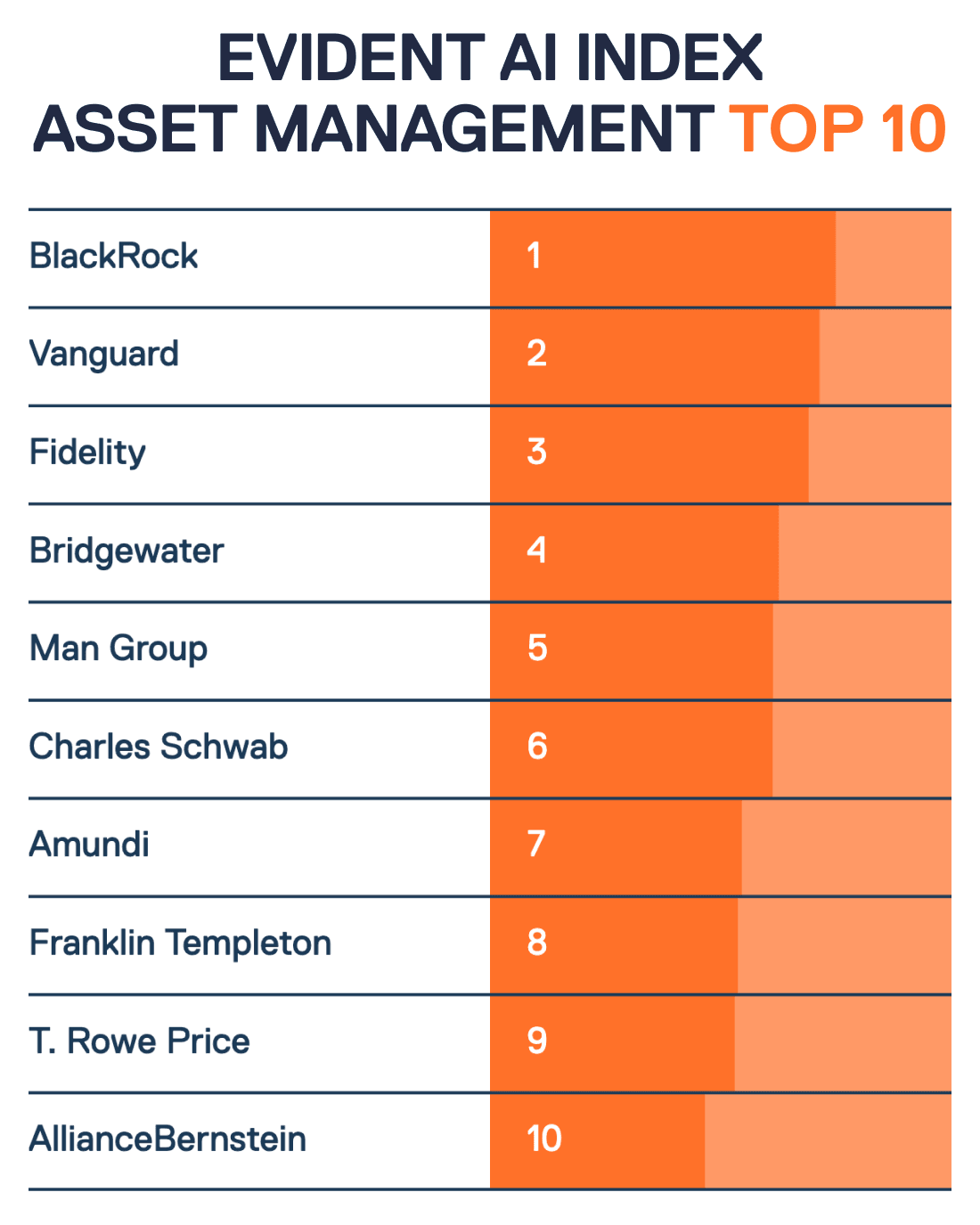
BlackRock is the top asset manager on AI, the inaugural Evident AI Index for Asset Management, out this week, shows.
The world’s largest investment firm edged Vanguard (#2) and Fidelity (#3) to claim the top slot in our ranking, which assesses firms’ AI deployment through their talent stacks, innovation agendas, executive leadership and AI guardrails. Hedge funds Bridgewater (#4) and Man Group (#5) rounded out the top five.
The asset managers in our Index have spent billions in the past couple years jostling for a chance to bankroll the AI buildout. Now, our data shows they're in a new race that may prove even more consequential: putting the resulting tech to work internally before competitors. Lose that one and they could end up watching rivals manage the new fortunes their investments created (assuming, of course, they survive).
“Quite frankly it's intimidating because we've never had the ability to evolve our investment process so aggressively,” Rick Rieder, chief investment officer of global fixed income at BlackRock, said about AI this week. Inside the top-ranked firm, the tech has been an “incredible augmentation” to his team’s ability to suss out correlations in data and spot trends in the market, he said.
At BlackRock, that’s increasingly done by “virtual AI agents that are scanning research notes, company filings, emails, to generate portfolio insights,” COO Rob Goldstein told investors. Those agents underpin Asimov, an investment research platform that processes 150,000 documents per week and turns them into trading signals that investors can act on (more on that in Use Case Corner below). Bridgewater similarly built a “pocket analyst tool” that, in a few months, saved the firm “multiple man-years” worth of research time (see: “Pocket aces,” The Brief, Aug. 6). In all, the top nine firms in the Index account for nearly half of the 320 AI use cases publicly rolled out.
But in this sector, AI success doesn’t get measured by the number of use cases or how well the tech spots patterns. To be worth the investment, AI needs to pass the same old-fashioned test star fund managers have been up against for decades: Can it make the firm more money? Man Group is testing that by letting AI come up with trading ideas. At least 20 of those strategies are in production, the firm said (see: “Man vs. Machine,” The Brief, Nov. 5). And Franklin Templeton (#8) built an agent that went from stress testing investment ideas to coming up with its own, Max Gokhman, the firm’s head of AI and digital asset solutions, said on a podcast last month. “It got smart enough where we were like, ‘hey, you can actually be more than just an adversarial agent,’” he said. “Now it really is a coworker.”
TOP OF THE (ASSET) CLASS
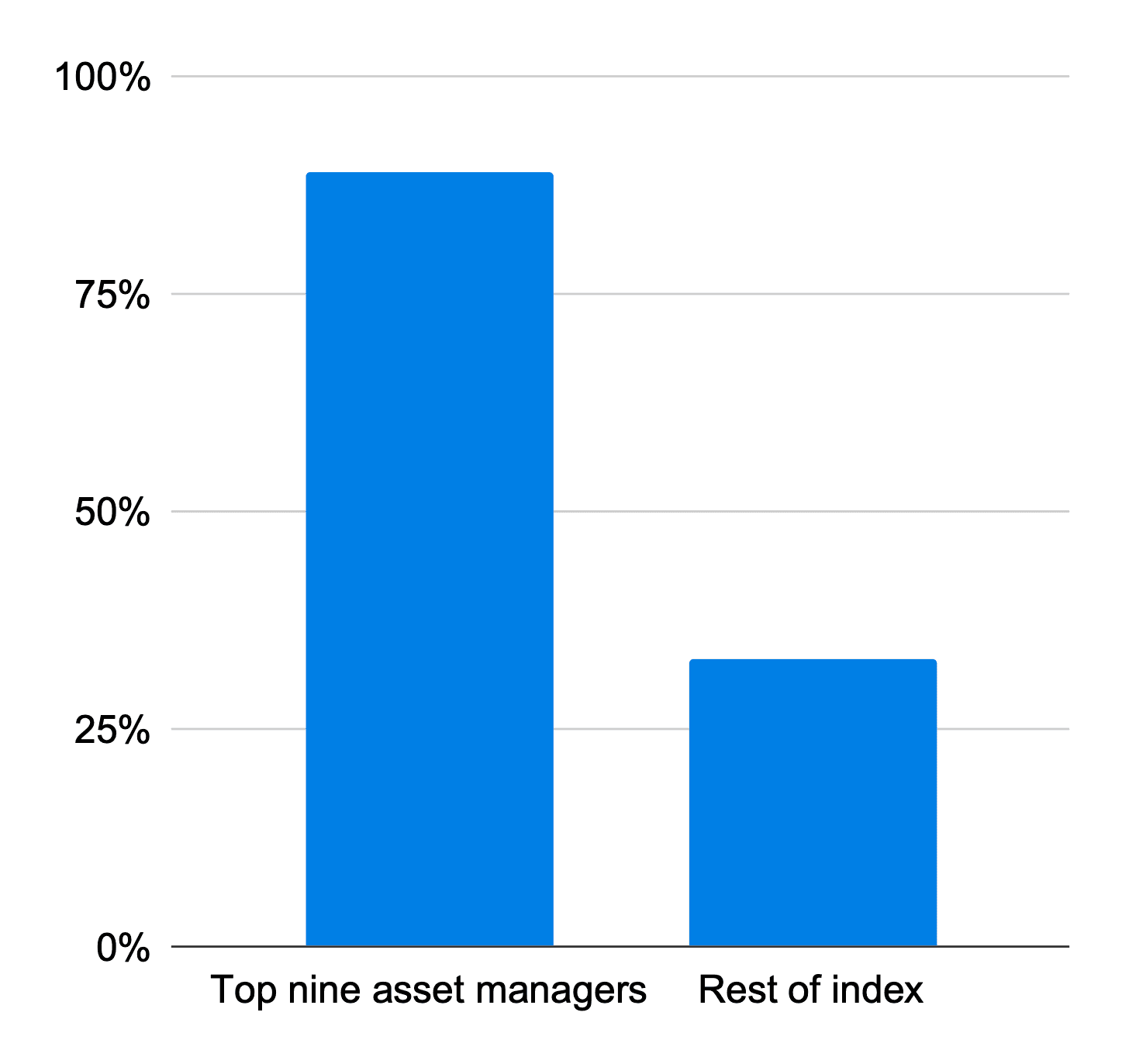
Eight of the top nine asset managers have embedded AI into investment processes, portfolio management or trading, compared to just one-third of the remaining firms.
Even though it’s the most direct path to the bottom line, beating the fund manager at their own game isn’t the only route to a payoff though, our Index shows. Amundi (#7) built a tool that answers 85% of the some 300 questions the firm has to answer as it onboards new clients, which gets money in the door quicker. And Vanguard built digital twins that simulate investor responses to products before they get pitched to maximize eventual returns. ”We can eliminate bad ideas very early in the process,” said Peter Borysov, head of AI, data science and ML engineering for personal wealth. “And we can double down on the really good ideas.”
Still, there’s a distinction between showing that AI can do the work – even generating investment ideas – and proving what it’s worth. Just three of the 30 firms in our Index have reported estimates of their overall returns on AI investment – less than half the share of firms in our banking Index that do the same.
“Market leadership has always shifted with technological change,” BlackRock CEO Larry Fink wrote to investors this year. “The broader question is who participates in the gains.”
JUST LAUNCHED
2026 EVIDENT AI INDEX FOR ASSET MANAGEMENT REPORT

Go beyond the rankings with the 2026 AI Index for Asset Management Key Findings Report. Discover performance profiles of the leaders, led by BlackRock, Vanguard and Fidelity, and where AI is unlocking value across the sector.

USE CASE CORNER
SCHOOL OF BLACKROCK
Beating the market has long required investors to see things differently. BlackRock is betting that doing that in the future will require changing the way they work entirely. In this week’s “Corner,” Tony Kim, the firm’s head of fundamental equities global technology, gave us a demo of Asimov, the AI platform at the center of the firm’s research overhaul.

Use Case: Asimov
Vendor: n/a
Firm: BlackRock
Why it’s interesting: Asimov is less an investment research use case than it is a blueprint for what AI-first architecture can look like inside a leading firm. BlackRock built a common foundation for data, models and agents that different businesses can tap into. In the demo, Asimov could, in seconds, pull up a fund’s exposure to the AI capex cycle and, in minutes, turn that information into a dashboard and a polished investor deck.
How it works: Asimov has three main layers. The first brings together public information – everything from company financials to podcasts and Substacks reporting on firms – with the proprietary data BlackRock gets from systems like Aladdin, its portfolio management platform. That feeds into what the firm calls its intelligence layer, where AI models process the information. Different agents – namely a planner agent and a coordinator agent – work to break complex questions down into smaller tasks. A dispatch agent then spins up smaller agents that complete them. For each task, a model router BlackRock built makes sure that the right model gets tapped, Kim said. The resulting research then feeds into the layer of the system that employees actually touch, customizing the interface to their role. The data also gets pushed to the firm’s more than 700 custom applications so information stays current across the business.
How they did it: Kim initially drew up the idea on a napkin in 2023 and spun the first version with a very small team, he said during the demo at the Evident AI Symposium last month. Over the course of two years, engineers unified the systems at work across the firm into Asimov. “Build the infrastructure once, then democratize the ability to create applications across the firm,” Kim wrote. Asimov was launched in 2025, but by late that year, its ready-made apps were still only reaching half the users the firm expected, according to a new case study. Throughout this year, his team gave investors more ways to build Asimov into their own routines and usage has since grown, the firm said.
By the numbers: BlackRock users have created more than 1,000 dashboards and applications, 30 of which now sit inside a shared catalog. More than 300 investors at the firm now use the platform regularly, and the firm is channeling their usage data into new features. “Each business contributes additional data, agents and applications, allowing the platform to scale and benefiting the broader organization in the process,” Kim wrote.

ASSET MANAGEMENT VIPS
FIVE TO WATCH

♟️Strategist: Erik Roth
Global head of applied innovation at BlackRock
Roth joined BlackRock in March to partner “across businesses and the global technology ecosystem” and tackle some of the firm’s toughest process redesign problems. With CEO Larry Fink saying he’s “more fearful that we’re not going to be able to execute” than of an AI bubble, Roth’s mandate is clear: Turn BlackRock’s AI resources into changes in how the firm operates. He has no shortage of raw material: BlackRock has one of the largest pools of AI developers and has made more tech- and data-centric acquisitions than any other firm in the Index. His job is the harder part: using them to redesign how work gets done. Today’s analyst processes begin “with a question,” he said during a panel this month. “Our intent modeling and recognitions capabilities will then translate that using the technologies, our RAG, semantic layer…to actually deliver against that investment request.”
💸Investor: Greg Jensen
Managing chief investment officer at Bridgewater Associates
Among his other duties, Jensen oversees the AIA Labs team at Bridgewater, the unit that leads the firms’ AI-led macro fund that manages more than $4.5 billion. Though humans make the final call on where to put client money, AI comes up with the investment ideas. Through the end of September, the fund had returned 16.4%. “I think we are a couple years from it being significantly better than the group of all humans at Bridgewater,” he said on a podcast in September.
⚡Catalyst: Deep Ratna Srivastav
SVP, head of AI and digital transformation at Franklin Templeton
Srivastav has something others in his position (publicly) lack: evidence of just how much money AI is making the firm. This year, his team launched Intelligence Hub, a platform that uses AI to help sales teams identify the best opportunities and tailor their approach as a result. With it, the firm has been able to reach 23% more clients and boost sales 11%, the firm’s CEO Jenny Johnson said earlier this month. It’s the result of an end-to-end transformation, something Srivastav is overseeing in other workflows across the business, like portfolio construction and AI-led investment, which Johnson has called out as two of her big AI priorities. “Getting the AI part done is easy,” Srivastav said on a panel. “Connecting it into all other systems, making it understand which system will play what role in this new, transformed, AI-first process, those become fairly big and complex questions involving both humans and multiple sets of technologies.”
🏗️Architect: Mani Iyer
Chief AI and technology officer at Vanguard
Iyer is this list’s newcomer, having joined from PayPal in June. His remit: Find a way to make a firm with a big AI footprint use the tech more effectively. Vanguard already has 97% of employees using AI tools and has more publicly disclosed use cases than any rival, the Index shows. But “the measure of AI isn’t how many use cases we have,” he wrote this week. “It’s whether an investor gets a better answer, faster, and one they can trust.” To that end, Iyer is hard at work redesigning core workflows around the business to make them more efficient. “We need to build for a world where AI does work end-to-end where appropriate, while humans serve as supervisors for use cases,” he said this month.
🌱Changemaker: Gary Collier
CTO at Man Group
Collier is the mind behind the AI systems at Man Group that generate trading hypotheses and write code to test whether they might actually make money. “This is very real, it’s not make-believe at this point,” he said on a podcast this summer. He’s also helped steer the firm’s partnership with Anthropic. As AI reinvents the way Man Group’s investment teams work, he’s also become a driving force behind setting the organization up to best take advantage of it. “The level of organizational change required to put all of this into effect is, I think, the bottleneck,” he said.
NEW FROM EVIDENT
PRIVATE BENCHMARKING, NOW FOR ASSET MANAGEMENT

We’re extending our private AI Outcomes Benchmark into Asset Management. Open to asset managers or firms with asset management arms, see how your AI deployment, adoption, returns and impact compares with peers. Places are limited.

TOP OF THE NEWS
DOLC-AI & GABBANA
MILAN – This week (and only this week), the most famous models in Italy’s second-largest city weren’t humans.
Blame ICAIF, the academic AI conference dedicated specifically to finance. Over four days, bank researchers descended upon Milan to showcase calculations rather than couture and talk runtime rather than runways. The food, thankfully, remained unmistakably Italian.
But as the academic set made one of the world’s foremost fashion cities its home base, much of the talk was about one particular faux pas: using LLMs for every AI project inside banking. In fact, for all the progress LLMs have made, it was the smaller, specialist models offering more control and better margins that were turning bankers' heads.
“I think people are realizing and stopping a bit this trend of ‘let’s use an LLM to do whatever is needed,’” said Francesco Bonchi, head of AI research at Intesa Sanpaolo. “You can fine-tune smaller models, and they can be better than large language models just because you are strengthening the type of skill that you need and not the conversational skill.”
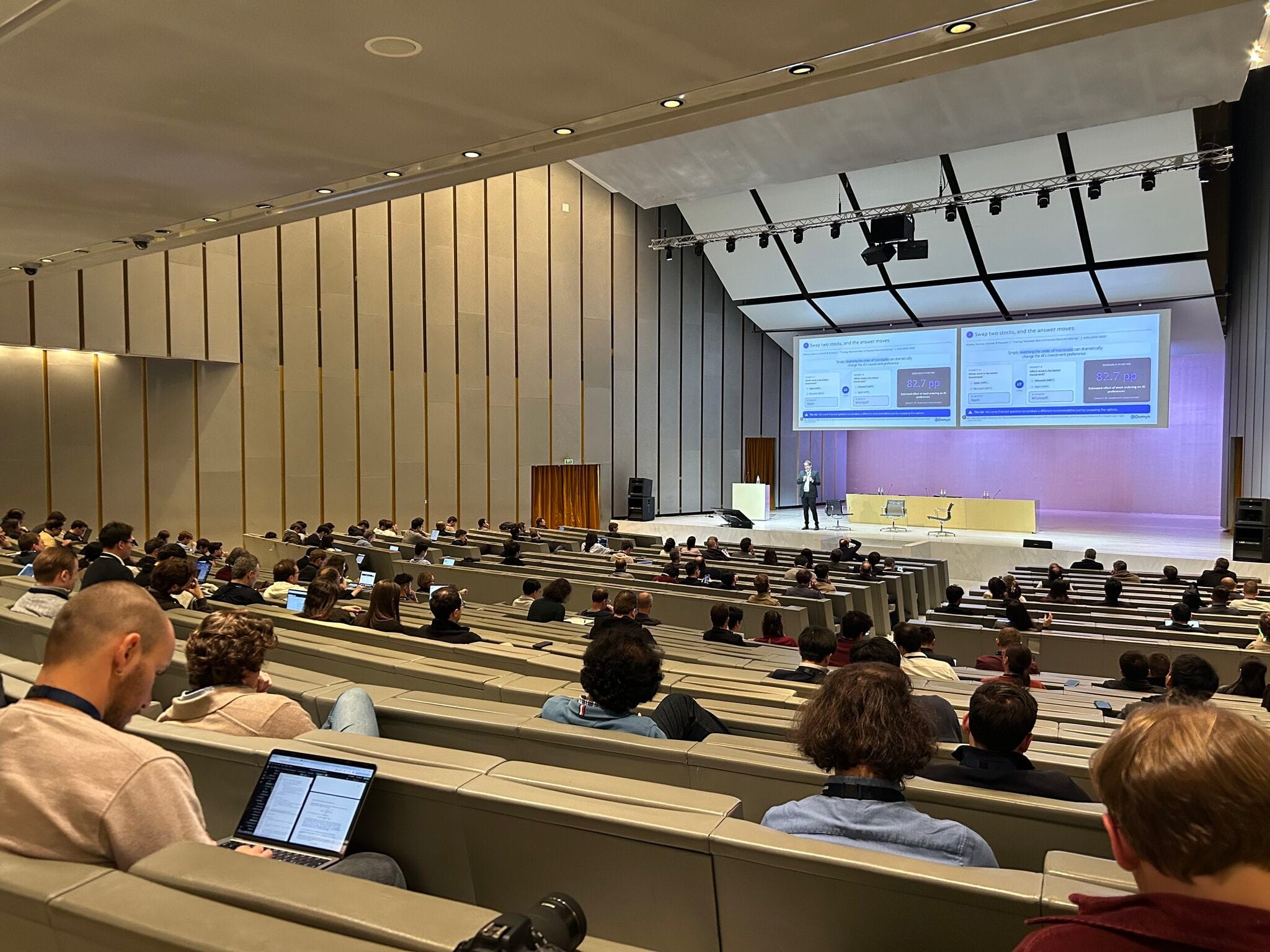
Stefano Pasquali, executive vice president at Domyn and former head of investment AI modeling at BlackRock, used derivatives pricing as an example of how those smaller models could work alongside an agent. Say an analyst wants to know what would happen to the value of a contract if interest rates suddenly jumped. An AI agent could work out which tools to call and explain the result. But the actual number-crunching ought to be left to a specialist pricing model, he said.
That doesn't mean LLMs are going anywhere necessarily. But the bankers I spoke to seemed just as interested in how they could get models to prove the answers they spit out were right as they were in the latest and greatest things bankers could get them to do in the lab. Daniele Magazzeni, group chief AI officer at UBS, backed that up on stage: The future of LLMs in banking, he said, hinges on being able to demonstrate that the answers were actually right. That requires “strong evals, guardrails and proof of correctness.”
As banks figure out how to do that at scale, it means there may still be room for last season’s trends. “Machine learning is not dead!” Pasquali declared.
–Maryam Akram

STAT OF THE WEEK

That’s the increase in the number of research papers published by the banks we track at this year’s ICAIF conference compared with last year. JPMorganChase’s four papers looked at using AI in trading and managing financial risk. One-third of the published work dealt with how AI could improve lending and fraud. But among all the research into what AI can now do in banking, a growing chunk focused on what it still really shouldn’t.
For one, U.S. Bank researchers found, AI systems shouldn’t be trusted to explain themselves well. The team pointed an LLM at a set of loan applications and asked the model to decide whether they should be approved. Then, it changed one detail – the U.S. state the applicant lived in – and reran the test. In 40% of the cases, the model flipped its decision. But when asked for an explanation as to why, it never mentioned geography – the only thing that changed between runs – as a deciding factor.
AI isn’t great at checking its own work either, Standard Chartered research showed. The bank tested 12 LLMs on sanctions screening, the job of checking whether a customer or payment involves someone on a government blacklist. It’s not as straightforward as a cross-check: names may be spelled differently and details like birthdays don’t always match. The research tested whether combining two models could help the bank prevent matches that should’ve been flagged from slipping through the cracks – a practice known as ensembling. But models tend to share the same blind spots, the research found: Even when the models were from different providers, the second model missed four in ten of the same mistakes the first one did. The lesson: Banks shouldn’t just pair their best models; they should pair the models that catch each other’s mistakes.
Why this matters: Until banks can build the guardrails and evals that make LLMs consistently trustworthy, the parts of the business where it promises the biggest financial gains will remain out of reach.

TALENT MATTERS
CAPITAL THREE
Kevin Cassar was appointed chief data and AI officer at Capital One. Cassar previously held the same role at TalkTalk, a broadband provider. Earlier in his career, he held data leadership roles at AXA Health and the FCA, the financial regulator in the U.K. It was one of several AI hires the bank made: Janet Peterson started as SVP of engineering, “overseeing technology strategy and delivery across Capital One’s corporate systems,” she wrote. She was previously a VP of engineering at Microsoft, where she worked on Engage, “an enterprise employee communications, collaboration, and knowledge management platform.” And Guy Gubi was hired as senior manager of product management for conversational AI, after serving as a principal product manager at Toast, a company that builds point-of-sale systems for the hospitality industry.
Mark Howden joined Barclays as director of data and chief data officer for the corporate bank. He was previously head of data and analytics and AI for Santander’s private banking unit.
Dorota Polak-Gilewska is now managing director of agentic AI and operating model transformation at State Street. She was previously head of operating models design and restructuring.
Kieran White was promoted to be the co-global head of the group AI office at Nomura. He was previously the international head of the AI center of excellence and has been with the Japanese bank since 2018.
Ibrar Ulhaq is now director of applied AI at BNY. He was previously an AI transformation leader at BP. Ulhaq joins Nastassja Hagan, now head of applied AI, who also worked BP before joining the bank. CIO Leigh-Ann Russell also worked at the oil and gas company before moving to banking.

WHAT'S ON
OUT NOW
Evident AI Index for Asset Management
Sat 21 Nov.
AI in Financial Services, London
Mon 30 Nov. - Fri 4 Dec.
AWS re:Invent, Las Vegas
Thurs 3 Dec.
Revolut Connect: Tech in London, London
- Alexandra Mousavizadeh|Co-founder & CEO|[email protected]
- Annabel Ayles|Co-founder & co-CEO|[email protected]
- Colin Gilbert|VP, Intelligence|[email protected]
- Matthew Kaminski|Senior Advisor|[email protected]
- Kevin McAllister|Senior Editor|[email protected]
- Daniel Shackleford Capel|MD, Banking|[email protected]
- Maryam Akram|Senior Research Manager|[email protected]
- Alex Inch|Data Scientist|[email protected]
- Sam Meeson|AI Research Analyst|[email protected]
- Gabriel Perez Jaen|Research Manager|[email protected]
- Jay Prynne|Head of Design|[email protected]
- Marcus Gurtler|Junior Designer|[email protected]

