

DATA-DRIVEN INSIGHTS AND NEWS
ON HOW BANKS ARE ADOPTING AI
AI backlash hits banking

Source: Adobe Firefly
28 May 2026
This week, AI backlash comes to banking. How much TD Bank’s new agentic mortgage tool is actually worth. Plus: banks can’t get enough of U.K. universities.
People mentioned in this edition: Bill Winters, Kristof Horompoly, Kasper Tjørntved Davidsen, David Hardoon, Raymond Chun, Ian Glasner, Jodie Wallis, Jordyn Buchanan, Dave Purrington, Marc Deveaux and others.
This edition is 1,873 words, a 6-minute read. Check it out online. If you were forwarded the Brief, you can subscribe here. We always want to hear from you: [email protected]
– Alexandra Mousavizadeh & Annabel Ayles

TOP OF THE NEWS
IMAGE PROBLEM
AI is losing the room.
New grads are booing pro-AI commencement speakers. The pope gave a stern warning about the tech’s implications. And Standard Chartered CEO Bill Winters is still in the hot seat for saying AI would replace “lower-value human capital” last week.
AI’s growing image problem is becoming an issue for banks. Lenders built their reputations on trust. Now they’re architecting their future around a technology that’s viewed skeptically.
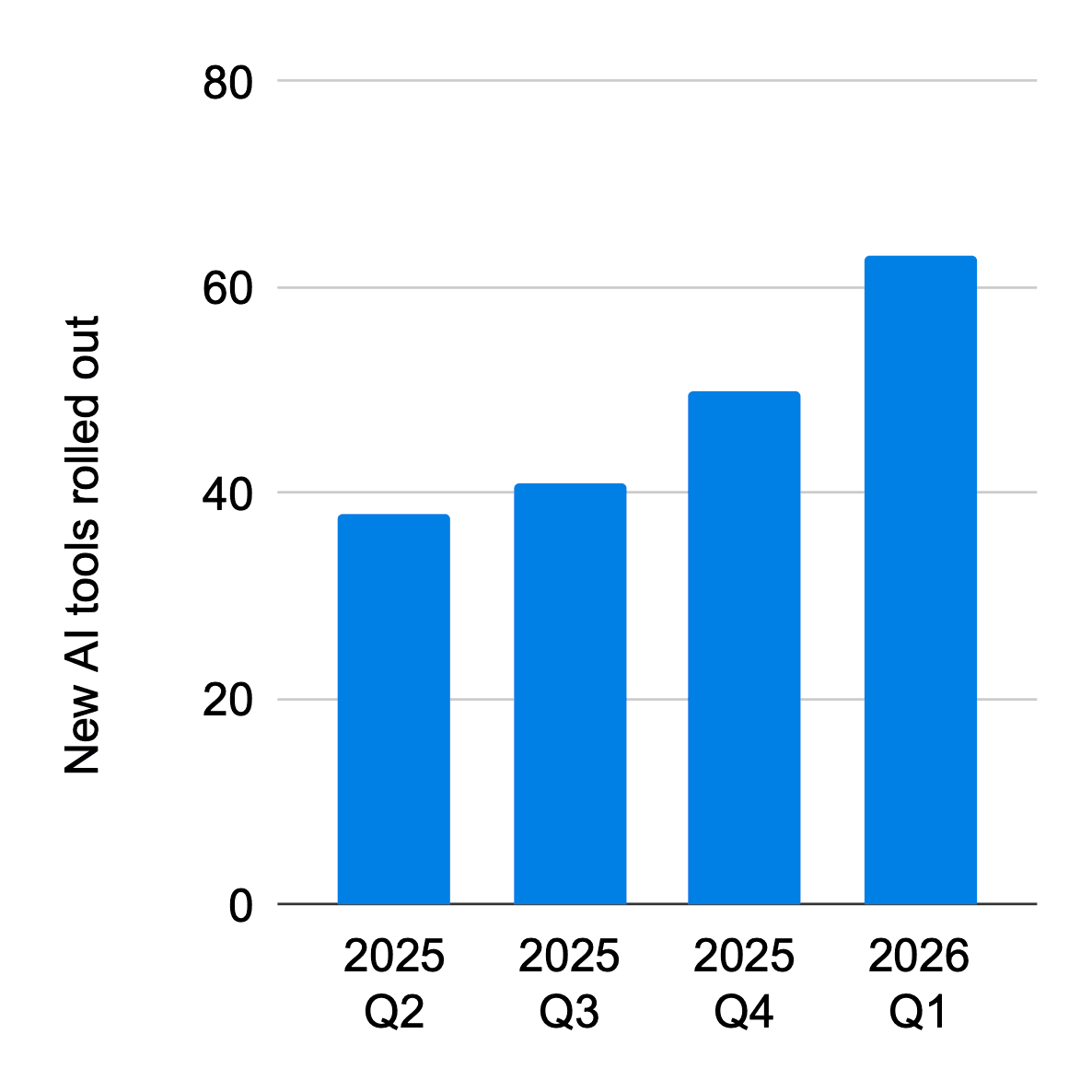
The sky isn’t falling just yet: The 50 lenders we track for the Evident AI Index increased the number of new AI tools they’ve rolled out in each of the last three quarters, our Use Case Tracker shows. But inside banks, AI fatigue presents an “actual risk” to adoption long-term, Kristof Horompoly, former head of responsible AI at JPMorganChase, told us in an interview this week.
FULL STEAM AHEAD
The number of new AI tools rolled out in Q1 by the 50 banks we track was the highest of any quarter.
That looming risk is starting to change how banks put AI in front of people. As skepticism rises, the demand isn't for more AI, but AI that measurably improves interactions with the bank. In turn, banks are taking the lessons learned from pushing AI usage internally to try to avoid the wider AI backlash from reaching their customers.
BNY, for example, is leaning in on new types of training. The bank recently rolled out a 40-hour program to give its staff an intensive way to experience AI. To pass it, they need to build a working prototype of an AI tool that can solve a problem within their particular team (see: “BNY levels up AI training,” The Brief, May 14). Citi and Bank of America, meanwhile, spend as much as $25,000 a day for sessions with a firm called Wall Street Prompt that trains bankers how to harness AI in their day-to-day workflows, Bloomberg reports.
Others are trying to make AI feel less like a mandate. Some banks use AI champions who nudge and celebrate their peers or tech forums that showcase the outcomes people are getting from using it. Programs like that are meant to get employees to see AI as something that can “deliver better outcomes, both in their day-to-day work and for the bank,” Kasper Tjørntved Davidsen, chief AI officer at Danske Bank, said in an interview with Evident this month (see: “Denmark’s AI bank shot,” The Brief, May 14).
Those lessons may translate to customers. For David Hardoon, former global head of AI enablement at Standard Chartered, one thing is clear though: Everyone – employees and customers – will need extra handholding with AI to get or keep it in good graces.
“Build it and they will come?” he told us this week. “No.”
NEW AT EVIDENT
AI USE CASE TRENDS IN BANKING | Q1 2026

Agentic AI applications hit a record high, the vendor landscape reshuffled – with Anthropic leading the pack, and AI ROI reporting matured. Discover the key findings from our latest AI Use Case Trends in Banking report.

USE CASE CORNER
HOUSE RULES
TD Bank rolled out an AI tool this week that automates part of the mortgage lending process, its first agentic use case. In this week’s “Corner,” we look at how much introducing an agentic system to this banking process could be worth to the bank.
Use case: Agentic AI for pre-adjudication (RESL)
Vendor: Built in-house by Layer 6
Bank: TD Bank
Why it's interesting: TD’s tool uses agents to tackle pre-adjudication of mortgage applications, one of the most document-heavy parts of this kind of lending. The tool cuts the time it takes underwriters to prepare one of these memos from 15 hours to roughly three minutes.
How they did it: The agentic system classifies documents, calculates and validates income, runs consent checks, hunts for discrepancies and writes the underwriter's memo. To figure out how each agent would interact with each other, the bank “mapped every step of the RESL (Real Estate Secured Lending) journey.” It’s using that to figure out how to deploy agentic tools in a way that will lower the unit cost for its mortgage business most. It’s starting with pre-adjudication, but will bring the underlying tech to other parts of the process in the future.
By the numbers: The bank’s mortgage business breaks down into adjudication, funding and discharge, CEO Raymond Chun said at a conference in January. With AI and automation, the bank has cut the adjudication costs of mortgages by 24%, from $371 down to $281. The cost of the funding process is down 22% and discharge is down 23%.
Bigger picture: TD’s mortgage book is roughly $230 billion, some 15% of Canada’s residential mortgage market. Apply that to 2.79 million originations in the country, and you can estimate that its bankers are doing about 420,000 mortgages per year. Over two years, per Chun, that $90 saved on adjudication from AI is worth about $38 million per year. But the “exciting part actually starts in 2026 when we start to layer in Agentic AI on top of that,” Chun said in January, previewing tools like this. For the discharge part of the process, agentic systems will save another 50% per mortgage, he said. Though he didn’t explicitly say the same for adjudication, if the bank could cut that same amount out of it with tools like this summary generation agent, it would translate to another $59 million in savings for the bank.

NOTABLY QUOTABLE
“Given the fact that we have these incredibly smart models… frankly, it’s been a little bit harder, or maybe a lot harder, to get the positive economic impact that we all thought we’d have at this level of technology.”
– Sam Altman, CEO of OpenAI, to CommBank CEO Matt Comyn, May 26

SOUTH AFRICA
BOKS SET
MANDELA EFFECT
South African banks have released 46% of all use cases rolled out by the 25 banks tracked in the upcoming Evident AI Index for Banks - Middle East and Africa.
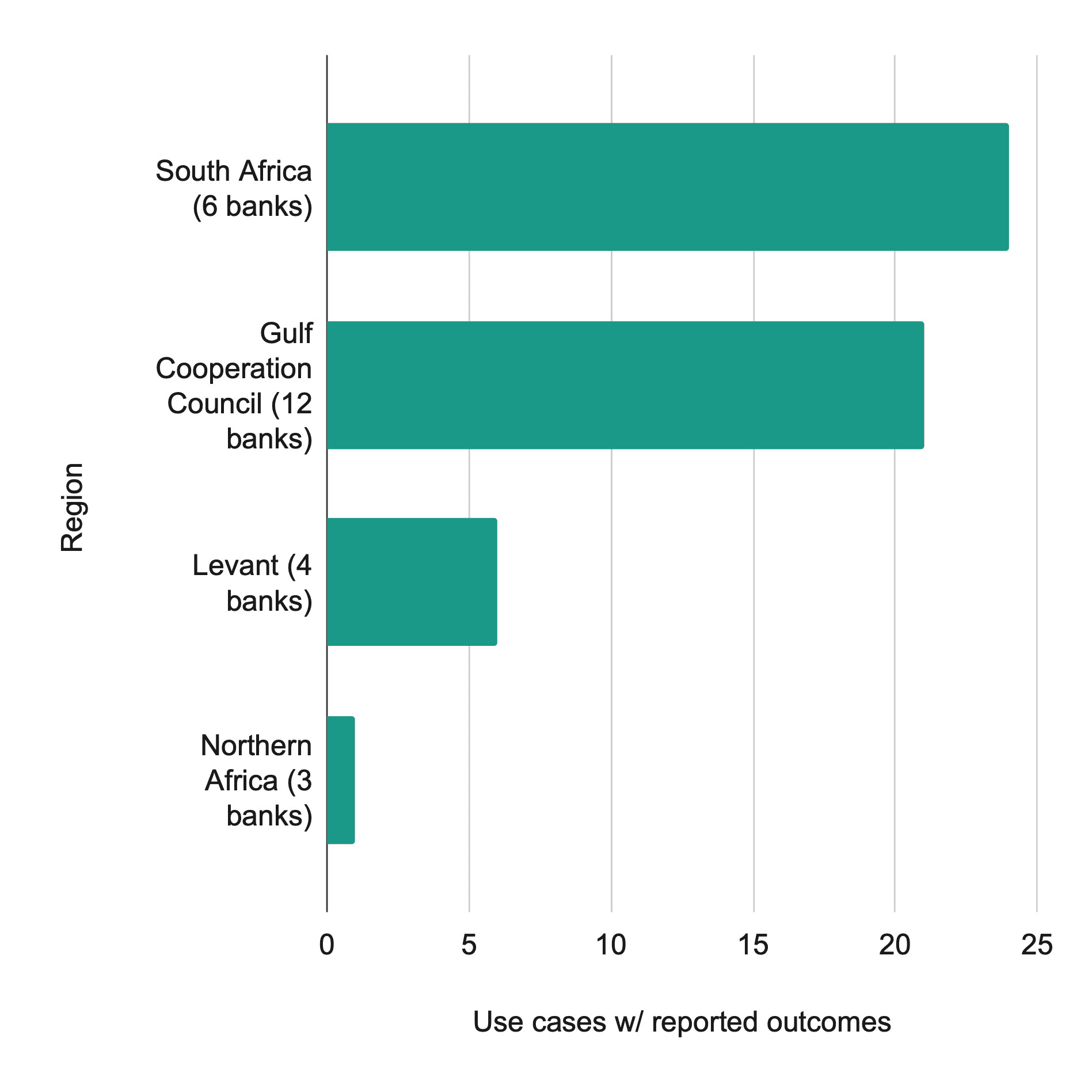
South Africa has become a hot spot for AI tools, coming analysis from the Evident AI Index for Banks - MEA – out next week – shows.
Six South African banks are responsible for nearly half of all the use cases publicly rolled out by the 25 Middle Eastern and African lenders ranked in the Index.
These banks tend to have a reach well beyond Johannesburg and Cape Town, with an average of 12 million customers each. They’re turning to AI to help manage issues that come with that kind of scale.
One of those is the rise of “mule accounts” which are used to commit fraud in Africa. Capitec, for example, built a tool that delivers real-time AI warnings to customers through its digital banking platform. In its first year, the tool blocked 394,000 fraudulent transactions, thereby preventing over $642 million in losses.
They’re using AI to help handle cross-border transactions. RMB, part of FirstRand, deployed an AI tool that uses import and export data to anticipate what clients may need for trade deals – such as letters of credit – based on seasonal patterns.
They’ve also leaned on the tech for translation. Absa employs conversational AI to understand and respond to customers in native languages like Zulu, Xhosa, and Sotho, catering to the fact that nearly half of South Africa’s population is first-language speakers.
NEXT MONTH: We're ranking 25 of the largest banks across the Middle East & Africa on their AI maturity. Find out more here.
COMING SOON
EVIDENT AI INDEX FOR BANKS - MIDDLE EAST & AFRICA EDITION
Which banks are winning the AI race in the Middle East & Africa? Next week, we're ranking 25 of the region's biggest institutions. Explore the Index and register your interest to be the first to know when it goes live.

IN THE NEWS
GROWTH MINDSET
JPMorganChase “will be hiring more AI people and fewer bankers in certain categories, and it will make them more productive,” CEO Jamie Dimon said at the bank’s China Summit this past week. He wasn’t the only CEO to opine on the labor market effects of the tech: In a New York Times op-ed, Goldman Sachs CEO David Solomon said that AI would be a job creator and that even though AI may automate about 25% of work hours in the next 10 years, humans would use the freed up time to create new jobs and expand what companies can do. And Bank of America CEO Brian Moynihan at a conference this week said that the bank retrained and redeployed 14,000 people as it’s adopted more AI. At last year’s Evident AI Symposium, Goldman Sachs CIO Marco Argenti mused whether the last person out of the bank would be an engineer or a banker. The answer may be getting a little clearer.
Mistral found a buyer for the cybersecurity model it’s building to rival Anthropic’s Mythos: longtime partner BNP Paribas. Access to Mythos has been limited, and other labs like OpenAI and Microsoft have moved to bring their own models to market, and specifically to banks. “The focus has been a lot on ‘is Mythos accessible or not accessible?’” said Marc Camus, the bank’s CIO during a press conference about the expanded partnership with Mistral. “Let’s not forget there are other models from other firms that exist.”
BMO drove $62 million ($85 million CAD) in annualized revenue in FY2025 by using AI for better personalization, the bank reported during its earnings call this week. It’s been a big week of new AI stats: At a conference Wednesday, Jamie Dimon said the bank now has 1,000 AI use cases: “Some of them we do NPVs on,” he said. “We know exactly what it is. We did this, we're going to save this money, overhead, error rates, better prospecting, better marketing.” And Scotiabank in its earnings presentation said it had improved the rate at which AI tools could answer employee questions by 30% compared to last quarter.

STAT OF THE WEEK
.png%3FupdatedAt%3D2026-05-28T12%3A33%3A17.697Z&w=3840&q=100)
That’s the share of the academic tie-ups announced by the 50 banks we track in the Evident AI Index for Banks that involved U.K. universities in the past six months. That’s up from 13% the six months prior. This week, BNY joined the list with a five-year, nearly $7 million partnership with the University of Manchester. The pair will establish The Future of Work Alliance, which will focus on “advancing how human-led digital transformation can be integrated responsibly into large, data-intensive organizations in the AI era.”
Zoom out: Some banks have pulled back on publishing papers, but collectively they’re still ramping up how much they spend on academic partnerships as they jockey for access to top talent. Last year, the 50 banks we track committed $36 million to universities, up from $13 million the year before (see: “Stat of the Week,” The Brief, April 9). U.K. universities are getting a growing share of those checks: Lloyds is working with the University of Glasgow on agentic research, and UBS is working with Oxford on applied AI. The increase in U.K. research partnerships comes as big AI labs have announced their own plans for expansions into London and beyond (and started offering huge salaries). For lenders, partnerships like these are a way to stay close to the AI talent they may soon be priced out of hiring full-time as OpenAI and Anthropic come to town.
OUT NOW: The Evident AI Research Tracker is a comprehensive analysis of how 50 major banks are building and growing in-house research teams to accelerate AI deployment. Members can explore here.
.svg&w=96&q=80)
TALENT MATTERS
GLASNER GONE
Ian Glasner is leaving HSBC on July 31 after five years. He was group head of emerging technology, innovation and ventures. During his tenure, the bank “built HSBC’s enterprise AI strategy and platform” and delivered “the first 100 Gen AI use cases into production,” he wrote on LinkedIn.
Manulife elevated Jodie Wallis, the firm’s chief AI officer, to the executive committee and has an “expanded scope that includes both AI and enterprise data,” the firm wrote in its release. She’ll report directly to CEO Phil Witherington.
Payments firm Fiserv hired Milind Nagnur as CTO and head of tech for its Financial Institutions Group. He was previously CTO at healthcare company Optum, and earlier in his career was Wells Fargo’s CIO.
Goldman Sachs hired Jordyn Buchanan as a managing director in engineering. Buchanan spent the past two decades at Google, where he “led the effort to drive Google’s internal cloud transformation,” he wrote on LinkedIn.
Dave Purrington is joining Capital One as a distinguished engineer on the bank’s AI/API Gateway Platform team, a group that works on building connections between AI tools and systems. He was previously a software engineer at Atlassian.
Marc Deveaux is starting at Citi as an AI architect. Earlier in his career, he spent time as a quantitative developer at Japan’s MUFG and at Morgan Stanley.
WHAT'S ON
Mon 1 June
ElevenLabs Summit, Warsaw
Weds 3 - Thurs 4 June
AI in Risk Management for Financial Institutions, New York, NY
- Alexandra Mousavizadeh|Co-founder & CEO|[email protected]
- Annabel Ayles|Co-founder & co-CEO|[email protected]
- Colin Gilbert|VP, Intelligence|[email protected]
- Matthew Kaminski|Senior Advisor|[email protected]
- Kevin McAllister|Senior Editor|[email protected]
- Daniel Shackleford Capel|MD, Banking|[email protected]
- Maryam Akram|Senior Research Manager|[email protected]
- Zachary Groz|Reporter|[email protected]
- Alex Inch|Data Scientist|[email protected]
- Sam Meeson|AI Research Analyst|[email protected]
- Gabriel Perez Jaen|Research Manager|[email protected]
- Jay Prynne|Head of Design|[email protected]
- Marcus Gurtler|Junior Designer|[email protected]

