

DATA-DRIVEN INSIGHTS AND NEWS
ON HOW BANKS ARE ADOPTING AI
AI shakes up wealth management

Source: Adobe Firefly
21 May 2026
Welcome back. This week: The AI revolution in wealth management. We look at how Middle East banks are using the government to get ahead. Plus, a big tech hire at CommBank.
People mentioned in this edition: Eve Varner, Inez Louzonis, Rick Wurster, Jed Finn, Mary-Anne Williams, Ranil Boteju, Sachin Mehra, Tim Ferriter, Andre Mansour, Paul McMahon, Mehrdad Abdolghafari and others.
This edition is 1,864 words, a 6-minute read. Check it out online. If you were forwarded the Brief, you can subscribe here. We always want to hear from you: [email protected]
– Alexandra Mousavizadeh & Annabel Ayles

TOP OF THE NEWS
NOT YOUR FATHER’S ADVISOR
AI in wealth management is booming.
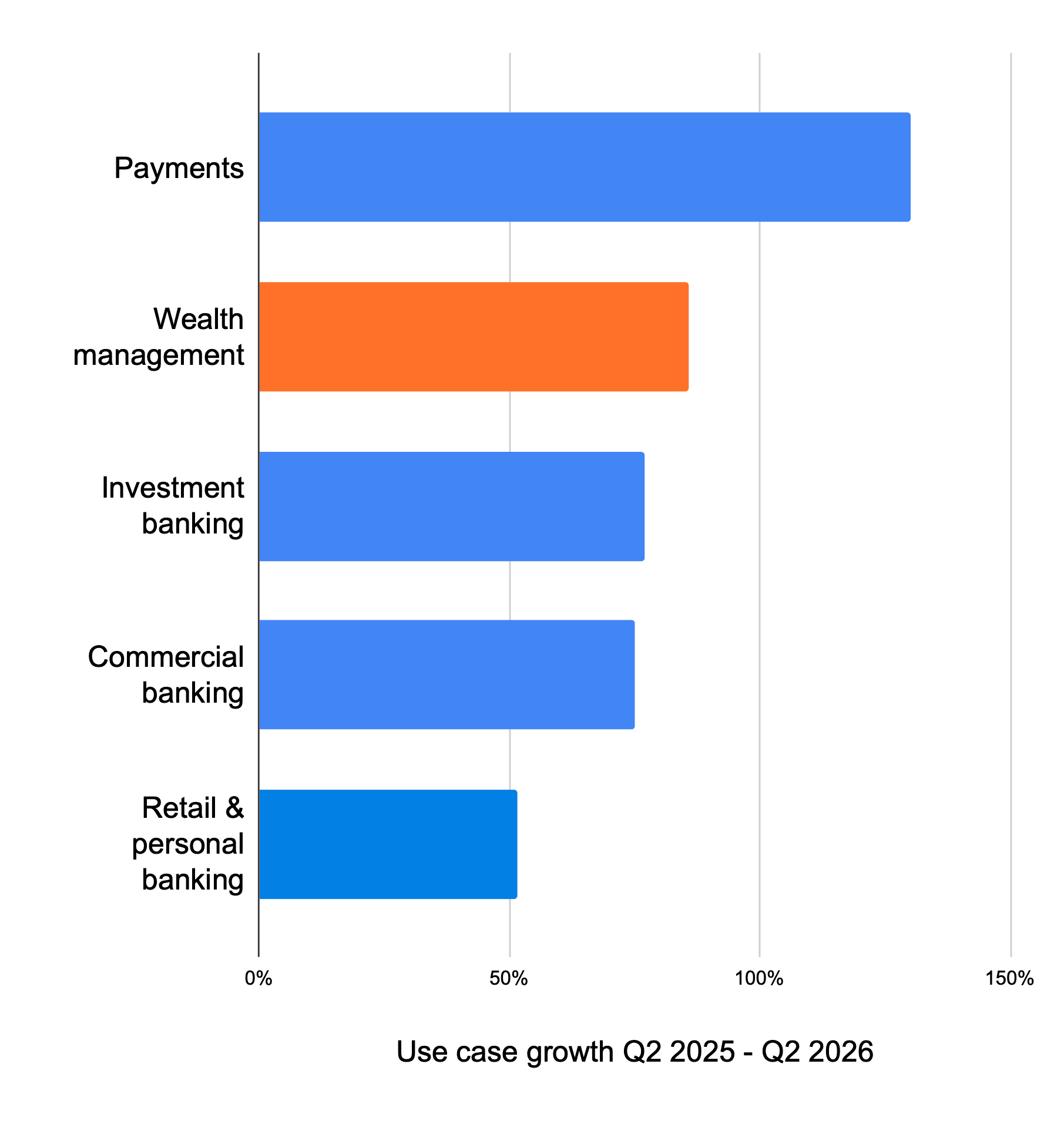
Wealth has been one of the fastest-growing areas for new AI tools this year among the 50 banks we track, new analysis from Evident’s Use Case Tracker shows. Banks are rolling out wealth use cases at a rate 50% higher than their broader AI portfolios, eclipsing nearly every other line of business in banking.
Those tools are already starting to change what wealth advisory looks like on the ground. As the next generation prepares to inherit $124 trillion from Baby Boomer parents, banks are rolling out new platforms, systems and tools to make sure the relationship to the bank comes with it.
At this point, that mainly means getting advisors better tools rather than replacing them with futuristic bots. Less than 10% of wealth AI tools are customer-facing, compared to roughly 25% across banking use cases overall.
Now we’ll see if advisors can turn the time AI gives them into a better client experience before someone else uses tech to make the relationship feel optional.
MONEY MOVES
The number of wealth management-focused AI tools has nearly doubled in the last year, outpacing most other lines of business.
At UBS, which manages the largest amount of private wealth globally, that means building tools that help advisors synthesize information better rather than just give them more of it. “When everyone has the same tools and same data, the differentiator is going to be what do you do with that information,” Kristen Griffin, head of investment manager analysis at UBS, said on a podcast this week.
Giving advisors an easier way to act on information is the idea behind Advisor Gateway, the one-stop-shop advisor platform Wells Fargo rolled out this month. The system connects to 200 different applications and data sources around the business so advisors can access more of the firm’s knowledge with less friction. “The application should be almost invisible and behind the scenes, because it's the workflow that matters,” Eve Varner, chief product officer for wealth management, told us. “The applications just become the enablers, as opposed to ‘here's the shiny new object I'm going to teach you all about’.” (More below in Use Case Corner.)
Bank of America is taking the same approach with Meeting Journey, which it rolled out in March. The tool, which plugs directly into the bank’s CRM and conferencing tools, is saving advisors four hours of prep and follow-up per meeting, the bank says. That allows them to spend more time working on client strategy. “What advisors are telling us is that it's finding nuggets that they would have forgotten about or didn't think about,” said Inez Louzonis, head of platforms and capabilities at Merrill Lynch. “The main driver here is productivity; financial advisors, we're trying to give them time so that they can do more.”
Banks’ next question is how much of that “more” they want to let clients do themselves. During Charles Schwab’s investor day, CEO Rick Wurster hinted that AI tools would be the new front door for clients with less than $1 million in their accounts. Morgan Stanley is working on “Jarvis from Iron Man, but for managing money,” wealth management head Jed Finn said this year (see: “Three-phase plan,” The Brief, Feb. 12). Citi, meanwhile, is rolling out Citi Sky, an avatar that will let users make basic financial moves, like switching CDs. And the new kid on the block, Revolut, is starting a private bank amid a broader push towards self-service tools.
AI could let firms serve more accounts, give clients more agency over their money and make the experience more modern. It could also loosen the personal relationships that make wealth management sticky. How banks figure out where that line is with their new tools could be the difference between capturing the next generation of investors or losing them.
“Our clients don't want to go figure it out and ask Claude or ask ChatGPT,” said one bank executive. “They're like, that's why we have an advisor. That's why I have someone that knows me, knows my family, understands my values, understands my whole family's values, understands what my financial goals are.”
NEW AT EVIDENT
AI USE CASE TRENDS IN BANKING | Q1 2026

Agentic AI applications hit a record high, the vendor landscape reshuffled – with Anthropic leading the pack, and AI ROI reporting matured. Discover the key findings from our latest AI Use Case Trends in Banking report.

USE CASE CORNER
SUPERADVISORS
Wells Fargo has poured $1 billion into updating its technology infrastructure for wealth management over the past few years. For this week’s “Corner,” we caught up with Eve Varner, Wells Fargo’s chief product officer for wealth and investment management, to hear what that investment has bought the firm.
Use case: Advisor Gateway
Vendors: eMoney and BlackRock
Bank: Wells Fargo
Why it’s interesting: Wells Fargo focused on simplicity, working with advisors to understand their workflows and bring as much of what they do as possible into one unified experience. “It’s more of a pull than a push,” said Varner. And it’s the “jumping off point for our next gen development around AI,” she added. “So it’s a big deal.” They’re closely tracking the platform’s early performance, analyzing how advisors use the tools and where they’re generating the most value.
How it works: Advisor Gateway is built on a unified data layer which takes client and market information and feeds that into the whole suite of tools accessible via the platform, consolidating 200 front- and back-end tools into one interface. Account 360 builds a holistic dashboard view of a client’s portfolio for advisors to track their positions and portfolio in real-time. eMoney’s advising software helps produce financial plans. BlackRock’s Aladdin platform will ingest those plans, spit out proposals based on its portfolio analysis, and through a Gen AI interface, provide on-demand commentary. And the Client Review Center helps generate performance reports to keep customers up to date.
How they did it: The firm started by mapping out exactly how advisors worked day-to-day and then built backwards from there, creating an end-to-end chain of apps for “one seamless flow” that makes the tech essentially “invisible.” Varner said the team designed the combination of in-house and vendor-built applications to fit into the same workflow. Advisors are “not looking to become point-and-click experts in any particular application,” she said. “They’re thinking ‘how does this make my day easier?’”
By the numbers: Advisor Gateway usage has now eclipsed the usage of Wells Fargo’s old platform, Varner said. But it’s still early days as the firm measures adoption. “It’s not about just surface clicking,” Varner said. “It’s really, how much time are people spending on it? What are they using it for? And we’re seeing a lot of success there.”
Bigger picture: As Wells Fargo layers on more capabilities, it’s considering how to handle self-service for more straightforward money moves. “There’s no reason that you wouldn’t ultimately translate all of those capabilities direct to client,” Varner said. “How do we do it so it’s useful for the client, and it’s meeting their expectations? I think there's a lot of work and thought to be done for that.”

NOTABLY QUOTABLE
“What people are saying, as in the employee base is bringing out, is, ‘We can do more with less, but we can't quite quantify for you what more with less looks like.’ Okay? This is important because as a CFO, if I'm sitting in the seat I am, I want to see a return on investment as well, as opposed to someone just telling me, ‘I would have normally come and asked you in theory for more people, but now I'm not gonna ask you for more people because I'm leveraging AI.’ I see the value of this. That's why we're investing in it, but I think we've gotta take the next click forward.”
–Sachin Mehra, CFO at Mastercard, at a conference, May 19

MIDDLE EAST
FRIEND OF THE STATE
In the Gulf, unlike in the rest of the world, the path to becoming a great AI bank runs through the royal palace.
The region is in the middle of a major transformation as it shifts its economy away from oil and gas towards tech. Banks are finding a way to use those national pushes to secure the two scarcest ingredients in their own AI transformations: talent and compute.
Unlike banks in the West, they’re not just trying to shape policy by lobbying from the outside. More than half of the 25 lenders we’ll rank in the Evident AI Index for Banks - MEA – out next month – contribute to their country’s national AI strategy. Among banks in the Gulf, that’s nearly two-thirds.
Their influence is showing up in how they woo talent. Emirates NBD, for example, created the National Digital Talent Incubator explicitly in support of the UAE’s strategic blueprint to diversify its GDP. The program has given the bank a pipeline into technical talent: It’s now home to nearly two-thirds of the AI developers working across the five biggest banks in the Gulf, Evident analysis shows. That kind of state-backed homegrown talent program matters even more as regional conflict makes it harder to recruit from abroad (see: “Gulf war’s AI cost,” The Brief, March 26).
Government ties are also helping banks get close to the other precious resource underpinning the AI buildout: compute. Gulf states have strict data ownership and sovereignty laws that require them to keep sensitive data inside the country. That means the AI tools being built on top of that data can’t just be sent to overseas providers. As a result firms are jostling for domestic compute resources, and banks are finding that tying directly into the efforts to bring those programs online are in a better position to take advantage as that capacity comes online.
First Abu Dhabi Bank, for example, was early to partner with Core42, part of the state-backed G42 effort, to move its workloads onto the UAE’s private cloud network. It also joined a $2.6 billion investment into upcoming data center projects. Those resources will help plenty of banks when they’re done. But getting in early is already helping the bank get a leg up. In its annual report, FAB said its data center consolidation – made possible by its access to the new facilities coming online – helped deliver more than 20% improvement in systems efficiency. That frees up resources to build and scale AI quicker.
NEXT MONTH: We're ranking 25 of the largest banks across the Middle East & Africa on their AI maturity. Find out more here.
COMING SOON
EVIDENT AI INDEX FOR BANKS - MIDDLE EAST & AFRICA EDITION
Next month, we’re ranking 25 of the largest banks across the Middle East & Africa on their AI maturity – revealing who’s pulling ahead, the challenges they face and where the biggest opportunities lie. Explore the banks featured in the inaugural edition, and register your interest to be the first to know when the Index goes live on June 2.

IN THE NEWS
PERSONAL CFO
OpenAI partnered with fintech Plaid to let users connect their bank accounts to ChatGPT and let the chatbot help organize their financial lives by answering questions about their money, spinning up dashboards or offering advice on how to hit financial goals. The release follows the lab’s acquisition of Hiro, a personal finance startup offering financial planning tools, last month and Roi, another app, last year. Getting people to trust the system enough to plug their data in will be an uphill battle: Less than half of respondents in an EY survey this year said they trust AI to handle their data securely. Still, the LLMs' continued push into personal finance is forcing banks to rethink their own chatbots (see: “Why chatbots are cool again,” The Brief, April 2).
Google released Gemini 3.5 Flash at this week’s I/O, an update to their mid-tier model class which boasts improved performance on coding and financial analysis tasks. It’s designed to be more efficient: The firm says it “thinks” four times faster than other frontier models. In theory, that would make it cheaper to run – the selling point for this type of lighter LLM. That’s not necessarily the case: On the Artificial Analysis benchmark, 3.5 Flash cost six times more than its predecessor. It continues a trend where new models are getting smarter but not cheaper (see “Priced Out,” The Brief, April 30).
Fiserv, the Wisconsin-based payments company, launched agentOS, a plug-and-play platform that allows banks to build and scale AI agents. With it, firms can access a marketplace of tools that they can then pull into their own systems. The tool launched with four agents in that marketplace: One does commercial loan onboarding, one does operational analysis and reporting, one focuses on deposit analysis and one does AML. The firm “co-developed” the platform with six regional banks, OpenAI and AWS. The tool, designed for smaller banking players, comes just months after JPMorganChase analysts projected that smaller lenders not investing in AI might fall behind and may need to look to mergers or acquisitions to survive.

STAT OF THE WEEK

That’s the share of “corporate functions” jobs at Standard Chartered the bank plans to eliminate by 2030 to support its broader financial targets. That includes HR and compliance jobs across its network in India, China and Poland. The announcement was not explicitly tied to AI, though it will include “reductions in favour of machines, and that will accelerate as we go forward into AI,” CEO Bill Winters said.
Go deeper: The bank is putting increased focus on shifting displaced talent into different jobs outside of the back office, newly appointed COO Tanuj Kapilashrami said. "If I looked at last year, over 50% of the new jobs that have been created in the bank have been filled by people internally by reskilling and redeployment. That number was less than 30%, even 18 months ago,” she said at an investor event this week. Leading banks like JPMorganChase and CommBank have had a similar focus on keeping workers upended by tech inside their walls (see: “Blockhead,” The Brief, March 26). It’ll become clearer how much Standard Chartered actually takes this approach in the coming years, but right now, doing “more with the same amount of resources,” as Anthropic CEO Dario Amodei put it this month, is putting banks in a better position than using AI to slash headcount.
.svg&w=96&q=80)
TALENT MATTERS
IT'S ACADEMIC
CommBank hired Mary-Anne Williams to be its first chief AI scientist. Williams has been the Michael J Crouch Chair of Innovation at the University of New South Wales. “Her appointment follows a model established by leading global technology and financial services companies in the United States, which have recruited senior AI leaders directly from academia,” the release said. In her new role, Williams will report to Ranil Boteju, who joined the Australian bank this year as chief AI officer from Lloyds.
Andre Mansour is now head of AI for wealth and investment management at Wells Fargo. Mansour was previously the head of capital markets at Google Cloud, “facilitating the adoption of first-party LLMs and AI platforms for top-tier asset managers,” he wrote on LinkedIn.
PNC hired Tim Ferriter to be head of product, digital and growth for its retail bank. Ferriter was most recently head of digital at JPMorganChase with responsibility over the Chase app and his experience in “AI and growth” was touted by his new boss Alex Overstrom, who heads retail banking at the Pittsburgh-based lender.
HSBC hired Paul McMahon as a CTO, managing director and head of cloud engineering. He was most recently the head of cloud at Citi.
Mehrdad Abdolghafari was promoted to be senior director, agentic AI platform at RBC. He’s been on the bank’s agentic AI platform team since February and with the bank since 2019.
WHAT'S ON
Thurs 28 May
Mistral AI NOW Summit, Paris, France
Weds 3 - Thurs 4 June
AI in Risk Management for Financial Institutions, New York, NY
Mon 1 June
ElevenLabs Summit, Warsaw
- Alexandra Mousavizadeh|Co-founder & CEO|[email protected]
- Annabel Ayles|Co-founder & co-CEO|[email protected]
- Colin Gilbert|VP, Intelligence|[email protected]
- Matthew Kaminski|Senior Advisor|[email protected]
- Kevin McAllister|Senior Editor|[email protected]
- Daniel Shackleford Capel|MD, Banking|[email protected]
- Maryam Akram|Senior Research Manager|[email protected]
- Zachary Groz|Reporter|[email protected]
- Alex Inch|Data Scientist|[email protected]
- Sam Meeson|AI Research Analyst|[email protected]
- Gabriel Perez Jaen|Research Manager|[email protected]
- Jay Prynne|Head of Design|[email protected]
- Marcus Gurtler|Junior Designer|[email protected]

