

DATA-DRIVEN INSIGHTS AND NEWS
ON HOW BANKS ARE ADOPTING AI
How to unchain your agent

Source: Adobe Firefly
19 March 2026
Welcome back to the Banking Brief. This week: Banks’ biggest technology hurdle isn't technological. We explore JPMorganChase’s new agentic payment play. Plus: Why AI costs might not be so easy to predict in the future.
People mentioned in this edition: Jensen Huang, Tim Spence, Bobby Grubert, Chintan Mehta, Sarthak Pattanaik, David Hardoon, Manoj Bohra, Manas Ranjan Mohanty, Jessica Glanfield, Dhruvin Barvalia and others.
This Brief is 1,716 words, a 5 minute read. Check it out online. If you were forwarded the Brief, you can subscribe here. We always want to hear from you. Write us: [email protected].
– Alexandra Mousavizadeh & Annabel Ayles

TREND LINES
WHAT’S HOLDING BANKS BACK
At Nvidia GTC this week, Jensen Huang pitched an agentic utopia where AI tools handle every process from start to finish. What banks are actually putting into production makes Huang’s vision look like science fiction (for now).
That’s not to say the rollout hasn’t started. Nearly 10% of all deployments announced by the 50 banks we track are agentic, according to new data from the Use Case Tracker. But nearly three-quarters of them are internal, and less than half are in full production.
Banks aren’t short on ideas or technology. The constraint is governance. The way they govern these tools hasn’t caught up with what they can actually do now. But if they want to move from agents that automate one part of a process to those that run the show, they need rules that can keep up.
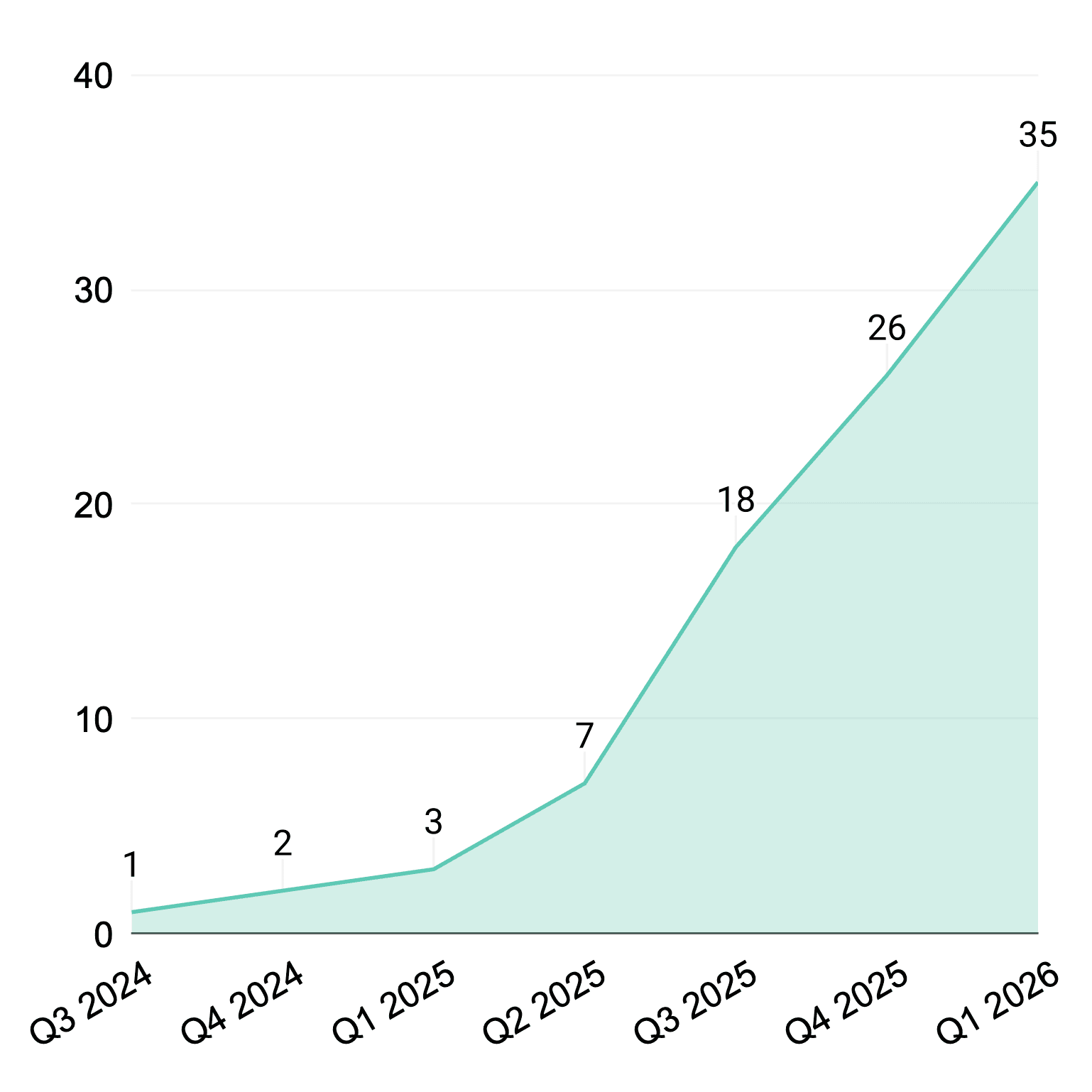
AGENTS RISING
The cumulative number of agentic tools rolled out by the 50 banks we track has nearly doubled since Q3 of last year.
It’s clear what happens when they don’t. McKinsey rushed to fix a vulnerability in its internal AI platform that allowed a cybersecurity firm’s attacking AI agent to gain full read/write access to its production database. Amazon reportedly held an emergency meeting to address “high blast radius” outages linked to Gen AI coding tools. And at Meta, an agent nearly wiped a researcher’s inbox after taking a “clean and declutter” prompt too literally.
All that points to the same underlying issue (and opportunity): These tools were given enough access and autonomy to act across real environments, as they're meant to, but what makes them useful also makes them hard to control – and creates risks. There are trade-offs that have to be made, and we’re seeing the banking sector starting to grapple with them.
First, they’re defining what those risks actually are with a common reference point, like the MIT AI Risk Database, which lays out different threats of AI tools. Firms like Deloitte are even translating them into the specific risks for financial services firms. But they’re still missing a clearer framework for how risk changes with agents – how decision-making shifts to the system, how access expands across data and workflows, and how autonomy moves suggestions into real actions. From there, the job is to create controls that can handle AI tools.
Get that kind of “agent risk management” right and banks can start to let agents loose and get humans out of the loop. Until then, they’ll have to stick with the limited, low-risk tasks – and Jensen Huang’s vision will stay out of reach. (See more below on banks and agents from Nvidia’s GTC.)
WHAT'S ON AT EVIDENT
JOIN US LIVE

The 4-week countdown to our next virtual roundtable starts now. Join us and senior leaders from BMO, Wells Fargo, and EY to discuss where and how banking leaders should be focusing their AI efforts in 2026. On the agenda:
- Where banking leaders are prioritizing AI deployment
- How strategic investment and partnership decisions are shifting over time
- Where enterprise-wide ROI is really materializing – and where you can get the most bang for your buck

USE CASE CORNER
BUYER DON’T BEWARE
Agentic commerce – the idea that agents can browse, compare and eventually buy things for you – comes up short without the right controls around payments. In this week’s “Corner,” we look at how JPMorgan Payments partnered with French commerce platform Mirakl to build infrastructure that lets agents transact on behalf of consumers securely.
Initiative: Agentic commerce partnership
Vendor: Mirakl
Bank: JPMorganChase
Why it’s interesting: Right now, agents can browse and recommend, but the final step, transacting, requires trusted payment rails, fraud controls and identity verification that most AI commerce startups can't provide on their own. The partnership means that the bank handles that final step and brings real agentic commerce closer to a reality. JPMC is effectively providing the infrastructure so that businesses – and ultimately consumers – can plug into the agent economy without needing to build their own plumbing.
How it works: Mirakl Nexus makes agents better at shopping. It optimizes merchants’ product catalogs so that agents from platforms like Gemini, Copilot and Perplexity can discover, read and rank products. J.P. Morgan Payments provides the payment layer underneath. That means the bank processes the payments and handles tokenization – the process of swapping a customer’s card for a one-time digital stand-in so that agents can check out without actually touching the card.
By the numbers: The two are currently being tested with select retailers and merchants, with broader rollout planned for later this year. Neither the bank nor Mirakl have disclosed figures, so we did some back-of-the-envelope math to size the opportunity.
Start with JPMC's merchant acquiring business: It had roughly $2.4 trillion in processing volume in 2023, and was growing at a double-digit rate. UBS research from 2023 shows acquirers charge an average of 29 bps per transaction across $12.3 trillion in total U.S. volume – giving JPMC a ballpark of $7bn in acquiring revenue and roughly a 20% market share. Now the demand side: Morgan Stanley Research estimates agentic e-commerce in the U.S. could reach $190bn to $385bn by 2030: that's 10–20% of online retail. If those volumes were flowing today, they'd represent about 1–3% of what JPMC's merchant services already process.
Zoom out: The bank is planting a flag before the volume arrives, ensuring it stays competitive against Fiserv, Worldpay and the card networks' own agentic bets (see : “Evident AI Index | Payments”, The Brief, Feb 26). If agentic commerce grows as forecast, being the payments partner of record from day one is a lot more valuable than scrambling to catch up later.
Want to know more about the specific ways banks are rolling out AI? Check out our Use Case Tracker – the inventory of all the AI use cases announced by the world’s largest banks available to members.

STAT OF THE WEEK
.png%3FupdatedAt%3D2026-03-18T21%3A46%3A49.747Z&w=3840&q=100)
The share of Fifth Third’s code in production now generated by AI. That’s up from 30% a year ago. Since the bank brought Microsoft Copilot on board a couple years ago, the results have been “pretty remarkable” CEO Tim Spence said. That’s given the bank a confidence boost to “experiment more than maybe we have historically.”
Zoom out: Fifth Third isn't the only bank to share how much AI-generated code it’s using: NatWest last month reported 35% of the bank’s code is now AI-generated. Those numbers will continue growing as more firms use tools like Morgan Stanley’s DevGen.AI, which uses AI to translate legacy code into different languages (see: “4 favorites for ‘25,” The Brief, Dec. 18).

NVIDIA GTC
GTC’S BANKING TAKEAWAYS
Agents aren’t judged by what they can do in the future anymore; they’re judged by what they can do at scale today. That’s the takeaway from Tuesday’s Agentic AI in Financial Services: Model Use Cases panel at Nvidia GTC with RBC Capital Markets’ Bobby Grubert, Wells Fargo’s Chintan Mehta and BNY’s Sarthak Pattanaik.
They laid out three ways that agentic was delivering ROI:
#1: STAY IN YOUR LANE
Agents get tapped by a diverse set of internal users at the bank, BNY’s Pattanaik said. Asset servicing will use agents to find pricing anomalies. Payments will use them for lockbox processing. Legal will use them for document extraction. Banks need to define boundaries for what agents can do upfront within each line of business and build agents that have expertise in those areas. One general agent won’t be able to get deep enough to rewrite a process.
#2: CHANGE IS THE CONSTANT
The only way to get real ROI is to rewrite workflows around tools – specifically agentic ones, Grubert said. RBC is rolling out the final component of Aiden Banker – an agentic suite of tools for real-time research. Within the next four weeks, the first 50 employees will get early access to Pitchbook Creator, which he called a “game changer” in how investment bankers pull data into IPO and M&A decks. Slapping a general-purpose tool on top of an existing process wouldn’t deliver the same kind of return, he said.
#3 MONEY MOVES
No tool should be greenlit if it doesn’t show top-line or bottom-line gains, Wells Fargo’s Mehta said. The bank uses customer service agents to deflect between 2-3 million calls and has developer augmentation tools that make new projects up to 25% cheaper.
JOIN US
WE'RE HIRING
Evident is growing, and we’re looking for ambitious Business Development Managers to join our team. You’ll engage C-suite decision-makers at the world’s largest financial institutions to identify and develop impactful partnerships around our benchmarking and data products. Interested or know someone great?

IN THE NEWS
MISTRAL’S ENTERPRISE PLAY
French AI lab Mistral launched Forge, a platform that helps businesses build their own AI models instead of relying on APIs to call third-party models. The platform lets enterprises train and run models fully on-prem, meaning sensitive data doesn’t need to leave the bank’s servers. It’s a targeted enterprise push for the lab that now counts BNP Paribas and HSBC as customers as more businesses look for security in AI tools.
Nordea plans to cut up to 1,500 jobs this year and next citing efficiency gains from AI. It’s the second announcement of headcount reductions for the Nordic bank in as many months as it seeks to hit benchmarks for its “2030 strategy” of tech transformation. In February, Nordea announced it was laying off a chunk of its IT department. HSBC is also reportedly mulling job cuts of up to 10% of its workforce due, in part, to AI (see also: “AI layoff bubble,” The Brief, March 5).
BMO published a set of responsible AI principles and described how they fit into the bank’s broader risk management and governance strategy. Use cases go through checks by BMO’s data, risk, and audit teams, and a dedicated “Responsible AI” group, “at each stage of the lifecycle.”

NOTABLY QUOTABLE
“The reality we’re hurtling towards isn’t binary [between blue- and white-collar work]; it’s turquoise. A world where the most valuable work fuses physical presence with cognitive command, human hands guiding AI’s reach.”
– David Hardoon, former global head of AI enablement at Standard Chartered, in The Business Times, March 14
.svg&w=96&q=80)
TALENT MATTERS
SILICON VALLEY DEFECTIONS
State Street brought Manoj Bohra onboard as the firm’s new chief data and AI officer. Bohra was most recently a managing director at Google Cloud and spent close to a decade and a half at Bank of America, where he focused on enterprise data, AI, and cloud initiatives.
Capital One hired Manas Ranjan Mohanty as lead AI engineer for its AI Foundations, LLM Core and Agentic AI team. He was previously an applied scientist at Amazon.
David Hardoon, Standard Chartered’s AI head, is reportedly leaving the bank, less than a year after starting. The firm declined to comment on Bloomberg’s reporting.
Jessica Glanfield joined Scotiabank as a director of strategy, digital, data and AI for global wealth management. Glanfield previously led digital product strategy for RBC’s mobile servicing portfolio, she wrote on LinkedIn.
Dhruvin Barvalia joined BMO as lead for AI and data platforms. He spent eight years with Manulife Canada.

CODA
DISCOUNT DEPENDENCY
Forbes reported that Anthropic may be selling subscriptions for their coding agents at a steep discount: A $200 monthly plan appears to offer somewhere between 10 to 25 times as much value in API credits. That is a consumer offer, not an enterprise contract, but it still points to a question banks should keep in mind as they build around generative AI: If today’s pricing is subsidized, what happens when it stops being so generous?
There’s prior form in Silicon Valley. We estimate that Uber, for example, has roughly tripled the cost of a 30-minute journey since launching, as they’ve moved from burning VC cash for market share to profitability. If Anthropic is doing something similar, banks should be wary of treating today’s economics as permanent.
That matters most where banks are using AI to drive headcount or productivity assumptions. A coding tool that looks transformative at a subsidised price may look far less compelling if prices rise sharply once customers are locked in. The risk is not just higher software spend, but projected efficiency gains starting to dwindle as model providers unilaterally hike costs.
Banks do not need to avoid these tools. But they may need to treat current pricing as provisional, not permanent. Business cases built on model providers should account for the possibility that today’s discounts won’t last.
WHAT'S ON
Fri 20 March
Return on Intelligence: How Leaders Are Scaling AI That Delivers Value, Virtual
Weds 15 - Thurs 16 April
AI in Finance Summit, New York
Mon 27 - Tues 28 April
Momentum AI New York 2026, New York, NY
- Alexandra Mousavizadeh|Co-founder & CEO|[email protected]
- Annabel Ayles|Co-founder & co-CEO|[email protected]
- Colin Gilbert|VP, Intelligence|[email protected]
- Matthew Kaminski|Senior Advisor|[email protected]
- Kevin McAllister|Senior Editor|[email protected]
- Daniel Shackleford Capel|MD, Banking|[email protected]
- Maryam Akram|Senior Research Manager|[email protected]
- Zachary Groz|Reporter|[email protected]
- Alex Inch|Data Scientist|[email protected]
- Sam Meeson|AI Research Analyst|[email protected]
- Gabriel Perez Jaen|Research Manager|[email protected]
- Jay Prynne|Head of Design|[email protected]
- Marcus Gurtler|Junior Designer|[email protected]

