

DATA-DRIVEN INSIGHTS AND NEWS
ON HOW BANKS ARE ADOPTING AI
NEW: Top AI banks in the Middle East & Africa
Source: Adobe Firefly
4 June 2026
Welcome back to the Banking Brief. This week, we launched the Evident AI Index for Banks - MEA, the first ranking of banks’ AI maturity across the Middle East and Africa. We explore who leads and why and highlight five VIPs shaping the sector.
Also, how Morgan Stanley is getting its platforms ready for agents. And Bank of America is doubling down on junior employees.
People mentioned in this edition: Margaret Nienaber, Eyal Efrat, Miguel Rio-Tinto, Sebastian Walter, Abdullah bin Sharaf Alghamdi, Hanan Friedman, Mark Mitchell, Antonio Bravo, Luisa Gómez Bravo, Anna Cross, Shebani Baweja, David de Niese and others.
This edition is 2,019 words, a 7-minute read. Check it out online. If you were forwarded the Brief, you can subscribe here. We always want to hear from you: [email protected]
– Alexandra Mousavizadeh & Annabel Ayles

EVIDENT AI INDEX - MEA
TALE OF THE TAPE
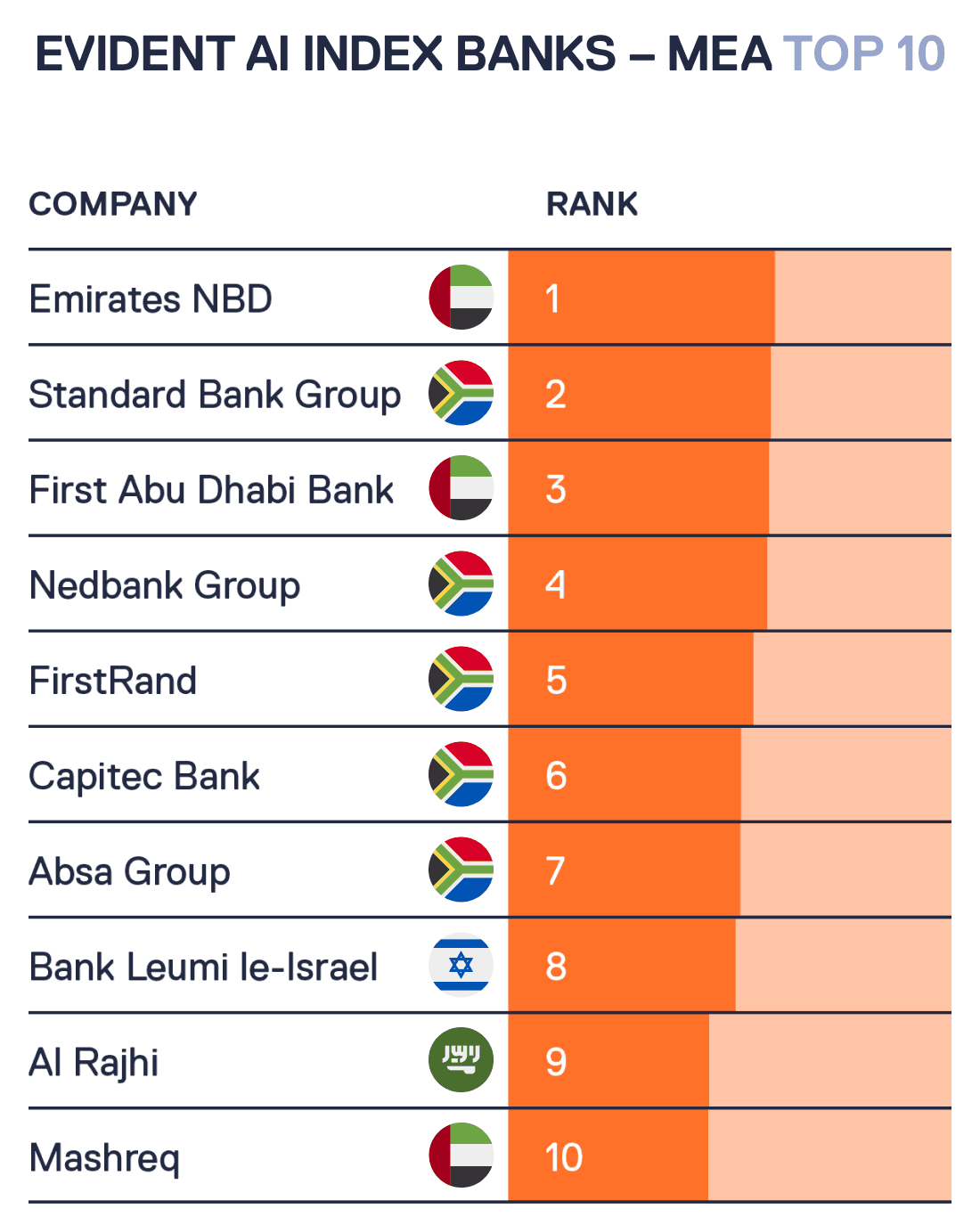
Emirates NBD leads all banks in the Middle East and Africa on AI maturity, the new Evident AI Index for Banks - MEA out this week shows.
The UAE-based lender edged out South Africa’s Standard Bank, local rival First Abu Dhabi Bank and South Africa’s Nedbank. All three finished within one point of each other on the Index’s 100-point scale.
The Index, Evident’s inaugural regional ranking, assesses 25 of the largest Middle Eastern and African banks on the quality of their talent stacks, their innovation efforts, the tech leadership of their top executives and the guardrails they’ve set up to govern AI effectively.
The leading banks in these regions are changing as quickly as the countries they operate in. They’re deploying AI while the infrastructure, talent and rules around it still take shape. That creates a spikier version of AI than we see elsewhere: No bank leads more than two pillars of the Index. It also creates an environment where banks can leapfrog the traditional stages of AI development.
Emirates NBD, for example, hasn’t concentrated as many resources on research or experimentation as top finishers in other regions. It’s gone straight to deployment and scale. The lender has more AI staff focused on software implementation and product management – roles critical to connecting AI to business goals – than any other bank ranked. What they’ve rolled out connects clearly to returns: One tool automates job interviews and has saved the bank 13,000 hours and some $400,000. The AI tools it’s given engineers are now authoring more than a quarter of the bank’s code (more on that in our VIPs section below).
Standard Bank meanwhile has expedited the AI push into its lines of business. With 20 million customers spanning more than 21 countries, the bank didn’t spend much time treating AI like a single enterprise project. “The business units have their focus areas and AI use cases that they are driving,” said Margaret Nienaber, the bank’s COO. “Making sure that they drive those commercial outcomes is something that we're actually quite deliberate about, and [CEO] Sim [Tshabalala] includes in our KPIs to make sure that we unlock that value as we learn on the run.” The bank’s AI gains show the targeted approach: In its personal banking unit, a cross-selling tool boosted campaign success by 20%. In investment banking, a tool called SmartNudge generates insights and recommendations for traders and clients that get accepted two-thirds of the time.
First Abu Dhabi Bank has focused on speed to deployment. NUMO, its internal system that standardizes how new products get built, and Gernas, the AI platform that plugs into the bank’s data, are opening the door to agentic AI faster. Agents have sped the bank’s cross-border payments by 75%. And AI advisors deployed in the commercial bank have lifted the revenue per human relationship manager by 30%.
Looking ahead: The ongoing conflicts in Iran and elsewhere cloud the region’s outlook. If it makes talent harder to attract or compute harder to access, the need for AI to plug the gaps will only become more urgent. The banks leaning in now will have the best shot to absorb the pressure.
JUST LAUNCHED
EVIDENT AI INDEX FOR BANKS - MIDDLE EAST & AFRICA EDITION
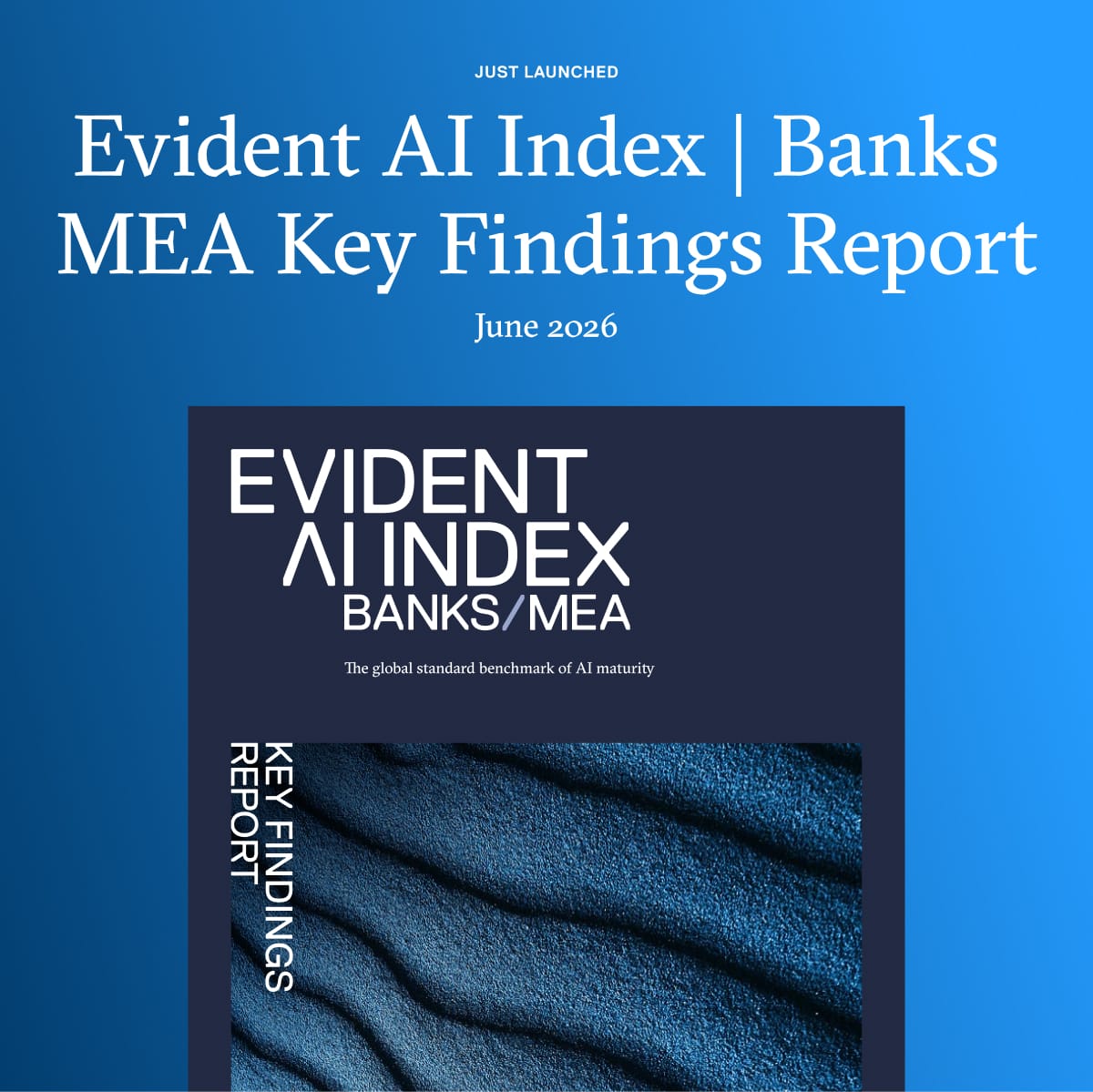
Explore the 2026 Evident AI Index for Banks - MEA ranking and dive deeper into the performance profiles of the region's most AI-first banks, the challenges they face, and the trends to watch.

MEA INDEX CONTINUED
FAQS
#1. Why does South Africa have half of the top 10 banks?
South African lenders – led by Standard Bank, Nedbank, FirstRand and Absa – account for almost half of all the use cases rolled out by the 25 banks tracked in this Index (see: “Boks set,” The Brief, May 28). Size helps: They are among the region’s biggest banks by headcount. What gives them an edge though is knowing how to aim their AI at the areas where the returns compound fastest. Standard Bank, for example, built a tool that improved cross-border payment automation by 90%. Standard Bank serves more than 20 countries and processes billions of those payments, meaning every AI-generated improvement has immediate bottom-line impact.
#2. Is the UAE pulling away from the rest of the Gulf?
The story, as ever, is the talent: Emirates NBD and First Abu Dhabi Bank employ two-thirds of all the Gulf’s bank employees focused on AI implementation, people who are the linchpin to scaling tools. It’s no accident: In 2019, FAB established the Intelligent Automation Center of Excellence. In 2021, Emirates NBD started building an advanced analytics organization. UAE banks also benefited from the tech company relationships built out by G42. The combination of talent and tech means the country’s banks are responsible for almost a quarter of all AI use cases publicly rolled out by the 25 banks.
#3. Why aren’t Israeli banks ranked higher?
Israeli banks show the flipside of the scale story. These banks have smaller footprints, meaning AI gains from employee usage don’t snowball as quickly as they would inside, say, a larger South African lender. They’ve compensated by staffing up in ways that allow them to chase bigger AI transformations through innovation efforts that “enable us to rethink how we work,” as Eyal Efrat, head of the technologies division at Bank Leumi, put it. Each of the three Israeli banks ranks in the top six overall for AI talent as a share of headcount. They still aren't as forthcoming publicly with use cases, but Bank Leumi is now showing what that focus can produce: The bank redesigned its credit application process completely around AI and cut the time it takes for approvals from weeks to a day or two.
#4. Why is North Africa absent from the leaderboard?
The three North African banks – Attijariwafa bank, Banque Misr and National Bank of Egypt – all rank in the bottom half of the Index. The environment they operate in is one reason why: More than half of their customer bases don’t have bank accounts. That means they spend more time working to bring people into the financial system than peers in other regions. It limits the extent of their AI push. They still use the tech in fraud detection or to improve efficiency, but they don’t have as clear a way to push it to customers.
OUT NOW: Explore the full report here.

WHO’S WHO
FIVE LEADERS TO WATCH
.jpg&w=3840&q=80)
🏗️ Architect: Miguel Rio-Tinto
Chief digital and information officer at Emirates NBD
The man behind Emirates’ AI transformation. He orchestrated the “biggest Claude Code deployment in the Middle East,” he said on a podcast last month, with 2,300 engineers at the bank now using the tool. It’s getting results: More than a quarter of the bank’s code shipped to production is now written by AI. He now has his sight on consumer tools: “We are seeing places where we believe full rules in banking are going to disappear,” he said. “ChatGPT, you interact with in chat, and you talk to it. Imagine your bank like that.”
🔗 Operator: Margaret Nienaber
COO at Standard Bank
The AI whip at South Africa’s largest bank. “Artificial intelligence does indeed form a central part of our group strategy,” the bank’s CEO Sim Tshabalala said during the bank’s March earnings call. “It is led by our Chief Operating Officer, Margaret Nienaber.” The former wealth head became COO in 2022 and set out to unify the bank’s data and streamline the business. The result: The bank is getting 15% more revenue for every unit of tech spend. Now she’s applying the same discipline to making AI an institutional imperative: “The real divide will not necessarily be between humans and AI, but between those who learn how to use AI and those who do not,” she said at an investor event in March. “We are driving a culture of adoption.”
🚀 Visionary: Sebastian Walter
Chief AI officer at First Abu Dhabi Bank
The driving force behind FAB’s agentic push. Walter has been with the bank for less than a year, but leads the AI Innovation Hub and focuses on “translating emerging technologies into real business impact,” he said. That’s played out through the bank’s growing pipeline of agentic tools: More than 30 agentic tools are “progressing” in payments, operations, compliance and engineering, he said. "I’d rather have us working on edge cases where, as of today, it’s barely working, and success is hard to measure, but we generate early learnings and put them into place," he said during a 2024 interview before joining the bank.
🤝 Dealmaker: Abdullah bin Sharaf Alghamdi
President at the Saudi Data & AI Authority
The frontman of Saudi Arabia’s economic transformation. He was instrumental in rolling out the Kingdom’s “Vision 2030” strategy and is following through by courting investment – like a 2025 deal with Nvidia – to build AI infrastructure and make Saudi Arabia a true tech hub. The success of those efforts is critical to “developing advanced digital infrastructure that enables various sectors to adopt AI applications efficiently,” he said at a conference in February. As the conflict in the region drags on, he’s a major part of making sure the investments that banks in the region will rely on continue.
♟️Strategist: Hanan Friedman
CEO at Bank Leumi
Israel’s top banker turned AI commander in chief. Since taking the helm, he’s reorganized the bank by focusing on giving tech efforts the structural support to succeed. “Our AI leadership report directly to me, ensuring that development is a top-down strategic priority,” he said during the bank’s March earnings call. That priority is focused on “providing hyper-personalized products and a proactive real-time service model,” he said. But the bigger prize is in reinventing the bank altogether: “With AI's help, we'll make another revolution in our spending structure,” he told a conference last month.
JOIN OUR ROUNDTABLE
CAPTURING THE AI ADVANTAGE WHAT MEA BANKING LEADERS DO DIFFERENTLY

To mark the launch of the Evident AI Index for Banks - MEA, join top AI executives from the region's leading banks to unpack the 2026 results and explore what the frontrunners are doing differently.

STAT OF THE WEEK

That’s how many companies will be able to plug their own AI agents into two Morgan Stanley platforms used to manage employee stock compensation plans by next year. A handful of clients have early access, said Mark Mitchell, chief product officer of Morgan Stanley at Work, the unit that runs the now-agent-friendly ShareWorks and Equity Edge platforms. Agents built by those clients can now access and retrieve the data and information in them – like vesting schedules or plan documents – directly. To make it work, the bank set up a Model Context Protocol, a type of API designed specifically for LLMs. Other banks like JPMorganChase have released MCPs before, but Morgan Stanley is the first to plug other companies’ AI agents into their own live data feeds.
Bigger picture: Banks are still sketching out how much of the customer experience they’re willing to hand over to agents across different parts of the bank. In retail banking, NatWest and BBVA debuted apps that let people interact with the bank via ChatGPT (see: “Curb App-eal”, The Brief, May 14). In wealth management, they’re debating the extent to which AI might be able to handle the simpler requests (see: “Not your father’s advisor,” The Brief, May 21).

IN THE NEWS
PRICE ISN’T RIGHT
GitHub officially joined the list of model providers changing its pricing model, shifting to usage-based billing this week. Some users have reported that the shift is increasing their monthly costs 10-fold. The firm added some carrot this week though, too: At its Build conference, Microsoft released a new desktop app for GitHub and launched a new “ultra efficient” coding model fine-tuned for GitHub which it says will lower costs. Real world use will prove or disprove that claim, but other labs’ releases have largely shown the opposite (see: “Fat bill coming,” The Brief, April 30)
BBVA launched a new “AI Transformation” unit, led by Antonio Bravo, the bank’s data chief. It will bring “together the current Data area and the critical technological capabilities needed to industrialize the creation, deployment and management of AI agents across the organization,” the release said. The announcement comes as the bank shared more on AI efficacy at this week’s Goldman Sachs’ conference: Some engineering teams are saving 50% of the time it previously took them to write and test code, CFO Luisa Gómez Bravo said. At that same conference, Barclays CFO Anna Cross said the U.K. bank had sped the process of getting code into production by 15% thanks to AI.
RBC is expanding the Vancouver banking and innovation hub it opened last November, the Canadian lender announced this week. The bank will bring on 250 more employees by the end of the year and plans to have 1,000 people – 440 of which are new – working out of the hub by 2029.

NOTABLY QUOTABLE
“I find it very surprising when really smart people take one side or the other. They sit there and they say, ‘It's not a threat to employment,’ or they sit there and say, ‘It's a huge threat to employment.’ Right? It's so obvious to me, looking at the way we're using AI inside the company, it is both of those things.”
– Charlie Scharf, CEO at Wells Fargo, at a conference, May 27
.svg&w=96&q=80)
TALENT MATTERS
CAMPUS HERO
Bank of America has 4,000 people joining the firm next week, half of whom are full time employees hired out of college, the other half interns. Despite AI adoption, it’s roughly the same size class of junior hires as the bank has had in years past, talent head Josh Bronstein said. As they enter the firm, the rookies will get AI training within their line of business, he added. It fits with a broader training push: In April, the bank added new people to its AI Capabilities and Enterprise Learning team, which designs AI-led training programs. And last month, CEO Brian Moynihan said the bank had retrained and moved 14,000 people into new jobs inside the company (see: “Growth mindset,” The Brief, May 28).
Shebani Baweja is now group chief data officer at Standard Chartered. She was most recently the chief information security officer for the bank’s wealth and retail banking unit and international markets. In her new role, she’ll report to COO Alvaro Garrido.
Chad Ballard joined Northwest Bank, a community bank with roughly $17 billion in assets, as CIO. He was previously CIO for shared services operations at Wells Fargo and before that was head of global banking platform at JPMorganChase.
David de Niese joined Mastercard as senior vice president of The Foundry, the firm’s innovation arm. He was previously chief data and architecture officer at Aldermore Bank and spent time at Accenture and UBS before that.
WHAT'S ON
Wednesday 10 - Thursday 11 June
AI Summit, London
Friday 12 June
AI for Financial Services, New York
Wednesday 17 June
AI in Capital Markets Summit, London
Tuesday 30 June
Capturing the AI advantage: What MEA banking leaders do differently, Virtual
- Alexandra Mousavizadeh|Co-founder & CEO|[email protected]
- Annabel Ayles|Co-founder & co-CEO|[email protected]
- Colin Gilbert|VP, Intelligence|[email protected]
- Matthew Kaminski|Senior Advisor|[email protected]
- Kevin McAllister|Senior Editor|[email protected]
- Daniel Shackleford Capel|MD, Banking|[email protected]
- Maryam Akram|Senior Research Manager|[email protected]
- Zachary Groz|Reporter|[email protected]
- Alex Inch|Data Scientist|[email protected]
- Sam Meeson|AI Research Analyst|[email protected]
- Gabriel Perez Jaen|Research Manager|[email protected]
- Jay Prynne|Head of Design|[email protected]
- Marcus Gurtler|Junior Designer|[email protected]

