

DATA-DRIVEN INSIGHTS AND NEWS
ON HOW BANKS ARE ADOPTING AI
Unripe AI

Source: Adobe Firefly
14 May 2026
Welcome back. This week: Banks get into testing mode. Danske Bank CTO Richard Davis and chief AI officer Kasper Tjørntved Davidsen tell us how they plan to deliver on new AI promises they made to the market. Plus we take NatWest’s new ChatGPT app for a test drive.
People mentioned in this edition: Jamie Dimon, Andy Sieg, David Griffiths, John Waldron, Steven van Rijswijk, Solange Chamberlain, Michelle O’Reilly, Dom Grillo and others.
This edition is 1,955 words, a 7-minute read. Check it out online. If you were forwarded the Brief, you can subscribe here. We always want to hear from you at [email protected].
– Alexandra Mousavizadeh & Annabel Ayles

TREND LINES
TESTING TIME
The AI use cases making the biggest splash in banking recently have a peculiar thing in common: They don’t exist yet.
Two weeks ago, Citi introduced Citi Sky, an AI avatar pitched as an always-on wealth advisor. The first pilot of this tool that wealth boss Andy Sieg says will “change the model of wealth management”? Check back later this summer. And that agentic tool that can automatically move money into different investments Jamie Dimon talked up in his shareholder letter last month? “It is early stages for this particular product,” he said on the company’s earnings call.
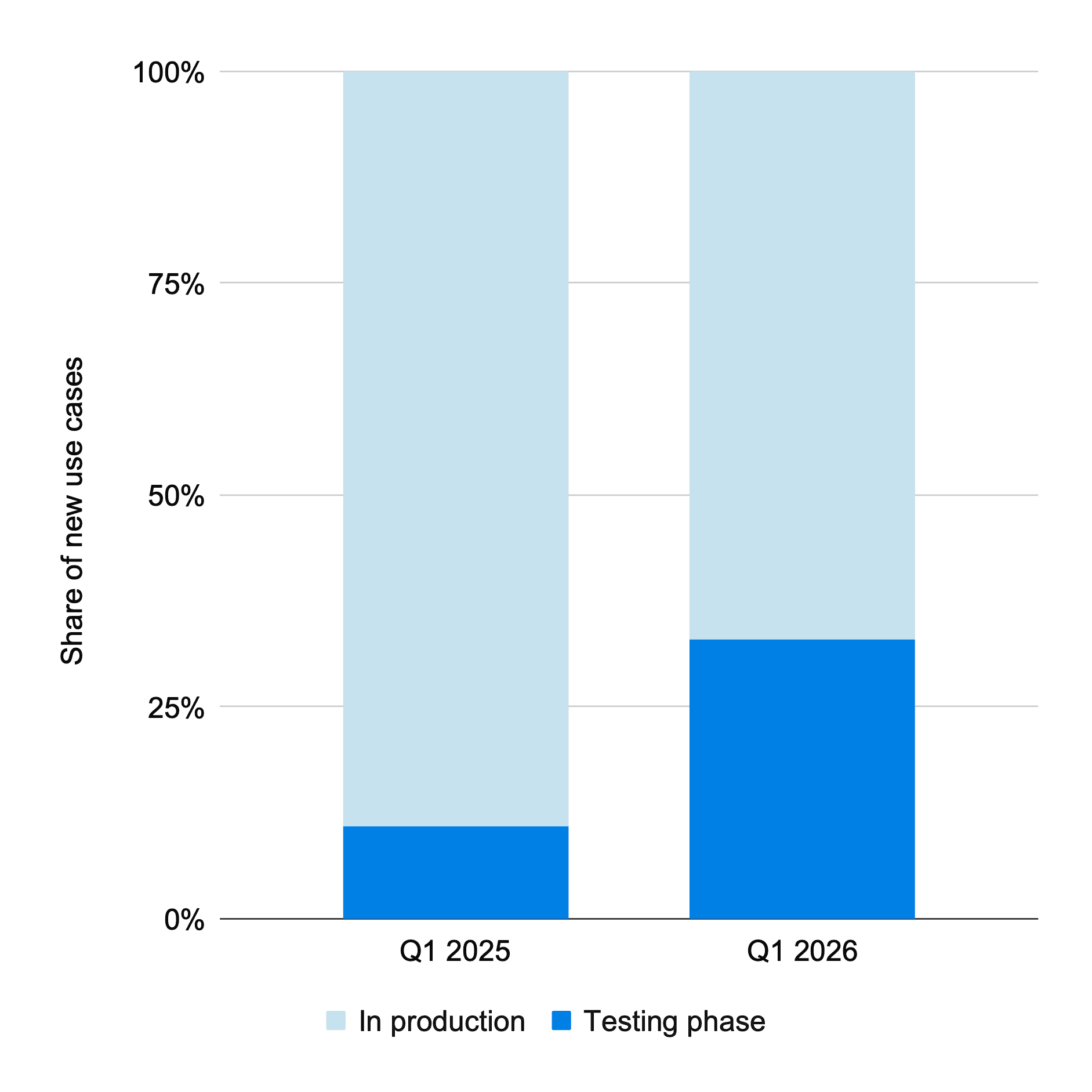
That’s becoming a pattern across the 50 banks we track. A year ago, only about 10% of the new tools banks rolled out were still in testing when they were made public. Last quarter, that rose above 30%. This isn’t just laggards throwing their hats in the AI ring either: Among the top 10 lenders in the Evident AI Index for Banks, half the announcements last quarter were for tools not yet in full production.
Banks have increasingly promised the market that billions of dollars of AI benefits are on the way (see: “CFO-phie’s choice,” The Brief, April 2). Their current use case portfolios aren’t yet equipped to deliver that. As a result, they’re showing more of what’s behind the curtain to prove that it’s not all talk. But it puts even more pressure on them to prove they can actually take those tools to production.
COMING SOON
The share of new use cases in the testing or pilot stage announced this past quarter by the 50 banks we track tripled compared to Q1 last year.
It’s no easy task: “You’ve got to set up governance infrastructure. It’s complex. There’s data challenges,” said John Waldron, president of Goldman Sachs, this week. “Most of us do not have particularly clean data so everybody’s trying to clean up their data, create more structured data.”
Banks have been building AI platforms to combat that – infrastructure that aims to turn scaling AI into something like an assembly line (see: “Platform or bust,” The Brief, Dec. 11). But even that’s becoming table stakes. In the last two weeks, Lloyds launched its platform, Envoy, and Citi rolled out Arc, which is the bank’s “operating system” for agentic AI, group head of AI David Griffiths said.
The test now becomes how successfully and how fast those assembly lines can deliver products and tailor them for different lines of business. ING offered one clear metric: The Dutch bank is now moving 90% of its tools in development into production, CEO Steven van Rijswijk told investors during its most-recent earnings call.
That hit rate – and the time it takes to get there – will matter more as banks share more of what’s not yet live. Because the more they show the pipeline, the easier it becomes to tell what’s moving through a well-oiled machine and what’s just part of a messy backlog.
COMING SOON
EVIDENT AI INDEX FOR BANKS - MIDDLE EAST & AFRICA EDITION
.jpg&w=3840&q=80)
Next month, we’re ranking 25 of the largest banks across the Middle East & Africa on their AI maturity – revealing who’s pulling ahead, the challenges they face and where the biggest opportunities lie. Explore the banks featured in the inaugural edition, and register your interest to be the first to know when the Index goes live.
.svg&w=96&q=80)
Q&A
DENMARK'S AI BANK SHOT
Denmark’s Danske Bank and its CEO Carsten Egeriis put AI at the center of its retooled strategy and 2028 financial goals two weeks ago.
Some three years into its “Forward ‘28” strategy, the bank (#33 in the Evident AI Index for Banks) is rolling out “an evolution, not a revolution,” CTO Richard Davis told us. As part of it, the bank says AI and tech will deliver 2 billion Danish kroner – roughly $315 million – in productivity benefits annually by 2028. “At the strategic level, we’re now putting our money where our mouth is,” said Kasper Tjørntved Davidsen, the bank’s chief AI officer.
Fifteen of the 50 banks we track now share projected or realized gains from AI. At the core of those gains is what Danske Bank calls the “AI City,” a shared platform different teams can tap into so growth doesn’t turn into disconnected sprawl.
This conversation with Richard Davis and Kasper Tjørntved Davidsen is an excerpt from our full Q&A. It has been edited for length and clarity.
.png%3FupdatedAt%3D2026-05-14T11%3A20%3A22.428Z&w=3840&q=100)
EVIDENT: Where did this idea of the AI City come from, and how is it different from what other banks are doing?
RICHARD DAVIS: When we start talking technology – Bedrock agents, AgentCore, all this stuff – to operational users, you can see their eyes glaze over. The idea behind the AI City came from a simple realization: To scale AI across a bank with 20,000-plus employees, you need shared infrastructure – reusable platforms, built-in security, governance, orchestration and development blueprints. The AI City metaphor helped align executives quickly because just like a real city needs roads, utilities and building codes before it can scale, enterprise AI needs strong foundations.
KASPER TJØRNTVED DAVIDSEN: It definitely comes from a practical scaling challenge that we have. We’ve seen momentum with Gen AI tools and pilots, but if you look at a bank of our size with all the individual use cases, that’s not enough for us to reap the benefits that we committed to the market. The “AI City” is how we make capabilities reusable across teams and actually deploy workflows with the right evaluation and controls built in so that you can embed these things at scale and at a cost point that is significantly lower than if everyone went out there and did things on their own.
How do you evaluate and measure the impact of those use cases? And how do you determine what’s worth pushing into different lines of business versus where you need to go back to the drawing board?
TJØRNTVED DAVIDSEN: They will all leveraging our asset registry, observability, traceability, meaning that, from a corporate point of view, we can always see what has gone live, where it runs, how it performs and how we can pick it up and redeploy it elsewhere. There’s a very clear prioritization mechanism that is rooted in the value that is being created. We are always focusing on the largest, the most strategic initiatives. It has to have clear outcomes for the bank that we can actually put a KPI towards. The requirements are a material business problem, clear ownership from business, measurable outcomes and the ability then to scale beyond a single team.
You’ve talked about the technology piece of the strategy and the organizational piece of it. How do you balance the effort between changing the way people use the tech vs. developing new tools that facilitate that way of work?
DAVIS: That’s that million-dollar question, isn’t it? The tech is pretty much proven with regards to what it can do. We spend as much time changing how people work as we do building the technology itself. We focus heavily on embedding AI directly into existing workflows. But also, how do we reimagine, reinvent, rewire the whole organization to optimize the outputs that we can get from this technology? The technology is moving so quickly, even quarterly reviews or two week sprints, maybe the technology is outpacing that as well. So reimagining how we do things like that: How do we do three-day deliveries? Or rather than a team of eight, how do we do the same delivery with a team of three so the rest of the team can take on other projects?
You’ve told the market AI and tech are going to generate 2 billion Danish kroner – $315 million – in productivity benefits annually by 2028. Where’s that coming from?
DAVIS: We continue to invest significantly in our tech transformation and AI tools, with investments rising from around 4 billion Danish kroner (roughly $630 million) last year to about 4.5 billion ($707 million), and staying at roughly that level through 2028. Those investments allow us to size the benefits to a 2 billion Danish kroner ($315 million) run rate in 2028. And it’s not a hockey stick, it’s fairly linear, with meaningful run-rate benefits already in 2027. Broadly, it comes from three areas: developer productivity, frontline tools and back-office and enterprise productivity.
TJØRNTVED DAVIDSEN: That drives the improvement in cost-to-income ratio from AI and tech. The AI City contributes to this by allowing us to reuse capabilities, apply common controls and monitoring, and deploy solutions across teams instead of rebuilding from scratch – taking out cost by optimizing on the back end in our processes. But it is also driving increased customer engagement that will then drive revenue for the bank.
Read our full interview with Richard Davis and Kasper Tjørntved Davidsen.

STAT OF THE WEEK
-1.png%3FupdatedAt%3D2026-05-14T11%3A22%3A42.744Z&w=3840&q=100)
That’s the amount ponied up by a cohort of founding partners – including BBVA – to back the OpenAI Deployment Company, a new firm the ChatGPT-maker is launching to help companies deploy and adopt AI better. Sam Altman’s lab also bought Scottish consultancy Tomoro, whose engineers will form the first class embedded with clients as the new venture gets off the ground.
Zoom out: OpenAI’s company follows the launch last week of a similar AI services firm by Anthropic, which counts Goldman Sachs, Blackstone and Hellman & Friedman as initial investors and raised $1.5 billion. That companies have committed $5.5 billion to this new class of firms shows how much adoption the market still believes is ahead before enterprise AI peaks. But it also shows how eager labs are to take a page out of Palantir’s playbook: The firm has long used forward deployed engineers to embed its tech deep into a company's workflows which, in turn, makes it harder to rip out.
RETURNING THIS OCTOBER
2026 EVIDENT AI SYMPOSIUM

The Evident AI Symposium is back in New York this October. Take a first look at this year's speakers and register your interest to join us on the day.

USE CASE CORNER
CURB APP-EAL
NatWest has become the first U.K. bank to launch an app inside ChatGPT, offering home-buying guidance directly in the chatbot. It’s part of a push to meet customers “in the right places at the right time,” the bank’s retail CEO Solange Chamberlain said. In this week’s “Corner,” we took the app for a test drive to see if it felt like the bank was getting in on the ground floor of Apple’s App Store or the Zune Marketplace.
Use case: Mortgage discovery and affordability guidance
Vendor: OpenAI
Bank: NatWest
Why it’s interesting: ChatGPT is becoming a new shop window for financial services. BBVA launched a ChatGPT app for product information in Germany and Italy. U.K. insurer Aviva built one to offer home insurance quotes. The open question is what firms will actually get from these integrations: a new sales channel, a way to educate customers or just another avenue to route users back to their own websites.
How it works: NatWest’s app asks for the usual mortgage inputs: annual income, deposit, number of dependents, credit card balance and other affordability details. It then returns an indicative borrowing figure in an embedded NatWest card (see below). Users can ask ChatGPT follow-up questions – for example, how the numbers change if buying with a partner – and request specific mortgage rates. In our test, the app generated a comparison view showing different mortgage packages and clear pricing. From there, users are directed back to NatWest-owned channels for advice, appointments or applications. That made the experience more useful than a typical mortgage calculator, more like having an advisor beside you to explain the consequences and meaning of each input.

But the issue is discovery. To find NatWest’s app, we had to click through seven different menus and scroll down an alphabetical list of ‘Productivity’ apps to NatWest at about the 120th position. There’s no dedicated finance category to find relevant apps. Nor does ChatGPT suggest relevant apps to users, even if they were a U.K. resident specifically discussing mortgage rates.
By the numbers: ChatGPT has enormous reach with some 900 million weekly active users. But app-store placement isn’t the same as distribution. And even if users discover a bank’s app, it’s not clear how beneficial it would be: Walmart’s early test showed that ChatGPT checkouts converted at one-third the rate of users clicking through to Walmart’s own site.
Bigger picture: It’s perhaps no surprise that the first banks in the door – NatWest and BBVA – have some of the deepest ties to OpenAI. That doesn’t make the app a gimmick. But it’s hardly a front door to banking either. For now, it’s more like a side entrance, down some stairs, hidden in an alleyway. But discoverability for humans might not actually matter in the long run. If you buy into the agentic future, what really matters is whether agents can locate and interact with bank offerings. If developing this app helps NatWest get a head start on that, it could be worth more than whatever new business the app itself brings in.

NOTABLY QUOTABLE
“The journey of an enterprise is undoubtedly in my opinion going to be slower than the speed of the modeling. The new models are coming out weekly, monthly and they’re getting better and better at a very rapid clip. We’re not going to be able to move as enterprises at that pace. But it doesn’t mean that we won’t ultimately catch up and start to deploy at a very rapid clip. I think you’re going to start to see more progress second half of this year, first half of ‘27. And I’m sure you’ll start to see KPIs that people will start talking about that will prove that theory.”
–John Waldron, president at Goldman Sachs, on CNBC, May 12
.svg&w=96&q=80)
TALENT MATTERS
BENGALURU BOSS
CommBank hired Shubha Iyer as managing director and CEO of CommBank India. Iyer spent the last decade and a half at Goldman Sachs, most recently as the global lead for control, finance and operations strategic initiatives. That included “identifying AI-sensitive opportunities,” she wrote on LinkedIn. Earlier in her Goldman tenure, she was COO for the India engineering operation and led the bank’s Automation Center of Excellence.
JPMorganChase is hiring an agentic treasury product strategy executive director. The bank is aiming to “deliver an agentic treasury platform that maps to real-world treasury workflows and decision-making,” the job description says.
Westpac is hiring a chief engineer for AI engineering with a focus on “AI‑first software delivery and enterprise impact.” The Australian bank has made a slew of data and AI hires in the past year: Andrew McMullan joined as chief data, digital and AI officer, Dan Jermyn joined as chief AI officer and, most recently, Maggie Shi joined as chief AI innovation officer (see: “New chiefs,” The Brief, April 23).
Prudential Financial promoted George Sinnott to be head of data and AI strategy and delivery. Sinnott was previously vice president of technology operations and strategy for the firm’s retirement and insurance businesses. He’ll work “in partnership” with Bob Bastian, who Prudential named chief data and AI officer last month.
Jasmine Khristi joined JPMorganChase as an AI technical project manager. Khristi previously spent five years at Citi.

IN THE NEWS
BNY LEVELS UP AI TRAINING
Roughly 2,300 of BNY’s employees have completed the bank’s 40-hour AI bootcamp, which it launched in April last year – a big step toward getting the firm to be more AI-fluent. The course goes beyond normal training programs: Every participant is required to build a working AI prototype that can solve a problem in their area of the bank before tossing their graduation cap. Alongside formal training, the bank is developing what it calls “Digital Employee Agency,” a framework managers can use to decide when a certain problem warrants spinning up a digital employee versus, say, a contractor or a human employee, said Michelle O’Reilly, the bank’s head of talent.
CommBank opened a new tech hub in San Francisco this week as the Australian bank looks to deepen ties with Silicon Valley. The bank, which entered into a strategic partnership with OpenAI in Australia last year, now finds itself neighbors with the ChatGPT-maker. “The fact that we’re next door to each other now, and that we have the ability to deeply share what’s happening with our roadmap and current initiatives, creates a real flywheel of feedback,” said OpenAI’s global head of technical success Dom Grillo. The bank launched a similar effort in Seattle in March 2025.
Japan’s largest banks – MUFG, SMBC and Mizuho – will get access to Anthropic’s cybersecurity model Claude Mythos by the end of May, sources told Reuters. Some U.S. banks got their hands on a preview of the model, dubbed “too dangerous to release” to the public, last month (see: “Much ado about Mythos,” The Brief, April 16). European banks largely haven't been able to test it. It’s not the only game in town anymore though: OpenAI’s GPT-5.5 is just as capable as Mythos, the U.K.’s AI Security Institute found. Microsoft built its own “agentic security system.” And Mistral is developing a cybersecurity model specifically targeted at the European banks that haven’t been able to tap into Mythos yet, Bloomberg reported.
WHAT'S ON
Thurs 28 May
Mistral AI NOW Summit, Paris, France
Weds 3 - Thurs 4 June
AI in Risk Management for Financial Institutions, New York, NY
- Alexandra Mousavizadeh|Co-founder & CEO|[email protected]
- Annabel Ayles|Co-founder & co-CEO|[email protected]
- Colin Gilbert|VP, Intelligence|[email protected]
- Matthew Kaminski|Senior Advisor|[email protected]
- Kevin McAllister|Senior Editor|[email protected]
- Daniel Shackleford Capel|MD, Banking|[email protected]
- Maryam Akram|Senior Research Manager|[email protected]
- Zachary Groz|Reporter|[email protected]
- Alex Inch|Data Scientist|[email protected]
- Sam Meeson|AI Research Analyst|[email protected]
- Gabriel Perez Jaen|Research Manager|[email protected]
- Jay Prynne|Head of Design|[email protected]
- Marcus Gurtler|Junior Designer|[email protected]

