

DATA-DRIVEN INSIGHTS AND NEWS
ON HOW BANKS ARE ADOPTING AI
How to pick your vendor

Source: Adobe Firefly
7 May 2026
Welcome back. Today, our latest data shows a shift in how banks choose their vendors. Citi makes a couple of big executive moves. And what Dario and Jamie said about jobs and AI this week.
People mentioned in this edition: Jane Fraser, Jamie Dimon, David Griffiths, Anand Selva, Dario Amodei, Robin Vince, Anshu Bhardwaj, Saud Al Dhawyani, Brijesh Dwivedi, Kristin Milchanowski, Paul Thwaite and others.
This edition is 1,624 words, a 6 minute read. Check it out online. If you were forwarded the Brief, you can subscribe here. We always want to hear from you at [email protected].
– Alexandra Mousavizadeh & Annabel Ayles

TREND LINES
SMALL HORSES
Banks are moving their AI work beyond the industry’s biggest platforms, new data from Evident shows.
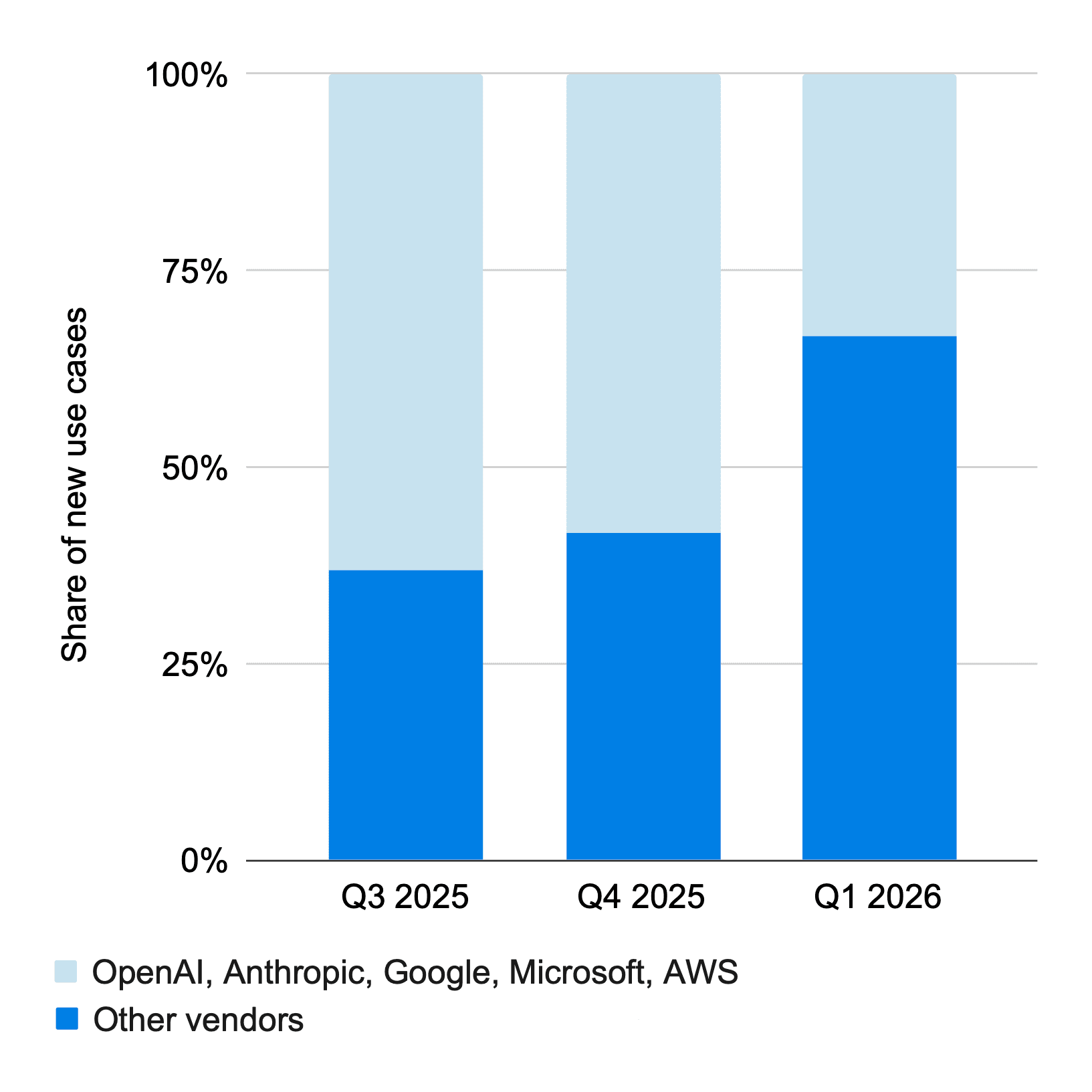
Two-thirds of the new tools rolled out by the 50 lenders we track last quarter featured vendors other than OpenAI, Anthropic, Google, Microsoft or AWS – in a marked shift from what we saw earlier in the AI era. Since the beginning of last year, the number of distinct firms banks have rolled AI tools out with – the “other” category in the chart below – has doubled.
The surge means the number of bank tools featuring those five huge firms in the Use Case Tracker, our repository of AI tools banks have publicly rolled out, is now almost exactly the same as the number featuring everyone else.
That’s indicative of a market that’s breeding new AI companies by the day. But another reason behind the shift is a fear of AI becoming cloud 2.0, where a few vendors suck banks in and then turn the screw. Some, like BNP Paribas and RBC, are cozying up to national AI champions offering sweetheart deals and more individual attention. Most are simply turning to AI specialists solving problems too specific to finance for the big labs to have an answer for yet.
PLAYS WELL WITH “OTHERS”
The share of new AI use cases at banks tied to vendors other than OpenAI, Anthropic, Google, Microsoft and AWS has grown in consecutive quarters, making up two-thirds of Q1 deployments
BMO this week launched a tool with startup Codat that generates insights about accounts payable within its business banking segment and allows it to sell to them better. Last quarter, JPMorganChase tied up with Mirakl on one specific element of agentic commerce infrastructure (see: “Buyer don’t beware,” The Brief, March 19). Each shows the appeal of smaller players: They do the work of making sure frontier labs’ models can plug in directly to solve a finance problem.
But the big labs are moving in on that turf now, too. On Tuesday, Anthropic launched a set of 10 “ready-to-run” agents the firm says can automate financial grunt work in banking and insurance, from building models and pitch decks to reviewing valuations and reconciling ledgers. That’s not so different from the functionality that Rogo – fresh off its $160 million series D funding round – offers clients including JPMC, Bank of America and Wells Fargo.
That leaves banks needing to walk a tightrope. Bet too heavily on the specialists and they risk integration headaches, security concerns and a stack of tools too scattered to add up to real transformation. Back the giants and they risk sliding back to overreliance, just as AI labs shift pricing models in their favor (see: “AI blows the budget,” The Brief, April 23).
“We always look at [enterprise AI] a little bit more like I’m making an investment and what I'm getting for it,” said JPMC CEO Jamie Dimon at Anthropic’s event this week.
COMING SOON
EVIDENT AI INDEX FOR BANKS - MIDDLE EAST & AFRICA EDITION
.jpg&w=3840&q=80)
Next month, we're ranking 25 of the largest banks across the Middle East & Africa on their AI maturity – revealing who's pulling ahead, the challenges they face and where the biggest opportunities lie. Find out more about the inaugural edition, and register your interest to be the first to know when the Index goes live.

STAT OF THE WEEK
.png%3FupdatedAt%3D2026-05-07T14%3A18%3A19.983Z&w=3840&q=100)
The share of jobs in the U.S. today that didn’t exist in 1940, according to new research from Bank of America, which it says goes to show that AI will transform the labor market but not eviscerate jobs. In every labor market cycle – the industrial revolution, the internet boom – the economy consistently creates new classes of jobs that match or outweigh the initial shock of jobs being cut, the authors contend, and AI will be no different.
“The main labor market risk is near-term task displacement and job reconfiguration, rather than large-scale unemployment,” they wrote. BNY CEO Robin Vince echoed the sentiment at the Milken Institute conference on Monday: “We are not AI doom mongers,” he said. “We’re driving capacity so we can do more and make our people more productive.”
Even the so-called doomers – like Anthropic CEO Dario Amodei, who last year predicted AI would wipe out half the white-collar workforce – are changing their tune as businesses focus on making workers better with AI rather than replacing them. “Companies have a choice,” Amodei said during his conversation with JPMC’s Dimon Tuesday. “They can do the same thing with less resources, and that leads to things like layoffs, or they can do more with the same amount of resources. But that requires creativity.”
Zoom in: The leading banks on AI have been displaying that creativity for at least the last year, our data shows. Back in November, our analysis revealed that the top 10 firms in the Evident AI Index for Banks – those leaning most into tech – had grown their headcount 25% more than the average lender over the past year (See: “Not guilty,” The Brief, Nov. 6). That hasn’t stopped financial firms from blaming their layoffs on AI (see: “It’s not the AI, stupid,” The Brief, March 26). But it ought to.

TOP OF THE NEWS
CITI'S SLICKER STRATEGY
Citi’s first bank-wide investor day since 2022 kicked off Thursday morning in New York. The lender – coming off a quarter where it posted its highest revenue in a decade – is updating its financial targets, and says AI will help deliver on them.
In her opening remarks, CEO Jane Fraser said the bank’s AI implementation is now focused on revenue growth, productivity and process transformation, defensive capabilities and the evolution of its workforce. ”We’re not playing around the edges,” she said. “This is enterprise wide.”
As we went to press, Fraser had stopped short of putting a total value on its growing portfolio of tools. The event is still ongoing. But the tech will be a big part of how the bank will hit its new targets of returns between 11% and 13% through 2027 and 2028 and 14 to 15% in the two years following.
It’ll come, Fraser said, from a deeper focus on using AI end-to-end across its processes. That includes “our most complex, time-consuming processes” like KYC, reconciliations, loan operations and document processing.
“Our work on the transformation has built an important new muscle: We now implement change quickly and at scale across the firm,” she said of the bank’s AI moves. “We're developing new solutions at a speed we haven't seen before.”
RETURNING THIS OCTOBER
2026 EVIDENT AI SYMPOSIUM

The Evident AI Symposium is back in New York this October. Take a first look at this year's speakers and register your interest to join us on the day.
.svg&w=96&q=80)
TALENT MATTERS
WHO'S THE AI BOSS
Citi appointed David Griffiths as group head of AI, COO Anand Selva announced this week. Griffiths has served as the bank’s CTO for the past two years, and has been with Citi for more than a decade. The role is part of a broader reorganization, which “unites technology and operations under a single, unified AI mandate,” he wrote on LinkedIn. The move means Citi is now the 11th bank of the 50 we track to put a new person in charge of AI this year (see: “Ciao, CAIOs,” The Brief, April 30). It’s the second big tech move the bank has announced in as many weeks: The lender also hired Google veteran Brian Saluzzo to be CIO.
PayPal (#3 in The Evident AI Index for Payments) named Anshu Bhardwaj its chief AI transformation and simplification officer, where she’ll “focus on how we use AI to transform how we operate,” she wrote on LinkedIn. During PayPal’s earnings call on Tuesday, CEO Enrique Lores said the firm will be “accelerating the adoption of AI across the company” in order to “generate significant savings that can be reinvested in growth.” In her new role, Bhardwaj reports directly to Lores and sits on the executive committee.
Emirates NBD’s chief platforms officer, Saud Al Dhawyani, left the UAE-based bank after 13 years to become executive director of digital cloud and infrastructure operations at the country’s Department of Government Enablement. His move follows the UAE government’s directive to the private sector that they adopt agentic AI fast – via new trainings from the Dubai Chamber of Commerce, incubators for AI agents and new funding available to the businesses. COMING SOON: Evident is launching our inaugural Index covering banks in the Middle East and Africa. Get in touch to find out more about our first regional benchmark.
Brijesh Dwivedi joined Barclays as head of data deployment and risk management. Dwivedi was most recently a data engineer at NatWest.
Sam Farmer is now HSBC’s lead AI security architect. He previously worked on cloud security at the bank and at RBC, where he was senior manager of cyber resilience.
Barclays hired Calum Mackenzie as the bank’s senior AI product owner for conversational banking and Gen AI applications. Before, Mackenzie was AI product owner for conversational banking at Lloyds, where she spent 15 years.

NOTABLY QUOTABLE
“The workforce likes AI today as much as they liked the return to office mandates after COVID. So this is not a popular initiative, but it is here to stay and we are working with it.”
–Gunjan Kedia, CEO at U.S. Bank, at WSJ’s Future of Everything event, May 5

IN THE NEWS
CRIME STOPPERS
Payments firm FIS (#9 in the Evident AI Index for Payments) is linking up with Anthropic to develop an agentic AI system that helps with anti-money-laundering investigations in banking. As part of the development of the “Financial Crimes AI Agent,” the lab is sending forward deployed engineers into FIS, much like it’s done with the compliance and post-trade agents the firm is co-developing with Goldman Sachs (see: “Agents move beyond coding,” The Brief, Feb. 12). BMO will be among the first banks to use the agent, the release said.
Danske Bank put new targets on AI’s value as part of a broader update of its strategy. The Danish bank says AI and tech will deliver a productivity benefit of 2 billion Danish kroner – roughly $315 million – annually by 2028. With the announcement, Danske Bank becomes the 14th lender of the 50 we track to publicly share projected or actual gains from AI (see: “CFO-phie’s choice,” The Brief, April 2).
NatWest says the bank delivered £100 million ($136 million) in cost savings in the first quarter from “investments in simplification,” CEO Paul Thwaite told investors this past week. It’s coming from productivity enhancements, particularly among the engineering team. “Typically, our development process for new customer propositions requires 12 engineers and takes six weeks,” he said. “In some scenarios with a team of three engineers and seven agents, we can deliver in just six hours.”
Quantum is hot again at banks. Lloyds partnered with IBM to develop a quantum algorithm that can scan the bank’s troves of transaction data and detect illicit money transfers. The live experiment marked a significant leap from theory to practice for the bank, COO Ron van Kemenade said this week. Across town, HSBC – a quantum computing leader – this week announced it developed a new way to get quantum computers to model market risk alongside IBM and Haiqu, a startup that gives businesses access to quantum tech. And Canada’s BMO, who put “quantum” in AI chief Kristin Milchanowski’s title last month, received a provisional patent for a quantum algorithm that will help the bank predict natural disasters like earthquakes and wildfires, which it plans to integrate into its emergency response system.
WHAT'S ON
Thurs 14 May
Conference on AI in Financial Services, Chicago, IL
Thurs 28 May
Mistral AI NOW Summit, Paris, France
- Alexandra Mousavizadeh|Co-founder & CEO|[email protected]
- Annabel Ayles|Co-founder & co-CEO|[email protected]
- Colin Gilbert|VP, Intelligence|[email protected]
- Matthew Kaminski|Senior Advisor|[email protected]
- Kevin McAllister|Senior Editor|[email protected]
- Daniel Shackleford Capel|MD, Banking|[email protected]
- Maryam Akram|Senior Research Manager|[email protected]
- Zachary Groz|Reporter|[email protected]
- Alex Inch|Data Scientist|[email protected]
- Sam Meeson|AI Research Analyst|[email protected]
- Gabriel Perez Jaen|Research Manager|[email protected]
- Jay Prynne|Head of Design|[email protected]
- Marcus Gurtler|Junior Designer|[email protected]

